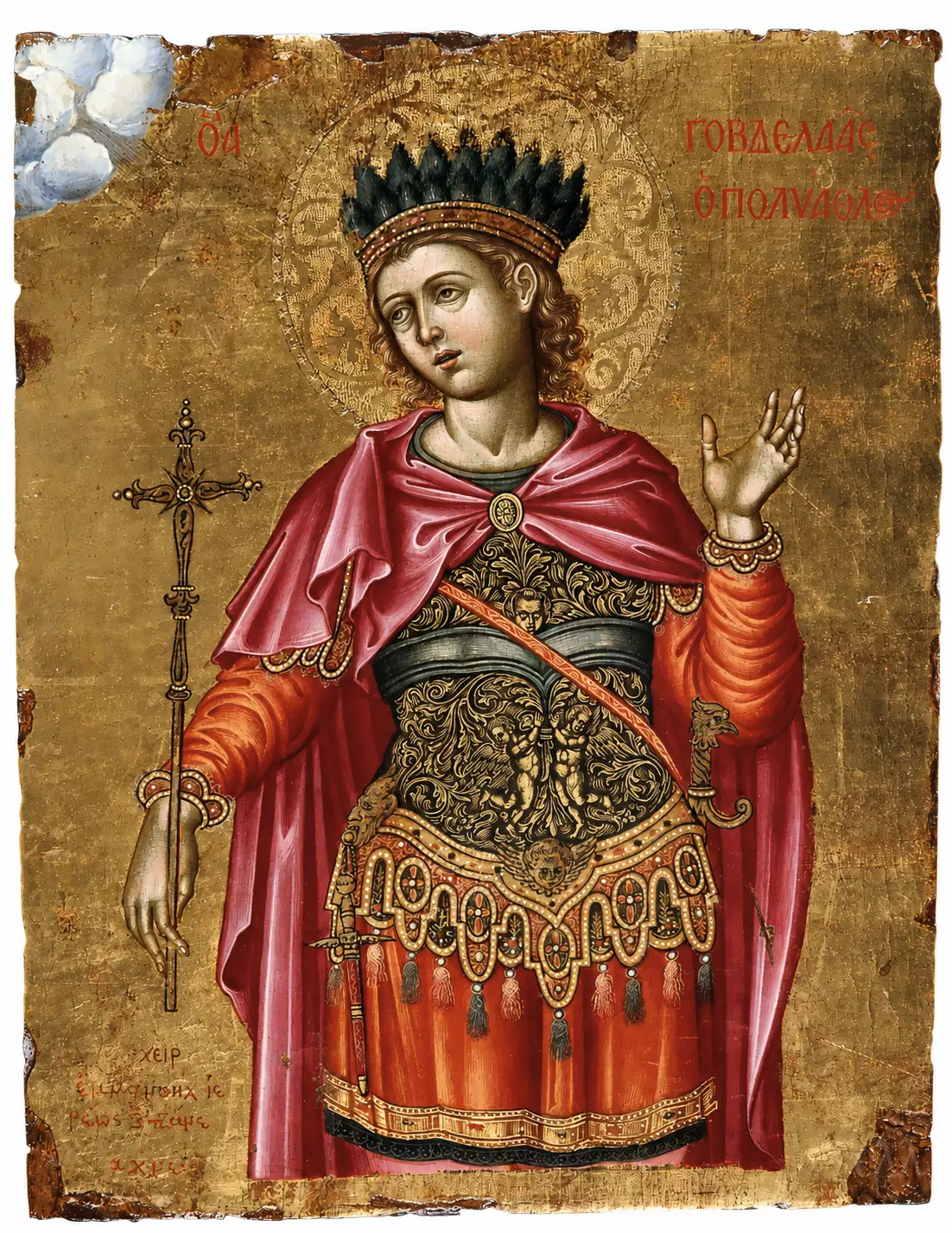
Emmanuel Tzanes‘s icon of Saint Govdelaas, painted in 1655, presents the Persian great martyr as a youthful military saint of exceptional splendour. Preserved in the Museum of Byzantine Culture in Thessaloniki, the small panel measures 31.2 × 24.7 cm and is executed in egg tempera on wood. Its scale is intimate, yet the figure fills the pictorial field with the elaborate costume, ceremonial bearing and concentrated detail characteristic of Tzanes’s refined seventeenth-century icon painting. Under inventory number BEI 962, the Museum records the work.
Against the uninterrupted gold ground, Govdelaas appears to the thighs, almost frontally, his head inclined gently toward his right shoulder. A red Greek inscription in the upper field identifies the saint and includes the epithet Polyathlos. Around his head, an expansive halo is worked with densely patterned vegetal ornament, its delicate circular design standing clearly against the comparatively quiet gilded surface. Above the curling brown hair rises an unusual feathered crown, edged with pearls and coloured stones, and in this single image royal rank, military identity and martyrdom are brought together.
Saint Govdelaas Icon: Military Splendour and Post-Byzantine Painting
In his right hand Govdelaas holds a slender martyr’s cross, its ornamental head rising beside his body. His left hand is raised with the palm exposed. The restrained gesture introduces a second vertical element on the opposite side of the composition, balancing the long cross while opening the silhouette of the saint against the gold ground. At his left side, the hilt of a sword emerges beside the richly decorated costume — the weapons and military dress establishing his identity as a military saint, while the cross refers directly to his martyrdom, an interpretation also given in the Museum’s description of the work.
Across the torso, ornament becomes unusually dense.
A dark cuirass-like garment is covered with scrolling foliage worked in gold and small winged figures, interrupted at the waist by a broad blue-grey band. Below, elaborate pendant panels, pearls, coloured stones and tassels form a decorative fringe over the warm orange-red tunic. The sleeves repeat this saturated colour, modelled through long curved highlights that give them appreciable volume. Over the shoulders falls a deep crimson mantle, its folds sharply described in pale pink and white, especially around the neck and across the saint’s right shoulder, where several broad surfaces of colour gather into angular, overlapping forms.
Within this abundance, the face remains remarkably calm. Tzanes models the youthful features through fine tonal transitions: a pale olive flesh tone, delicate rose colour on the cheeks, narrow highlights along the nose and forehead, soft shadows around the eyes. The slightly parted lips and large, carefully directed eyes give the physiognomy a reflective quality, while curling locks frame the cheeks and ears with an attention to individual strands that continues into the pearls, gemstones and minute ornamental motifs of the clothing. The combination of precise linear control and more gradual facial modelling belongs comfortably within the artistic environment of seventeenth-century Cretan and Italo-Cretan painting; specialist terminology for this post-Byzantine tradition requires precisely this distinction between established iconographic convention and later artistic development.
The saint himself belongs to an uncommon iconographic tradition. According to the Museum of Byzantine Culture, Govdelaas was regarded as a son of the Persian king Shapur II, who reigned from 310 to 379, and was put to death following his conversion to Christianity. Tzanes therefore depicts a Persian prince through the visual language of a Christian military martyr. Set above a costume already overflowing with gold ornament and jewellery, the feathered crown is particularly significant to the resulting image, giving the figure an explicitly courtly character while preserving the recognisable attributes of martyr and warrior.
The history of the commission makes the panel still more unusual. Its creation was associated with the recovery from illness of Frangias, the painter’s brother. Emmanuel Tzanes, a hieromonk as well as a painter and writer of ecclesiastical texts and hymns, subsequently published a liturgical service honouring Govdelaas in Venice in 1661, and that edition contained an illustration closely corresponding to the painted image. The Museum further records that this portable icon became a prototype for later icons, wall paintings and engravings, giving a comparatively rare saint a stable and reproducible visual identity.
Tzanes came from Rethymno in Crete and is counted among the important representatives of the artistic tradition commonly described as the Italo-Cretan School. In the Saint Govdelaas icon, this cultural setting can be approached through the painting itself: brilliant ornament, carefully articulated anatomy, elaborate costume, controlled modelling of flesh and the firm survival of the gold-ground devotional image. The saint’s body remains formally contained, while almost every surrounding surface — halo, crown, mantle, armour, belt, jewellery — is activated by line and pattern; even the quieter gilded field retains the visible marks and material irregularities of the panel’s long history.
Through a donation by the Society of Friends of the Museum together with the families of A., P. and E. Giannoukos and K. Kalfagian, the work entered the Museum of Byzantine Culture. At only two centimetres thick, the wooden panel carries an extraordinarily concentrated pictorial world, its rare subject given enduring form through Tzanes’s meticulous handling of colour, gold, costume and physiognomy.
(The translation was edited by A. Orfanos.)