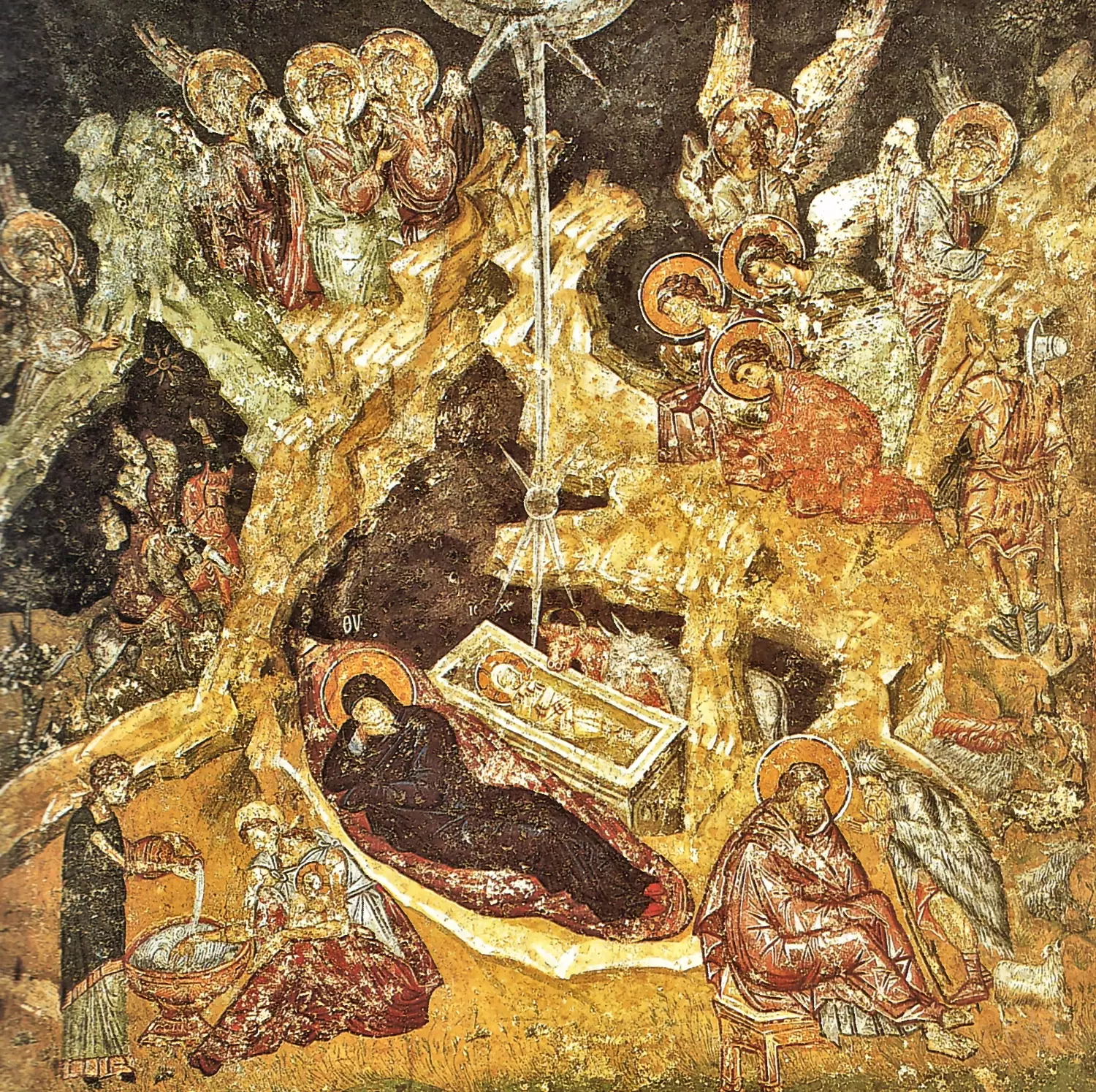
The Byzantine Nativity fresco at Peć, preserved in the Church of the Holy Apostles within the Patriarchate of Peć, unfolds the birth of Christ across a steep, fractured landscape in which separate episodes are gathered into a single pictorial field. Its chronology requires some precision. The church retains an important mid-13th-century programme associated with Archbishop Arsenije I, whose paintings in the sanctuary and beneath the dome are celebrated for their monumental character. The Nativity now occupying the south choir belongs, however, to a later repainting of that part of the church, generally dated to the third quarter of the 14th century. The distinction is significant, since the older and later campaigns coexist within the same monument and have sometimes been conflated in descriptions of individual scenes.
The monastery itself developed around the Church of the Holy Apostles, to which further churches were added until four domed structures formed the closely connected complex known today. Its surviving wall paintings span several periods and preserve unusually rich evidence for the movement of Byzantine pictorial forms through medieval Serbia and the wider Balkans. UNESCO singles out the 13th-century paintings of the Holy Apostles for their distinctive monumental style; the later choir decoration, including the Nativity, belongs to another artistic moment, livelier in colour, more intricate in narrative incident and noticeably more animated in the movement of its figures.
The Byzantine Nativity Fresco at Peć and Its Pictorial Landscape
A mountain occupies almost everything. Ochre ridges rise, divide, turn inward, open abruptly into black cavities; among them the human and celestial participants appear at different levels, as though the rock itself had been cut into a succession of stages. Yet the apparent irregularity is carefully controlled. From the celestial segment above descends a long, pale ray, almost unnaturally straight amid the broken contours of the mountain, reaching the area of the manger and fixing the principal vertical axis of the composition. Around this axis the painter allows the narrative to disperse.
The contrast is especially effective because the landscape possesses a physical weight absent from the heavenly sign. Broad passages of yellow and brown are modelled with angular white highlights, while the cave openings remain nearly impenetrable fields of black. Against them the haloes and pale faces gain exceptional visibility. Reds, muted greens, black garments, warm flesh tones and touches of white move through the composition in separate concentrations; colour does not cover the wall evenly but gathers around figures, vanishes into the cavities, returns in another group. Abrasion and local losses have disturbed the painted surface, yet enough survives to reveal a painter interested in sharp contour, emphatic folds and the rhythmic opposition of compact groups.
Across the upper zone the angels have been divided into distinct ensembles. Some stand upright, their hands raised or held before them; others incline dramatically towards the event below. Their wings create a second system of diagonals, narrower and more agitated than the massive slopes of the mountain. The celestial manifestation at the summit, the descending ray and the angels consequently occupy one continuous vertical field, while earthly movement arrives from the sides. The Magi advance on horseback along the rocky passage to one side; elsewhere a shepherd, accompanied by animals, belongs to a quieter pastoral episode. Such simultaneity is fundamental to the Byzantine treatment of the Nativity, which commonly combines the Christ Child in the manger, the Virgin, Joseph, the Magi, shepherds and angels within a single expanded representation.
Time, therefore, has no single direction. The Magi are still approaching while Christ has already been born; angels proclaim and adore; the shepherd remains among his flock; the customary bathing episode appears in the lower part of the painting. Actions separated in narrative time become neighbours on the wall. The mountain makes this possible. Its ridges provide visual partitions without converting the composition into independent framed scenes, allowing the eye to move from one episode to another while repeatedly being returned towards the manger by the converging slopes and by the ray descending from above.
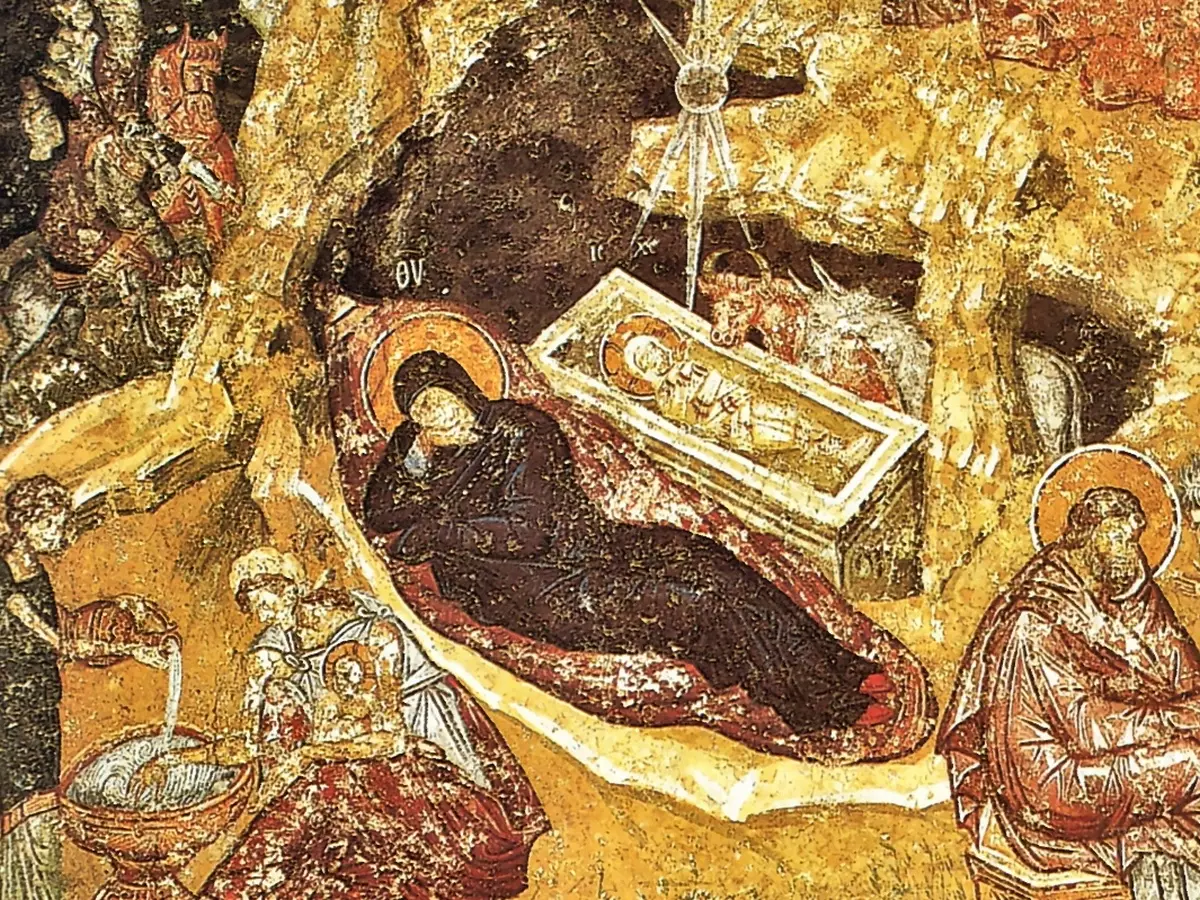
Near the lower centre, the Virgin reclines upon a dark red mattress, her almost black maphorion producing one of the largest unbroken masses of colour in the fresco. The Child lies above her in a rigid rectangular manger, tightly wrapped in pale swaddling bands; immediately behind, the ox and ass extend their heads from the darkness of the cave. This arrangement belongs to an established Byzantine iconographic type in which the newborn Christ is shown in the manger beside the two animals and the Mother of God occupies the adjoining space. The painter nevertheless gives the Peć group an unusually pronounced geometry: the diagonal body of the Virgin, the oblique manger and the uncompromising vertical of the heavenly ray meet within a small area without becoming mechanically aligned.
Joseph has been displaced from this compact centre. Seated lower down, wrapped in a reddish-brown mantle, he turns inward with the withdrawn posture familiar in medieval representations of the Nativity. His isolation creates a pause in a composition otherwise crowded with movement. The bathing group produces another rhythm at the opposite side, with the rounded basin, bending figures and flowing gesture of the attendant pouring water introducing domestic action into the monumental landscape. Subsidiary episodes of this kind had long belonged to the expanded medieval imagery of Christ’s birth, drawing together canonical Gospel material (Luke 2:1–20; Matthew 2:1–12) and pictorial traditions developed around the infancy narrative.
What distinguishes the choir paintings from the celebrated 13th-century layer elsewhere in the Holy Apostles is visible in this accumulation. The later painters favoured elongated figures, stronger movement, abundant incident and a more varied chromatic effect; contemporary descriptions of the choir restoration similarly note its colourful figures, carefully executed Great Feasts and detailed compositions, placing the campaign in the third quarter of the 14th century. At the edges of the Nativity the story continues almost restlessly, into horses, shepherds, sheep, angelic bodies and narrow paths among the rocks, while the slender ray above remains fixed.
(The translation was edited by Jason Papandreou)