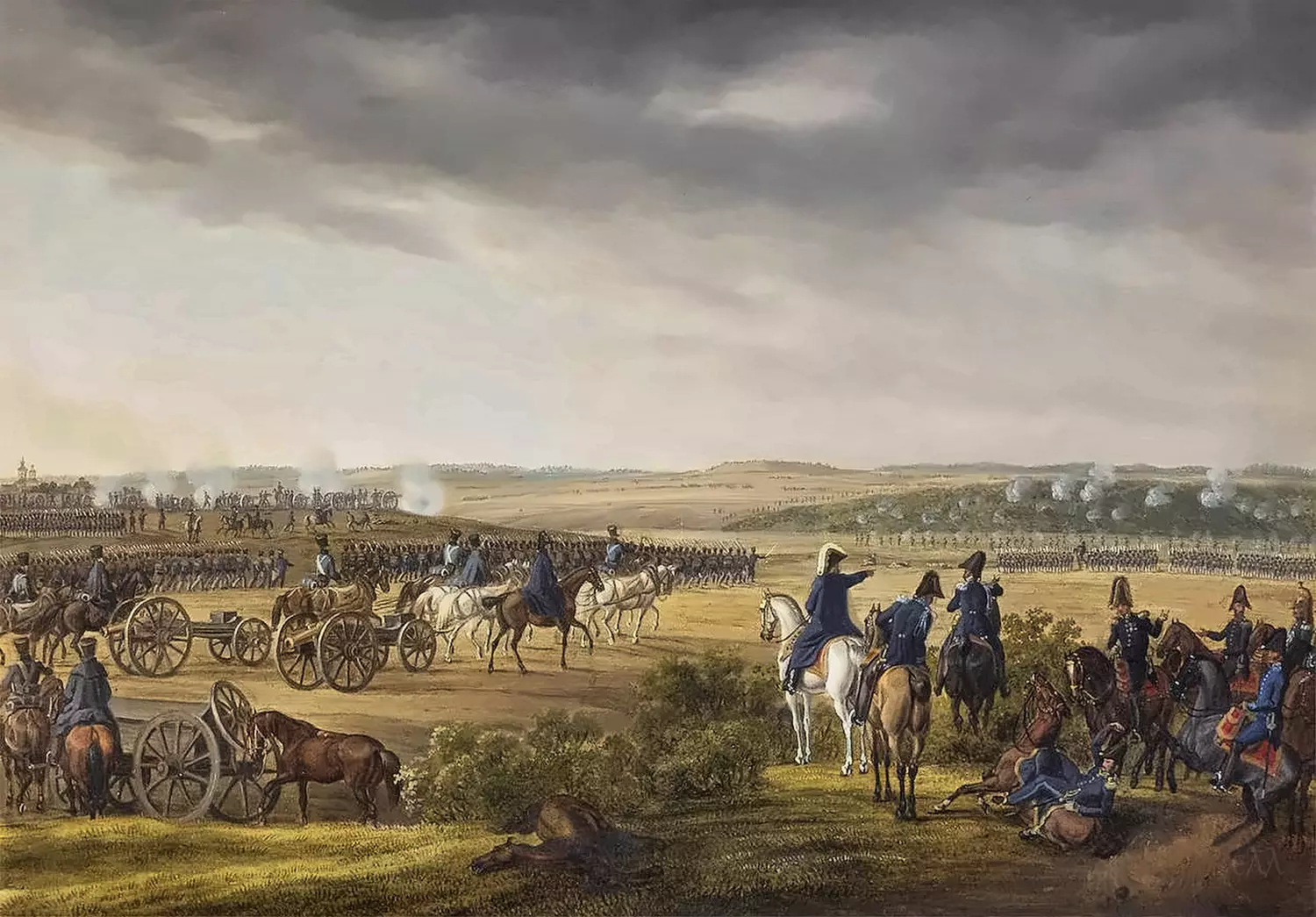
Albrecht Adam’s Battle of Moscow on 7 September 1812, painted between 1815 and 1825, is a remarkably small work for the scale of the event it represents. Executed in oil and gouache on paper and measuring only 21 × 30 cm, it belongs to the collection of the Hermitage in St Petersburg. The subject is the Battle of Borodino, called the Battle of the Moskova in French accounts, fought between Napoleon’s Grande Armée and the Imperial Russian Army on 7 September 1812. Through a panoramic field of vision, Adam approaches this enormous confrontation: the armies spread laterally across an open plain, artillery smoke interrupts the distant formations, and an unusually extensive sky weighs over almost the entire scene.
The first impression is consequently one of distance. Adam does not thrust the spectator into a cavalry charge or an encounter between individual combatants. A low horizon allows the battlefield to open gradually, from the horses, guns and mounted officers occupying the foreground to the long ranks of infantry that recede almost to the limit of visibility. The human figure becomes progressively smaller until soldiers are absorbed into lines, clusters and minute vertical accents. This reduction of scale gives the picture something of the precision of a military record, yet the surface never becomes merely diagrammatic. The mounts shift their weight, riders turn in their saddles, smoke drifts unevenly, and the terrain rises almost imperceptibly towards the distant ridge.
Battle of Moscow on 7 September 1812: the battlefield as observed space
Across the foreground Adam establishes several independent groups without forcing them into a rigid central composition. To one side, teams of horses and artillery vehicles move laterally, their wheels and harnesses described with enough precision to make the logistics of warfare visible alongside the fighting itself. Farther across the field, infantry units form dark horizontal bands. On the opposite side, mounted officers occupy slightly raised ground; one rider on a white horse extends an arm towards the battlefield, while the surrounding horsemen look in broadly the same direction. Below them, figures rest or lie close to the ground. The effect remains curiously controlled, even as scattered incidents continue across the field without any single action dominating the picture.
This organization of masses was one of Adam’s recognized strengths as a battle painter. The Neue Deutsche Biographie notes both his ability to distribute large groups naturally and the spatial clarity of his military compositions, qualities accompanied by detailed drawing and a comparatively free painterly handling. They are especially evident in this work. Artillery, cavalry and infantry occupy separate spatial zones, yet all remain part of one continuous landscape, legible almost from front to back.
Colour reinforces that spatial structure. Brown, olive and yellow-green earth tones dominate the foreground, punctuated by dark blue uniforms, black headgear and the pale flanks of several mounts. The white horse near the mounted group becomes an immediate visual focus, partly because its light surface stands against darker vegetation and riders. Beyond it, colour loses intensity. Troops in the middle and far distance become increasingly subdued, and grey-white bursts of gun smoke merge with the cooler atmosphere above the horizon. Adam uses this tonal recession with considerable economy; depth emerges without an emphatic system of architectural perspective.
More than half of the composition is given to the sky. It is a striking decision in a painting concerned with one of the major armed encounters of the Napoleonic Wars. Layers of grey cloud extend from edge to edge, darker towards the upper portion and more luminous near the horizon. The fighting occupies a comparatively narrow band beneath this vast atmospheric field. Smoke from the guns rises into it but never overwhelms it. There is no theatrical storm, no spectacular shaft of light isolating a hero.
Instead, weather and landscape together hold the thousands of human participants to an unexpectedly small scale.
The historical circumstances give this measured representation a particular significance. Borodino was fought roughly 75 miles west of Moscow and became one of the climactic encounters of Napoleon’s 1812 invasion. The Russian army survived the encounter and withdrew, leaving Napoleon able to continue towards Moscow, but its survival proved strategically important during the subsequent collapse of the French campaign. Adam’s title preserves another contemporary way of naming the battle. “Battle of Moscow” corresponds to the French Bataille de la Moskova, while modern English-language histories generally use Battle of Borodino. The two names, in other words, describe a single engagement, not fighting within the city of Moscow itself.
Adam had an unusually direct relationship with the military world he painted. Born in Nördlingen in 1786, he eventually specialized in horses and battle subjects and became court painter to Eugène de Beauharnais, Viceroy of Italy and Napoleon’s stepson. He accompanied Eugène during the Russian campaign of 1812. From that experience emerged a substantial group of images recording episodes of the expedition; an initial collection of eighty-three sheets was later expanded and issued in lithographic form between 1827 and 1833. His battle painting took shape, then, through close observation of armies in movement, camps, horses, weapons, roads and the physical organization of troops, not solely through the conventions of studio history painting.
In small things, that experience becomes apparent. The artillery equipment receives almost as much visual attention as the officers. The animals appear in varying attitudes instead of being repeated as a conventional cavalry motif. Some stand quietly; others pull vehicles or carry riders across uneven ground. The formations in the middle distance are differentiated through density and direction, while smoke appears at separate points along the opposing lines. Even the foreground vegetation has a practical role, partly concealing wheels, legs and bodies and creating an irregular threshold between the spectator’s position and the open field beyond.
Yet literal documentation does not explain the whole image. Adam has composed the battlefield. The strong horizontal movement of the armies is interrupted by vertical riders, gun smoke and the occasional upright silhouette; the foreground groups form a loose sequence across the picture, while gaps between them allow the eye to travel into the distance. The comparatively muted palette holds together an enormous quantity of minute information. Because the work is only 30 cm wide, such compression matters. A more violently contrasted treatment could easily have fragmented the surface into incidents.
For this combination of detail and breadth, the oil and gouache medium proves especially suited. Opaque passages define the pale animals and smoke with particular clarity, while thinner and more subdued areas allow distant terrain and formations to recede. Brushwork becomes difficult to separate from drawing at this scale: contours remain legible, yet they do not harden every figure into an isolated unit. Several soldiers in the far distance are little more than marks. Nearer figures acquire posture, clothing and individual movement.
War itself is present without being converted into spectacle. The foreground contains fallen or resting bodies, cannon, armed troops and the unmistakable evidence of firing in the distance, but Adam concentrates on the physical extent and organization of combat. The spectator encounters a landscape occupied by military systems: men assembled into ranks, horses attached to guns, officers observing, units advancing across ground whose gentle undulations continue beyond them. Precisely because the image remains visually controlled, no single sign discloses the scale of the event; it has to be pieced together, mark by mark, across the whole field.
The painting’s later history preserves a further connection with the world from which it emerged. It formed part of material associated with the journal of the 1812 Russian campaign of Eugène de Beauharnais, Adam’s patron, and is recorded as having formerly belonged to Eugène’s collection. The work entered the Hermitage from the Mariinsky Palace in 1921.