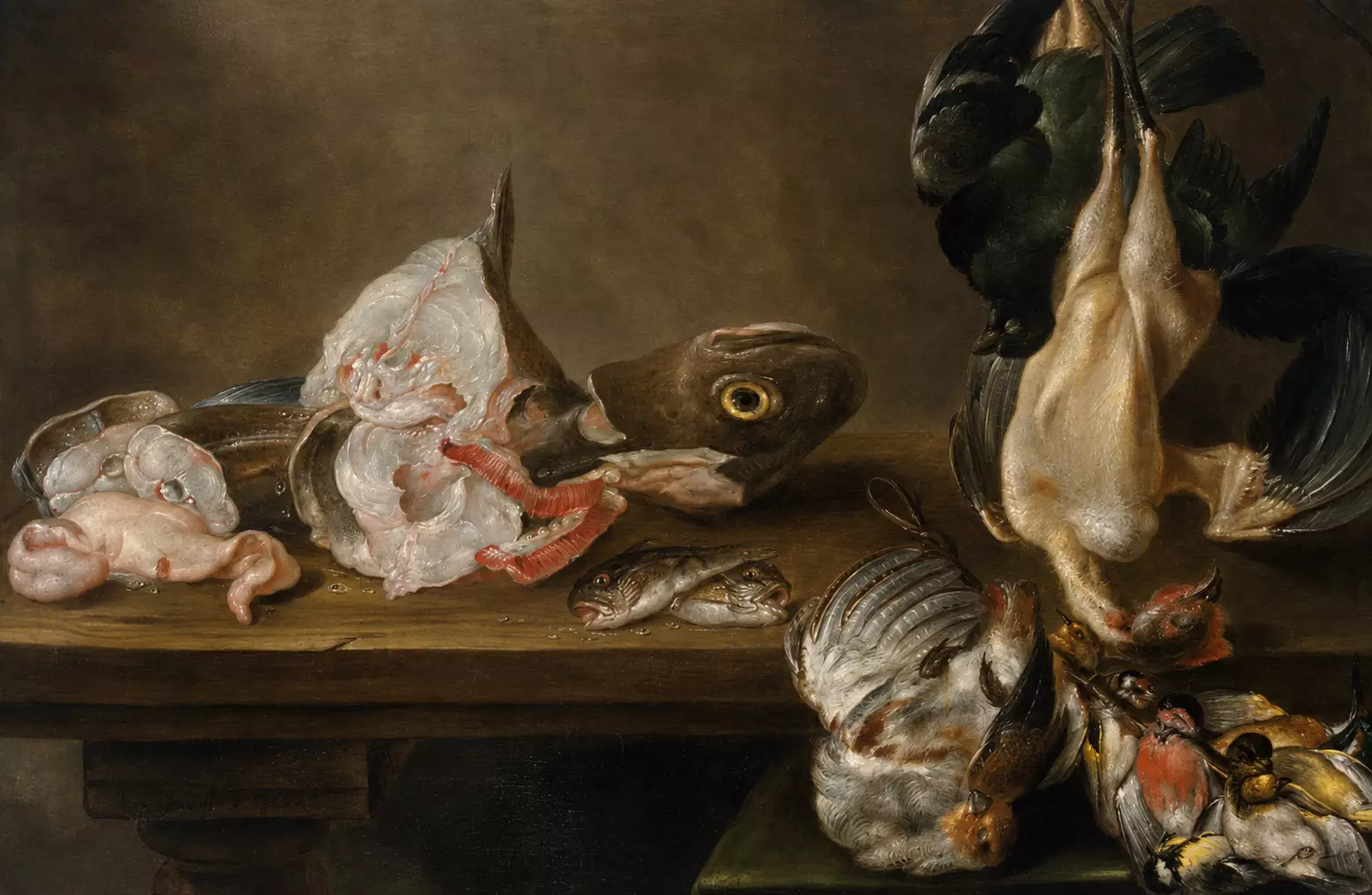
Painted in 1643, Alexander Adriaenssen’s Fish and Dead Game belongs to the mature period of a Flemish painter who made the material world of fish, birds, foodstuffs and other still-life subjects his particular field of observation. The oil on canvas, measuring 58 × 87 cm and now in the Hermitage in St Petersburg, is relatively compact, yet the arrangement has an unexpected physical amplitude. Fish occupy the long table at the left and centre; dead birds accumulate at the right, some suspended vertically, others resting below. Between them, a large dark fish head, its round eye sharply illuminated, becomes an unlikely visual hinge.
Nothing in the composition depends upon decorative scenery. Adriaenssen keeps the background nearly bare, a muted brown field against which pale flesh, silver-grey scales, black plumage and small accents of red acquire unusual force. The objects are close, sometimes overlapping, sometimes cropped by the limits of the picture. Their density is palpable. Yet the painting is not crowded in a disorderly sense: the low, horizontal spread of marine forms on one side is answered by the tall descent of hanging game on the other. Between these unequal masses, the painter constructs a balance that remains deliberately asymmetrical.
Fish and Dead Game: texture, balance and Flemish still life
Across the left half of Fish and Dead Game, Adriaenssen allows the forms to spread laterally, almost as though the tabletop itself had established the rhythm of the composition. Several fish lie one behind another, while the palest forms rise into a loose mound near the centre-left. Some have been opened or prepared, exposing whitish flesh marked by narrow passages of muted red. These reds matter. Small in extent, they interrupt the predominantly brown, grey and ivory palette and bring the eye repeatedly back to the physical condition of the displayed food.
At the centre, the large fish head introduces another kind of presence. Its surface is darker and smoother, its profile plainly defined against the warm background; the circular eye, surrounded by an ochre-gold ring, is among the most concentrated highlights in the painting. Adriaenssen does not animate the creature, but neither does he neutralise it into pattern. The head still possesses weight, anatomy, an almost disconcerting individuality. Below it, two smaller silvery fish form a short horizontal sequence. Light catches their curved backs and scales, then disappears rapidly into shadow.
Such passages reveal the painter’s close attention to different surfaces. The slick, moist appearance of fish skin requires one kind of modelling; exposed flesh another. A few highlights are sufficient to suggest the reflective quality of scales, while softer tonal transitions describe the paler bodies beside them. The effect is naturalistic without becoming microscopic. Adriaenssen selects. A fin may be defined crisply while part of the adjoining body dissolves into the general brown tonality; a mouth or eye receives precision, then a neighbouring contour loses itself in shadow.
The birds on the right create a markedly different structure. One pale game bird hangs upside down, its body stretched vertically through the upper and middle registers, while darker plumage gathers behind and above it. Lower down, further birds lie compressed together near the foreground edge, their wings, heads and feathers interlocking in a much tighter pattern. White, grey, brown, yellowish and subdued red notes occur within this group, but the overall tonality remains restrained. The contrast with the fish is therefore tactile as well as compositional: smooth and reflective surfaces to the left, feathered and more absorbent ones to the right.
Verticality gives the hanging birds their particular importance. Their suspended bodies cut across the predominantly horizontal organization of the table and prevent the arrangement from settling into a simple frieze of provisions. At the same time, the painter has allowed the uppermost dark forms to approach the frame closely. This compression makes the right-hand accumulation seem larger than the dimensions of the canvas might suggest. Below, the smaller birds descend towards the bottom edge, so that the whole group operates almost as a visual cascade—dark feathers, pale body, lowered head, then another knot of plumage.
Light links these two halves without making them identical. It falls most strongly across selected pale surfaces and is absorbed by the deep browns of the background and table. Adriaenssen does not employ extreme tenebrism; the shadows remain descriptive, preserving enough tonal distinction to keep forms legible. Even so, the limited illumination gives the still life considerable depth. The background recedes without architectural markers, while the tabletop establishes a firm horizontal plane and the overlapping bodies generate the shallow pictorial space in front of it.
The simplicity of this setting is significant for the painting’s visual rhetoric. There are no costly vessels, elaborate textiles or conspicuous luxury objects competing with the natural forms. Fish and birds carry the entire composition. As a result, attention is directed towards material differences: the translucency of a fin, the dull softness of a feather, the white flesh of an opened fish, the wet gleam along a darker body. The subject is abundance, certainly, but abundance stripped of ceremonial display.
Adriaenssen had been closely associated with Antwerp from the beginning of his career. A biographical entry by Segal and Alen records his birth there in 1587 and his apprenticeship to Artus van Laeck in 1597; another supplied source records his attainment of master status in the Antwerp Guild of Saint Luke in 1610. By the date of Fish and Dead Game, therefore, he had been active as an independent painter for more than three decades. The assurance of the 1643 picture—the refusal to embellish unnecessarily, the easy management of substantial overlapping forms—belongs to an experienced specialist.
Seventeenth-century Antwerp provided fertile conditions for such specialization. Still-life painting had developed into a field broad enough to sustain painters whose reputations rested on particular categories of things: flowers, fruit, game, fish, provisions, costly objects. Within that environment, Adriaenssen’s concentration on fish and animal subjects gave him a recognisable visual territory. An independently documented Still Life with Dead Birds, recorded in a 2004 Rubenshuis catalogue as a signed work by Adriaenssen, shows that avian game was a subject he treated elsewhere and in a different format.
Comparison of the two subject groups within the Hermitage painting also indicates how little Adriaenssen relied upon a single formula. Fish invite broad curves, reflective highlights and the repetition of elongated bodies. Birds produce broken contours: wings, feet, beaks, tail feathers. He sets one vocabulary against the other. Particularly effective is the transition around the central fish head, after which the horizontal sequence gives way to the vertical descent of the hanging bird. The pictorial structure changes direction without an obvious dividing line.
Colour performs a similarly quiet structural role. The dominant chromatic range is narrow—earth browns, olive-grey, black, off-white, silvery grey—but within it Adriaenssen creates several distinct centres of attention. The pale opened fish at the left is one. The golden-ringed eye near the middle is another. On the right, the cream-coloured body of the suspended bird stands against a mass of darker feathers. Small red passages, distributed irregularly across fish and birds, prevent the cooler whites and greys from becoming inert. There is no need for a brilliant palette; tonal contrast does most of the work.
The dead animals inevitably introduce the fact of mortality, though a fixed symbolic or vanitas reading need not be imposed upon the painting. No explicit emblematic device is required to understand that these creatures have passed from living bodies into food, commodities and objects of visual scrutiny. That transformation itself gives the work a particular tension. Adriaenssen renders them with an attentiveness that preserves something of their former physical specificity—the prominent eye, curved mouths, folded wings—even as the arrangement presents them as provisions assembled upon a table.
This doubleness may explain part of the painting’s power. Its objects are ordinary and extraordinary at once. A fish head is simply a fish head; under Adriaenssen’s controlled light it becomes a dark oval mass punctuated by a single brilliant circle. A hanging bird is game prepared for use; within the pictorial structure it becomes the principal vertical axis. The painter does not need to disguise the practical identity of these things in order to make them visually compelling.
Nor does he idealize them. Irregular bodies overlap, flesh is exposed, feathers turn in different directions, and the tabletop bears an accumulation whose order is clearly pictorial yet never geometrically rigid. The picture seems to have been built through weight and counterweight: pale against dark, horizontal against vertical, smooth against feathered, compact pile against suspended form. It is an art of distinctions.
In Fish and Dead Game, that discipline of looking ultimately matters more than spectacle. Adriaenssen has taken a limited group of objects and made each register behave differently while binding the whole through light and restrained colour. At the far left the forms spread and sink; at the right they rise, hang, descend. And almost exactly between these opposed movements remains the large fish head, dark and motionless, its round illuminated eye still commanding attention within a world in which every living movement has ceased.
(The translation was edited by M. Taylor.)