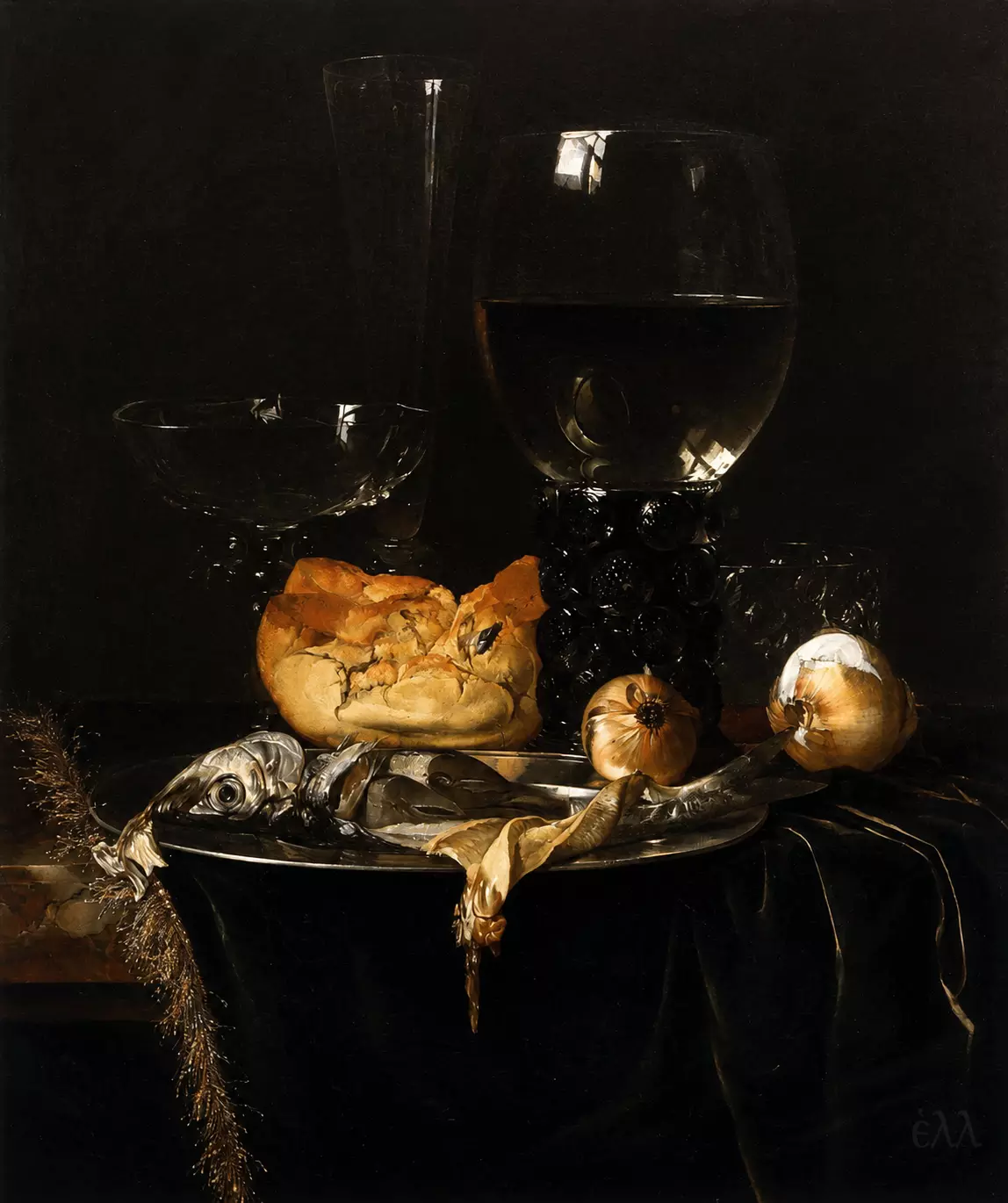
Willem van Aelst executed his Breakfast Piece in 1671, demonstrating the refined technical mastery that secured his reputation among the elite patrons of Amsterdam and international courts. Held in the Akademie der bildenden Künste in Vienna, this oil on canvas (49 x 41 cm) bridges the modest tradition of the Dutch ontbijtje (breakfast piece) with the opulent sensibility of the pronkstilleven (luxury still life). The composition centres on a highly polished silver platter resting upon a stone ledge, partially covered by a dark velvet cloth heavily bordered with gold fringe. Arranged upon this metallic surface are a partially consumed fish, a broken bread roll, and two unpeeled onions. Rising from the background shadows, a dark, studded glass—known as a roemer—and a slender flute command the vertical axis.
The precision of the brushwork is uncompromising. It renders the papery flimsiness of an onion skin and the gelatinous eye of the fish with equal, almost unsettling, objectivity. Such paintings functioned as complex pictorial statements about material wealth, sensory experience, and the inevitable decay of earthly commodities. The seventeenth-century Dutch Republic generated an unprecedented market for these images, where the painted object often rivalled the physical item in prestige and economic value. The artist, working with an observational acuity that borders on the forensic, asserts painting’s power to arrest time, offering a counterfeit permanence that outlasts the perishable commodities it meticulously records.
The Poetics of Materiality and Illusionism
The visual language of seventeenth-century Dutch still-life painting relies fundamentally on the tension between tangible reality and painterly illusion. Placed at the forefront of the pictorial space, the silver plate projects slightly over the edge of the table, an established illusionist device designed to invite the viewer directly into the composition. This spatial protrusion, meticulously delineated by van Aelst, establishes a psychological threshold between the physical world of the observer and the constructed reality of the canvas. The fish, its silvery body twisted and partially flayed, anchors the lower left quadrant of the arrangement. Its head, oriented toward the viewer’s left, catches a crisp, cold light that accentuates the damp texture of its scales and the rigid, skeletal structure exposed beneath the torn flesh.
Beside it, the bread roll has been violently broken. This physical intervention disrupts the geometric purity of the arrangement while offering a harsh tactile contrast to the cold metal and the slippery surface of the fish. The crust, rendered in warm, golden ochres and umbers, crumbles slightly upon the platter, suggesting a moment of interrupted consumption. Two bulbs, their translucent outer skins peeling away to reveal the smooth, luminous layers beneath, complete the primary grouping on the viewer’s right. Scholars examining the rhetoric of perspective in such works have noted that the realist ontbijtje operates through a specific variation of truth, one that prioritizes the sensual immediacy of the object over abstract narrative. The scattered crumbs, the torn roll, the detached bulb skin—these seemingly incidental details serve to heighten the verisimilitude, convincing the eye of a chaotic spontaneity that is the result of rigorous compositional calculation.
Willem van Aelst Breakfast Piece and the Empire of Things
The Willem van Aelst Breakfast Piece bears witness to the complex socio-historical realities of the Dutch Golden Age, a period characterised by an explosion of global maritime trade and unprecedented domestic consumption. Within this material culture, the still life functioned as a sophisticated mechanism for processing and displaying envisioned affluence. Although the subject matter here—the roll, fish, bulbs—originates in the modest, indigenous diet of the Netherlands, van Aelst raises these everyday staples through his virtuosic execution and their deliberate juxtaposition with imported luxury items.
The pieces are staged upon a rich, dark velvet drapery, its heavy folds cascading down the right side of the composition. Trimmed with an intricate gold fringe that catches the light in rhythmic, stippled impasto on the viewer’s far left, the textile introduces an element of aristocratic luxury to the humble meal. The glassware in the background further amplifies this socio-economic dialogue. The monumental roemer, decorated with applied glass prunts designed to ensure a firm grip during feasting, reflects the ambient light through the dark, heavy liquid it contains. Such vessels, manufactured by highly specialized craftsmen and often imported from the Rhineland, were expensive, high-status commodities. Their inclusion alongside the mundane fish and bulbs creates a subtle semantic friction. Reflected here are the broader societal tensions of the Dutch Calvinist Republic, where immense private wealth constantly negotiated with an inherited ethos of moderation, spiritual restraint, and domestic piety.
Chromatic Resonance and the Organization of Space
Van Aelst constructed his pictorial space through a highly controlled, restricted palette, relying heavily on the dramatic interaction of chiaroscuro to define mass and volume. The backdrop is engulfed in a dense, impenetrable darkness, against which the illuminated elements project with striking sculptural intensity. A cool, directional light falls from the upper left, catching the uppermost curve of the roemer, glancing off the polished rim of the plate, and bathing the roll and bulbs in a stark, revealing glow.
The tonal modulation across the canvas is exceptionally subtle. In the deep shadows behind the roemer, the faint outline of a tall, elegant flute glass emerges, its presence registered only by a few vertical white highlights on its delicate stem and elongated bowl. This spatial ambiguity—the dissolving of forms into the enveloping depths—requires the viewer to engage in close, sustained visual examination. Through the varying reflective properties of his subjects, the artist articulates their distinct physical natures. Matte and absorbent, the surface of the crust absorbs the light, whereas the plate reflects it in sharp, brilliant flashes. The fabric swallows the illumination into its deep, saturated folds, providing a dark, grounding mass that structurally balances the highly luminous cluster of food forms resting on the platter.
The Rhetoric of the Transitory
To perceive this sophisticated arrangement merely as a celebration of culinary abundance or technical craft is to overlook the fundamental philosophical underpinnings of the genre. Natural artifice in seventeenth-century Dutch still life frequently masks an acute awareness of perishability. The fish, already cut open and beginning to dry in the open air; the roll, broken and exposed; the wine, left unfinished in the heavy glass—all are subject to the inexorable, corrupting passage of time.
Without relying on the overt, moralizing symbols of a traditional vanitas painting—skulls, extinguished candles, or overturned hourglasses—van Aelst subtly implies the transience of the sensory world through the very materiality of his subjects. The work generates meaning pictorially, translating the inevitable decay of organic matter into a permanent, aestheticized state. The peeled skin of the bulb, brittle and detached on the edge of the plate, operates as a delicate emblem of structural fragility. The quiet solemnity of the arrangement remains undisturbed, holding its fragile, luminous balance against the encroaching dark.
(The translation was edited by N. Jones.)