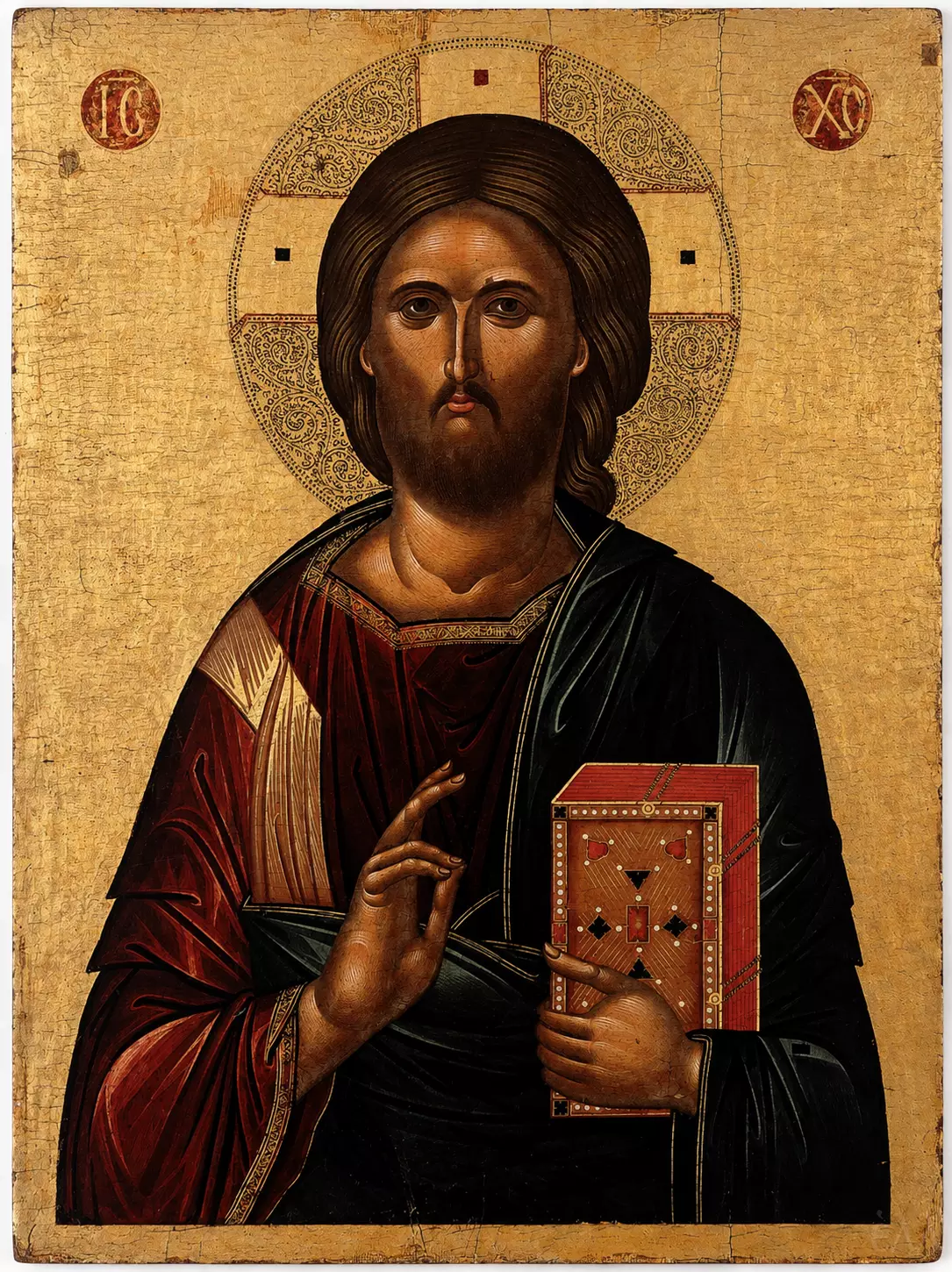
Preserved in the collections of the Antivouniotissa Museum in Corfu, this late fifteenth-century Cretan Christ Pantokrator icon represents a remarkable continuation of Palaiologan artistic models within the visual language of the post-Byzantine era. Measuring 0.738 by 0.55 metres, the wooden panel presents the Saviour in a half-length format, with the figure carefully composed below the waist. Although the image appears as a bust representation, the internal proportions and structural organisation of the body reveal its dependence upon an earlier full-length prototype. The anonymous painter achieves a powerful synthesis between the strict theological character of Orthodox iconography and the refined technical sensitivity associated with the Cretan School.
The frontal presence of Christ dominates the surface of the panel with an atmosphere of profound stillness. The softened modelling of the face, the carefully arranged folds of the garments, and the deep, saturated colours demonstrate a sophisticated command of tempera technique. Subtle Western influences in the treatment of volume and light have been absorbed into an established Byzantine vocabulary, without disturbing the icon’s hieratic character. The natural ageing of the wooden support, together with the delicate craquelure visible across the painted surface, contributes to the historical depth of the image.
Visual Articulation of the Cretan Christ Pantokrator Icon
The iconographic structure follows closely a highly respected fourteenth-century prototype. The composition derives from the celebrated Pantokrator icon dedicated in 1363 to the Monastery of Pantokrator on Mount Athos by the brothers Alexios, stratopedarches, and John, megas primikerios, today preserved in the State Hermitage Museum. That Palaiologan model established the visual formula that the Corfiot icon carefully preserves.
Christ holds a closed Gospel book against his chest with his left hand, while his right hand is raised in blessing. The fingers form the traditional Christogram, with the thumb joined to the ring and little fingers. The gesture combines authority and tenderness, presenting Christ simultaneously as teacher, judge, and merciful mediator.
The arrangement of the vestments follows the same traditional pattern. The dark himation covers much of the body, descending from the shoulders and wrapping around the figure, while the right side reveals the underlying chiton. The sleeve of the tunic ends at the wrist with a soft, undulating edge, a characteristic detail inherited from the Athonite prototype and repeatedly transmitted through workshop drawings (anthivola) across Late Byzantine and Post-Byzantine painting.
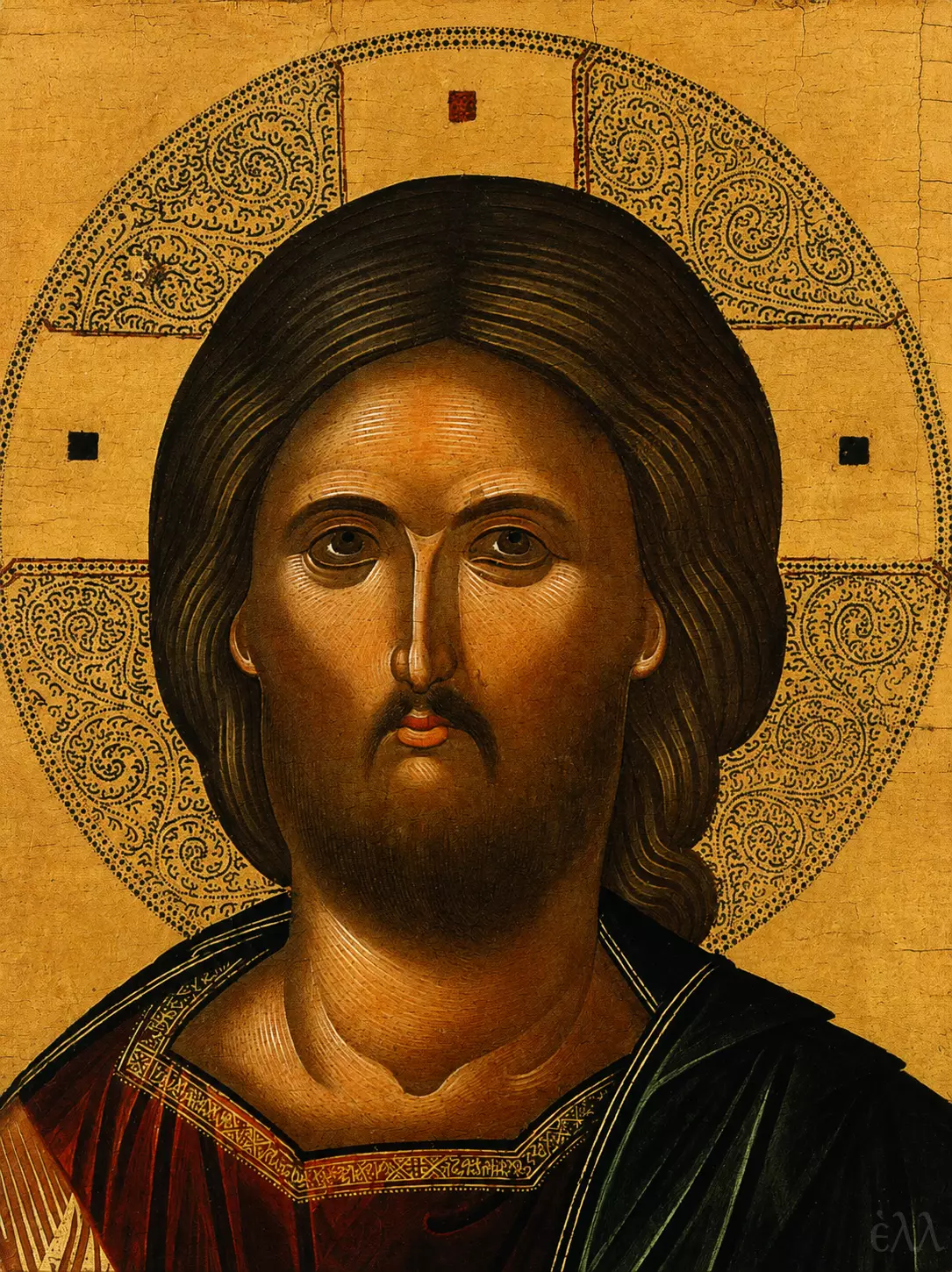
The theological centre of the image rests upon the face of Christ. The painter constructs the flesh tones through delicate transitions, beginning from a cool grey-green proplasmos that remains visible in the deeper areas around the eyes and neck. The luminous eyes, carefully shaped cheekbones, and restrained highlights along the nose create a direct encounter between the depicted figure and the viewer.
The dark hair, divided at the centre and falling symmetrically behind the shoulders, reinforces the solemn frontality of the composition. Around the head appears the cruciform halo, decorated with elaborate punched ornament whose intricate patterns transform the golden background into a radiant field surrounding the divine presence.
The representation of Christ Pantokrator forms one of the central visual expressions of Orthodox Christology. In this Cretan interpretation, the severe character often associated with earlier monumental images of the Pantokrator is moderated through a greater emphasis on compassion and personal encounter. The half-length format brings the figure closer to the worshipper, allowing the icon to function as a place of prayerful communion.
The closed Gospel book held by Christ carries particular symbolic significance. Unlike open Gospel books that display specific scriptural passages, the closed codex represents the fullness of divine wisdom contained within the person of the Logos. The careful placement of the fingers around the richly decorated binding emphasises the sacred nature of the book, which becomes an extension of Christ’s own teaching authority.
Beyond its faithful preservation of an established iconographic tradition, the panel reveals exceptional sensitivity in the handling of colour and texture. The chiton appears in a deep carmine red, modelled through carefully controlled transitions of light and shadow that create a sense of physical presence. The golden clavus on the shoulder introduces a sharp decorative contrast, while the dark green himation provides a powerful visual foundation for the composition.
Against this darker field, the Gospel book emerges with its bright vermilion edges and elaborate golden decoration. The contrast concentrates attention upon the sacred text and strengthens the balance of the entire figure.
The anonymous painter’s achievement lies in the harmonious union of traditional iconographic discipline, refined facial modelling, and a restrained assimilation of Western pictorial elements. The work does not merely repeat an inherited formula; it renews a long-established Byzantine image through a precise and contemplative artistic language characteristic of the Cretan School.
(The translation was edited by K. Pappas.)