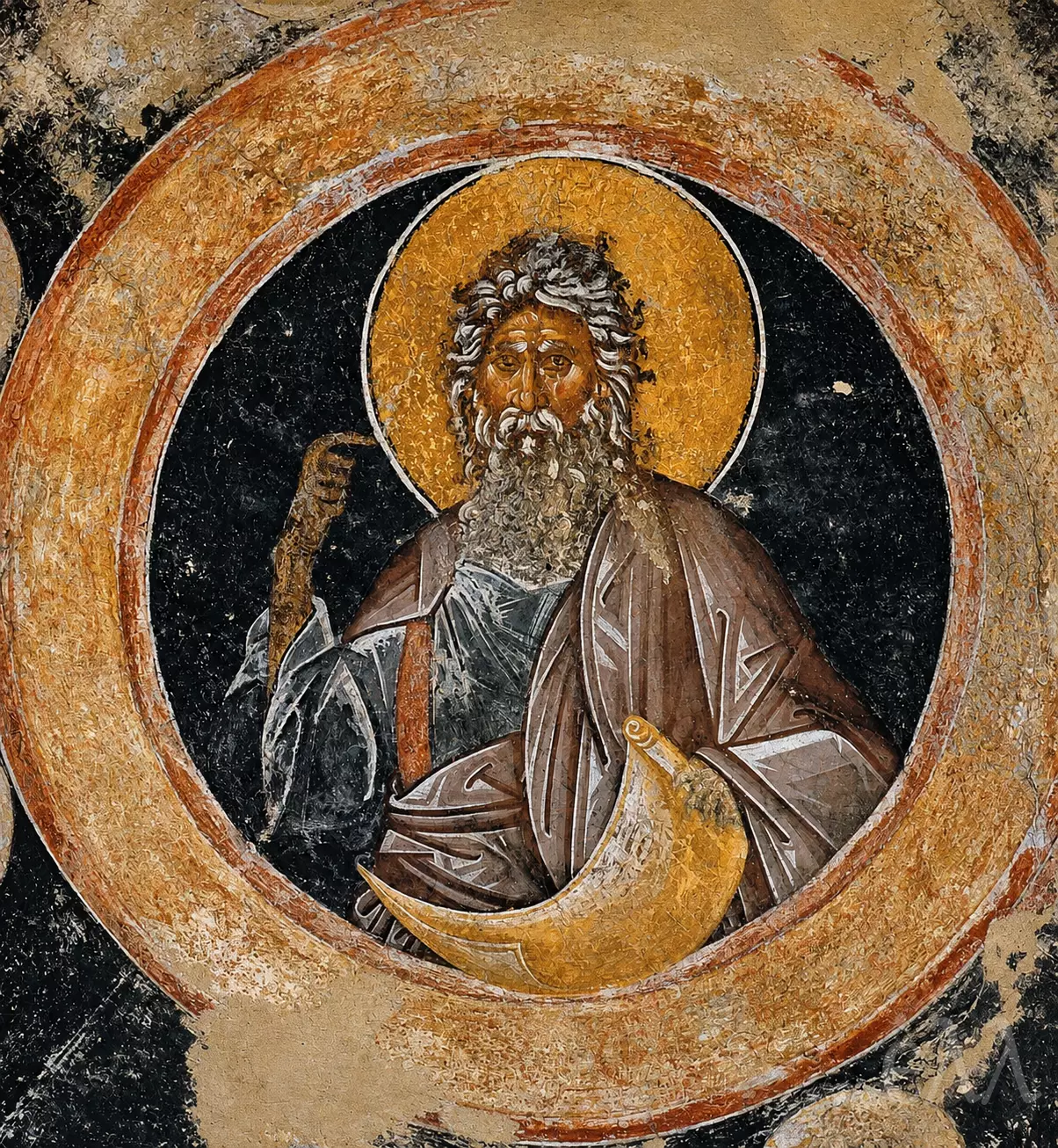
The Patriarch Reuben fresco in the Pantanassa at Mystras belongs to the fifteenth-century painted programme of the church’s upper galleries, wall paintings generally dated to around 1430. The painter is not known by name. In the western small dome of the north gallery, Reuben appears within a circular medallion, represented to slightly below the waist. His image forms part of a larger scheme: across the four small domes of the north and south galleries, Old Testament patriarchs, kings, righteous figures and other forefathers are distributed over the architectural surfaces in relation to the genealogy of Christ. The programme of the Pantanassa adapted important features from the earlier Hodegetria, or Aphentiko, at Mystras.
Within the medallion, Reuben is presented as an elderly man of physical presence. Thick, disordered white hair descends towards the shoulders in separate curling locks; the beard, equally abundant, spreads across the chest. Large eyes, a forceful nose with a broad ridge and emphatically modelled cheekbones give the face an intense concentration. The dark blue chiton and deep rose-coloured himation keep the chromatic range restrained, while pale, sharply defined highlights articulate the folds and separate the figure from the almost black background. Damage and abrasion interrupt parts of the face, garments and surrounding painted frame. Even so, the principal structure remains clearly legible: head, gesture, scroll, circular enclosure.
Patriarch Reuben Fresco and the Genealogical Programme
Particular importance belongs to one gesture. Reuben raises his right hand towards his own chest, while with his left he supports an open scroll whose broad curling end crosses the lower part of the medallion. The surviving inscription—fragmentary, yet sufficient for the identification recorded in the study of the Pantanassa paintings—preserves the words «ΠΡ(ΩΤΟΤΟΚΟΣ) ΜΟΥ (ΙΣΧΥΣ) …», corresponding to Jacob’s address to Reuben, “my firstborn” and “my strength” (Genesis 49:3). The text is integral to the figure’s identification. Inscription and gesture work together, the patriarch indicating himself while the scroll supplies the Scriptural words associated with his name.
The position of Reuben becomes clearer when the gallery decoration is considered as an ensemble. In the Pantanassa, prophets, kings and righteous Old Testament figures appear together with apostles, bishops and saints, incorporated into an iconographic system ultimately related to the Pantokrator of the central dome. Melita Emmanuel has emphasised this coherence and the dependence of the Pantanassa programme upon that of the Hodegetria, while noting its more developed organisation. Individual figures retain distinct physiognomies and gestures, yet participate in something larger: genealogy, prophecy, apostolic continuity, sacred history arranged through architecture.
Reuben’s dome belongs to this repeated structure. In the eastern small dome of the north gallery, the accompanying description records eight forefathers in the drum, alternating four kings in imperial dress with four righteous men wearing chiton and himation; six-winged seraphim occupy the pendentives. An analogous decorative conception governs the western dome containing Reuben. Repetition gives the galleries rhythm, but the painter does not reduce the central figures to interchangeable types. Reuben’s unruly white hair, heavy beard, concentrated gaze and emphatic self-pointing gesture establish a distinct visual identity.
The Pantanassa itself was founded by Ioannis Frangopoulos, an important official of the Despotate of the Morea, and its fifteenth-century paintings constitute a major surviving ensemble of late Palaiologan monumental art at Mystras. Scholarship has shown that the Hodegetria furnished an important model for its iconographic organisation, while the Peribleptos also supplied pictorial and iconographic precedents. Doula Mouriki’s detailed study of the church remains fundamental and is included as “The Wall Paintings of the Pantanassa at Mistra: Models of a Painter’s Workshop in the Fifteenth Century” in Twilight of Byzantium, beginning on page 217.
What gives the Reuben medallion particular weight is the balance between system and individuality. He belongs to an extensive Old Testament cycle spread across the gallery domes, yet the painter has given him the force of an autonomous sacred figure. The broad forehead, restless locks, dense beard, dark garments, raised hand and sweeping curve of the scroll gather tightly inside the circular field. Around him, architecture becomes frame; within that frame, the patriarch remains monumental.
(The translation was edited by E. Wilson.)