The Ascension of Christ at Ohrid, painted across the sanctuary vault of Hagia Sophia during the episcopate of Archbishop Leo (1037–1056), belongs to one of the most ambitious surviving programmes of eleventh-century Byzantine wall painting. On the site of an earlier foundation, the metropolitan church itself was rebuilt or substantially renewed, and its decoration, generally dated around the middle of the century, has long been associated with the artistic culture of Constantinople. Monumental scale, firm compositional order and an unusually dense theological programme give the ensemble a character far removed from a modest provincial cycle.
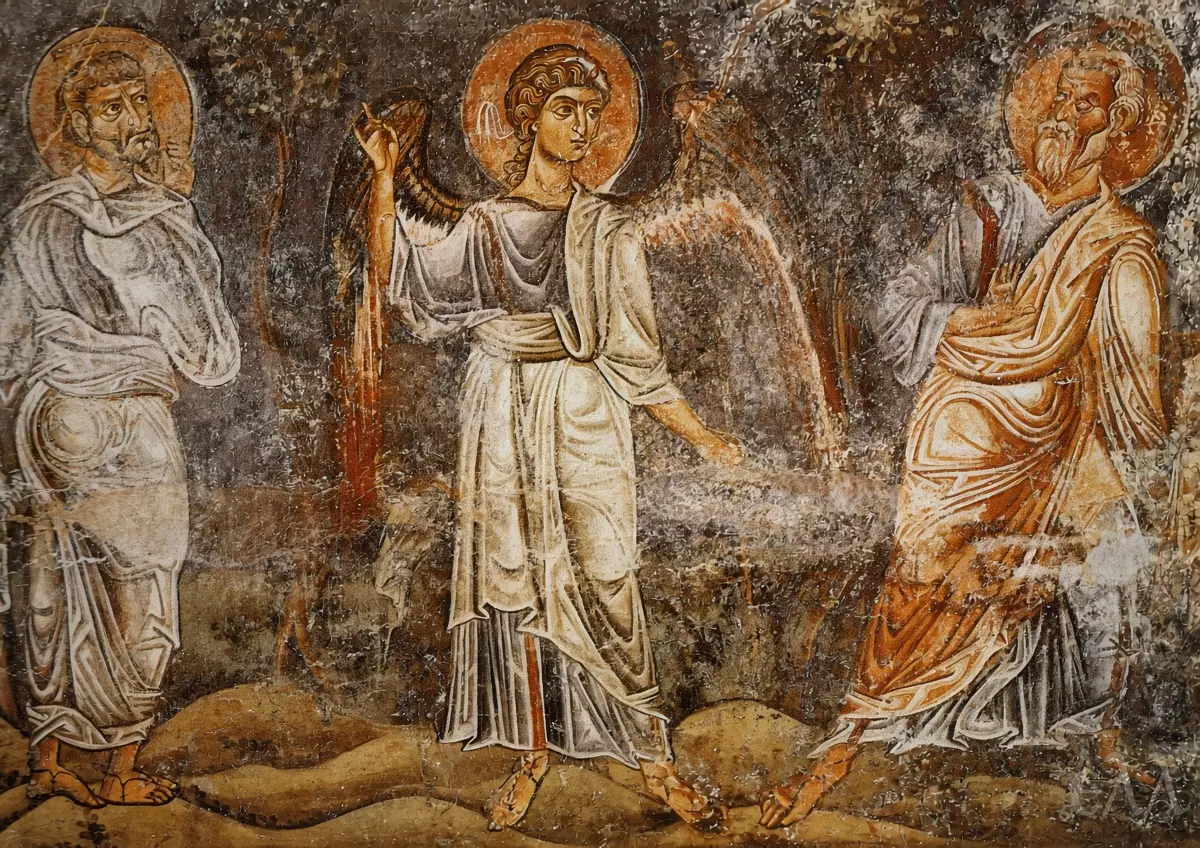
Within the complete Ascension (Acts 1:9–11), Christ is shown in glory, enthroned on a rainbow and enclosed within a luminous mandorla borne by four angels. The Apostles occupy the sides of the vault below, their gestures converting the upward movement of the event into a sequence of human reactions. Three figures from that lower zone are isolated in the present detail: a bearded apostle at one side, a youthful angel in the centre, an elderly apostle opposite him. Christ lies beyond this particular field, yet the entire arrangement still directs attention upwards. Gesture, gaze, the lifted arm of the angel, even the diagonals of the drapery participate in that ascent.
Ascension of Christ at Ohrid: Apostles, Angel and Monumental Rhythm
Despite the governing order of the larger composition, the three figures are arranged asymmetrically. The angel occupies the strongest vertical axis, standing almost fully upright, while the apostles respond with markedly different postures. On the left side of the composition, the bearded apostle remains comparatively still. His body is wrapped in pale grey drapery, the upper torso held firmly beneath the mantle; his gaze turns towards the angel and the implied celestial event. Opposite him, the older apostle bends and twists more emphatically. White hair and a long beard sharpen the age of his physiognomy, while the warm ochre-orange garment folds around the body in concentric, restless curves.
Between them stands the compositional hinge: the angel. His right hand rises beside the head in a precise, commanding gesture; the left arm descends, opening the body across two opposing diagonals. The face, youthful and oval, is modelled with broad planes of ochre and lighter flesh tones, framed by curling hair and a circular halo. Nothing is overextended. Force resides in the gesture, though its energy remains contained by the upright stance and by the long pale garment falling almost to the feet. The angel announces movement while remaining visually the most stable figure.
Much of the expression is carried by drapery. On the angel, pale folds descend in long channels before breaking at the waist and knees into sharper angular turns. White highlights define their ridges, recover volume from the darker passages of the painted field and clarify the direction of the body beneath. The apostle at the left is handled more broadly, with a quieter sequence of folds; the older figure on the right, in denser loops and repeated curves. One figure restrained, another agitated; between them the angel, clear, linear, vertical. Across the complete vault, these warm and pale forms originally stood within the broader blue field described for the Ascension, strengthening the separation between terrestrial figures and the celestial expanse.
Equally deliberate is the rocky ground below. Rounded ochre forms rise and fall beneath the feet, creating a low, undulating base instead of sustained landscape recession. It is sufficient to establish the earthly register. The painted surface preserved today, however, retains its background unevenly: extensive abrasion and pigment loss produce mottled dark areas, scattered lacunae and abrupt interruptions to faces, garments and surrounding colour. Still the principal contours remain legible. Faces, hands, folds emerge in fragments, sometimes suddenly; chromatic continuity has weakened, the underlying pictorial structure has not.
For the history of Middle Byzantine monumental painting, much of the importance of the Ohrid decoration lies in that structure. The figures possess weight and corporeality, yet their movement is governed by line. Bodies turn, arms rise, garments swing; throughout these shifts, a controlled symmetry remains perceptible behind the gestures. Ceremonial and measured, the resulting rhythm accommodates sudden motion while preserving the monumental clarity appropriate to a major sanctuary programme.
Central to the commission was Archbishop Leo. His Constantinopolitan background provides a persuasive historical setting for the metropolitan character of the paintings, while the iconographic choices and stylistic ambitions of Hagia Sophia reach beyond what might be expected from an isolated regional workshop. Attribution to a single painter would exceed what the surviving evidence securely establishes. The ensemble nevertheless demonstrates familiarity with a sophisticated artistic language: plastic modelling disciplined by contour, expressive physiognomies, rhythmic drapery, carefully organised registers, an unusually strong awareness of the architecture carrying the images.
Across the sanctuary operates an interdependent visual field. The Ascension above, the apostolic imagery, the solemn angelic procession further below and the Eucharistic and Marian elements of the apse programme acquire additional force through their proximity. Compositional relationships within the same decoration have been examined in the Cvetković study of the Communion of the Apostles, while the Cambridge volume, The Reception of the Virgin in Byzantium, includes the Ohrid sanctuary and its Ascension within a broader consideration of Byzantine Marian imagery. Placement, adjacency, scale: each contributes to the meaning of a programme conceived across the architecture rather than within isolated pictorial frames.
What this detail preserves most powerfully is the human scale inside a vast theological image. The apostles do not behave as interchangeable witnesses. One remains compact and grave, another bends under the pressure of the event; between them the angel raises an arm and establishes direction. Across worn plaster, diminished colour and broken passages of paint, the design still holds. The Ascension of Christ at Ohrid depends upon this tension—earth and heaven, stillness and movement, corporeal weight and upward impulse—and within these three surviving figures the larger conception is already present.
(The translation was edited by N. Jones.)