
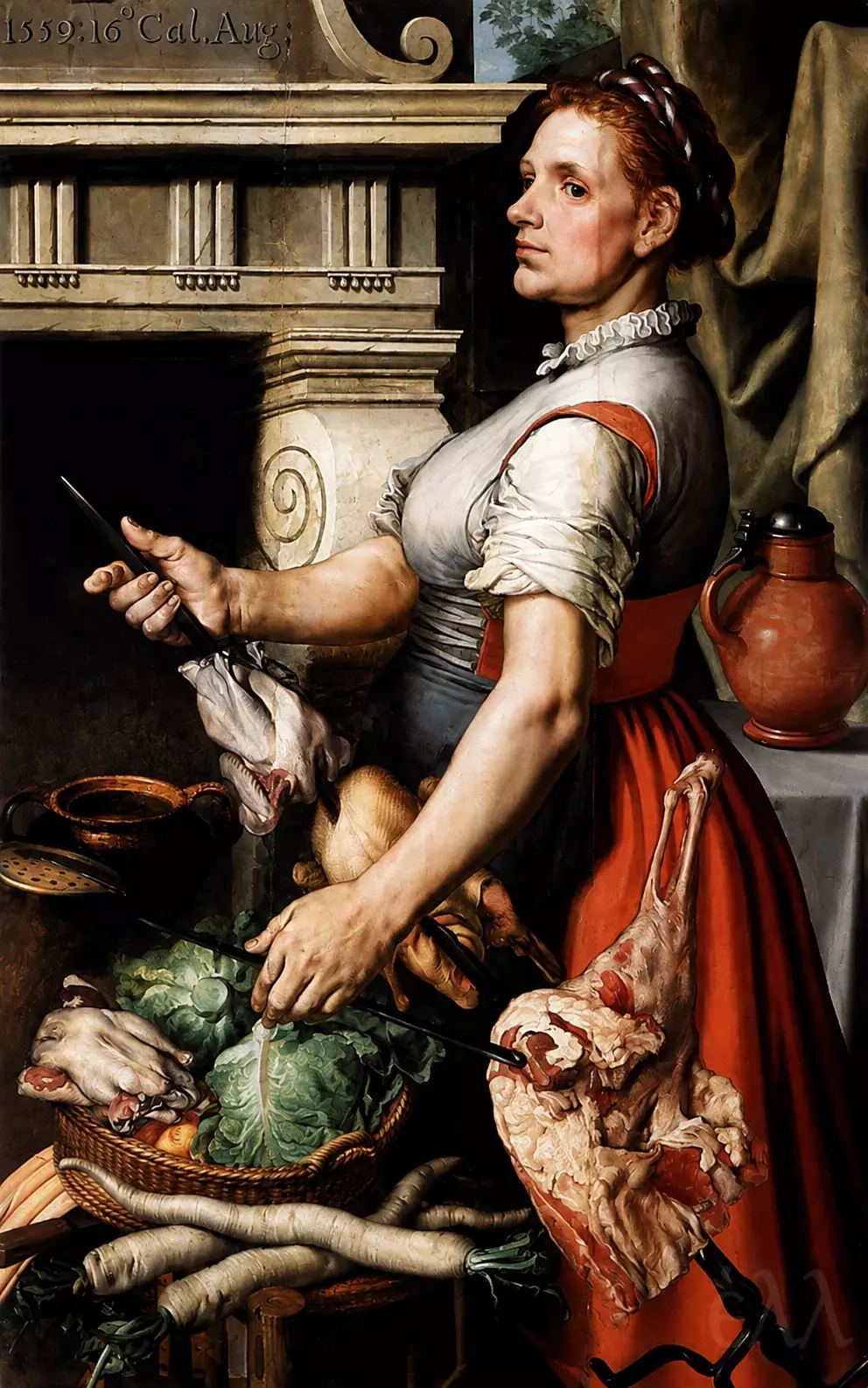
Pieter Aertsen’s Cook in front of the Stove, dated 1559, gives a kitchen worker the scale and pictorial authority that sixteenth-century painting more commonly reserved for elevated figures. The woman rises almost through the entire vertical field, pressed forward by the massive stone chimney behind her and by the dense accumulation of food and utensils below. Aertsen, Amsterdam-born and long active in Antwerp, had already made the kitchen and market scene one of the most experimental areas of Netherlandish painting. In this work the experiment is unusually concentrated, with a single figure occupying a narrow interior crowded by edible matter.
The painting belongs to the Royal Museums of Fine Arts of Belgium in Brussels. Its current museum catalogue records oil on oak, inventory number 3744, and dimensions of 127.5 × 82 cm; it also identifies Aertsen’s monogram on the table covering and the dated inscription on the chimney, “1559. 16° Cal. Aug.” The museum measurement is worth noting because a larger height of 172.5 cm has circulated in some secondary listings.
At first glance the subject belongs to ordinary domestic labour. Yet through scale, viewpoint and the pressure of objects around the body, Aertsen alters its visual status. Vegetables, poultry, meat, metal, cloth and glazed earthenware occupy the same carefully observed world as the woman herself. The kitchen becomes an arena for figure painting and still life at once, the distinction between them weakened amid the crowded provisions.
Cook in front of the Stove: Figure, Food and Monumental Scale
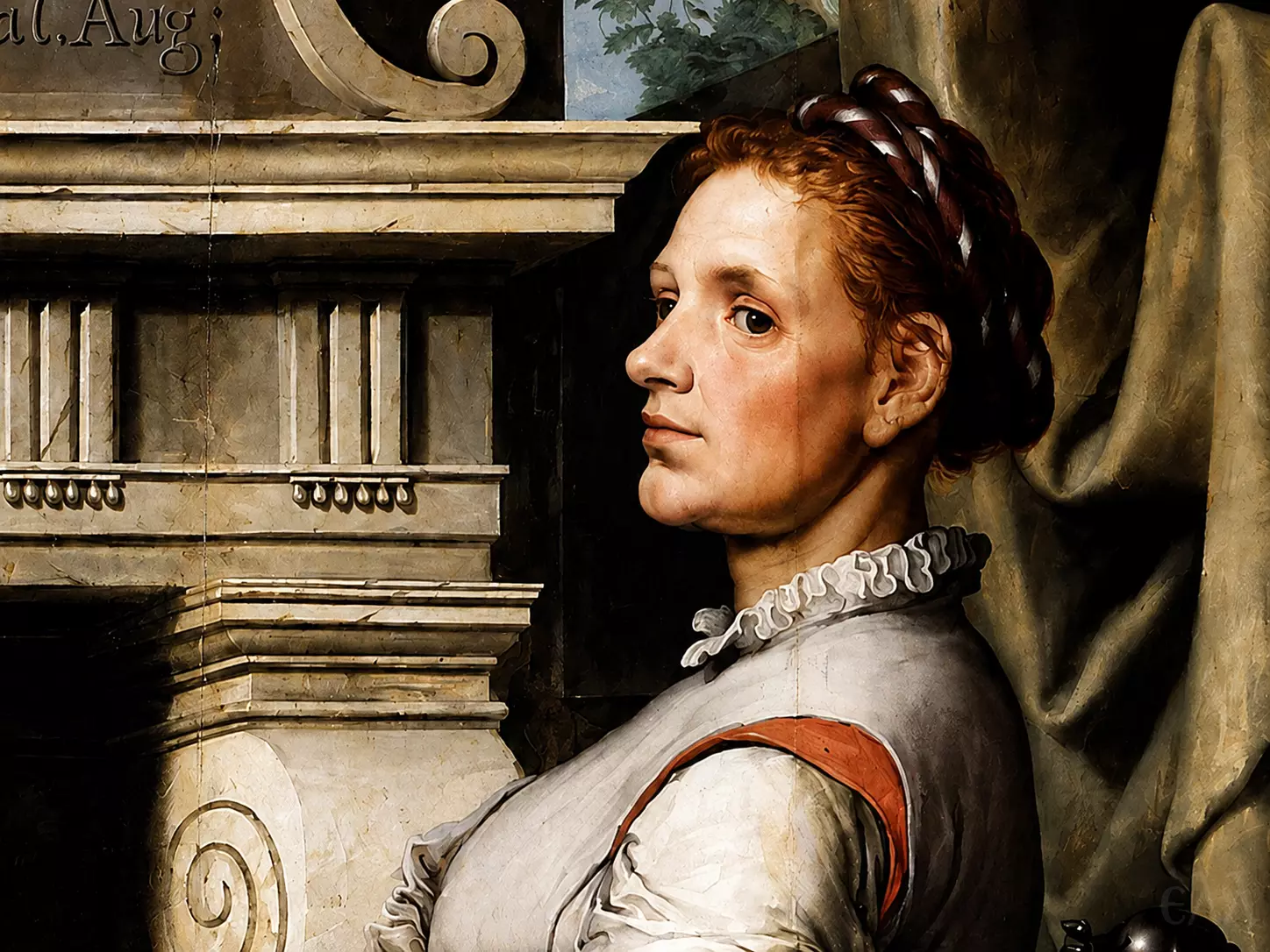
The cook stands slightly turned, while her head shifts farther across the axis of her body and her gaze travels towards the left side of the composition. This small displacement matters. It prevents the pose from settling into complete frontality and gives the impression that her attention has been caught by something beyond the painted field. Her expression remains composed, almost withholding. Whatever has attracted her glance stays outside the scene, beyond the dark opening of the stove.
Her physical presence is emphatic. The bare forearms are broad and carefully modelled, the neck firmly articulated above the white ruff, the face built through close tonal transitions around the cheek, eye socket and bridge of the nose. Against the dark recess behind her head, the flesh appears especially luminous. There is a portrait-like specificity to the physiognomy, although the painting presents her through occupation rather than documented personal identity. The braided hair, threaded with pale ornament, is tightly arranged above the head; beneath it, the ruff forms a crisp circular interruption between face and clothing.
Costume divides the figure into sharply distinguished areas. A pale blouse is gathered and rolled above the elbows. Over it lies a cool grey bodice edged at the shoulder with reddish fabric, while the lower body expands into the strong red of the skirt. Across the waist passes a darker blue-grey textile. The colours remain substantial without becoming brilliant: warm red and terracotta beside leafy green, chalky white and brown-black shadow, all held within the material world of the kitchen.
Behind the woman, Aertsen has given the chimney-piece an almost architectural gravity. Horizontal cornices, vertical supports and carved mouldings construct a firm geometric framework against which the curves of the body become more evident. The large stone structure also fixes the figure spatially. Contained by the kitchen yet seemingly too large for its narrow limits, she overlaps the dark opening with her shoulder and extends downward into the piled provisions. At the opposite side, a heavy hanging textile and an earthenware vessel close the composition more softly.
Below, order gives way to abundance. Broad cabbage leaves spread from a basket; pale root vegetables project horizontally across the foreground. A bird lies nearby, while other poultry and a substantial cut of meat are threaded onto a long roasting spit. A perforated skimming ladle introduces another material register, its thin metallic surface set against flesh, feathers and vegetables. These objects occupy a large part of the available pictorial space, overlapping one another and pressing close to the picture plane.
That density belongs to a larger change in Netherlandish painting to which Aertsen contributed decisively. Research on the history of the kitchen scene has placed his work near the beginning of the monumental treatment of food, kitchen equipment and servants as primary pictorial subjects. In his academic study, Zoran Kwak describes Aertsen’s mid-sixteenth-century kitchen paintings as striking innovations precisely because socially modest figures and culinary objects were enlarged to a scale that contemporary viewers would have found unexpected.
Cook in front of the Stove makes that shift especially plain because so little narrative scaffolding remains around the woman. Her actions are practical. One hand attends to the cooking implement, the other controls the long spit crossing the lower part of the picture. Aertsen slows those actions through composition, however. The diagonal rod passes across the mass of vegetables and meat, while the cook herself is held by the stronger verticals of torso, chimney support and panel format. Movement remains within a structure dominated by physical weight.
The food therefore demands prolonged looking. The crumpled leaves of the cabbages have a different surface from the smooth pale roots; plucked and feathered birds provide contrasting textures, while the exposed meat introduces dense reds and creams beside the saturated skirt. Aertsen moves repeatedly between soft and hard surfaces, between moist flesh and dry vegetable matter, between polished metal and rougher organic textures. Such differentiation was part of the virtuosity of Northern Renaissance oil painting, where the medium could register minute variations of matter across a densely occupied surface.
Most striking is the social scale granted to the cook herself. The low viewpoint strengthens the body, especially the arms and shoulders, while the narrow panel denies the figure much empty space. She is neither diminutive staffage nor a distant participant in somebody else’s story. Her labour occupies the centre, surrounded by kitchen goods whose size and proximity give them unusual pictorial insistence. At the lower edge, vegetables, poultry and butchered meat continue almost to the frame.
(The translation was edited by E. Wilson.)