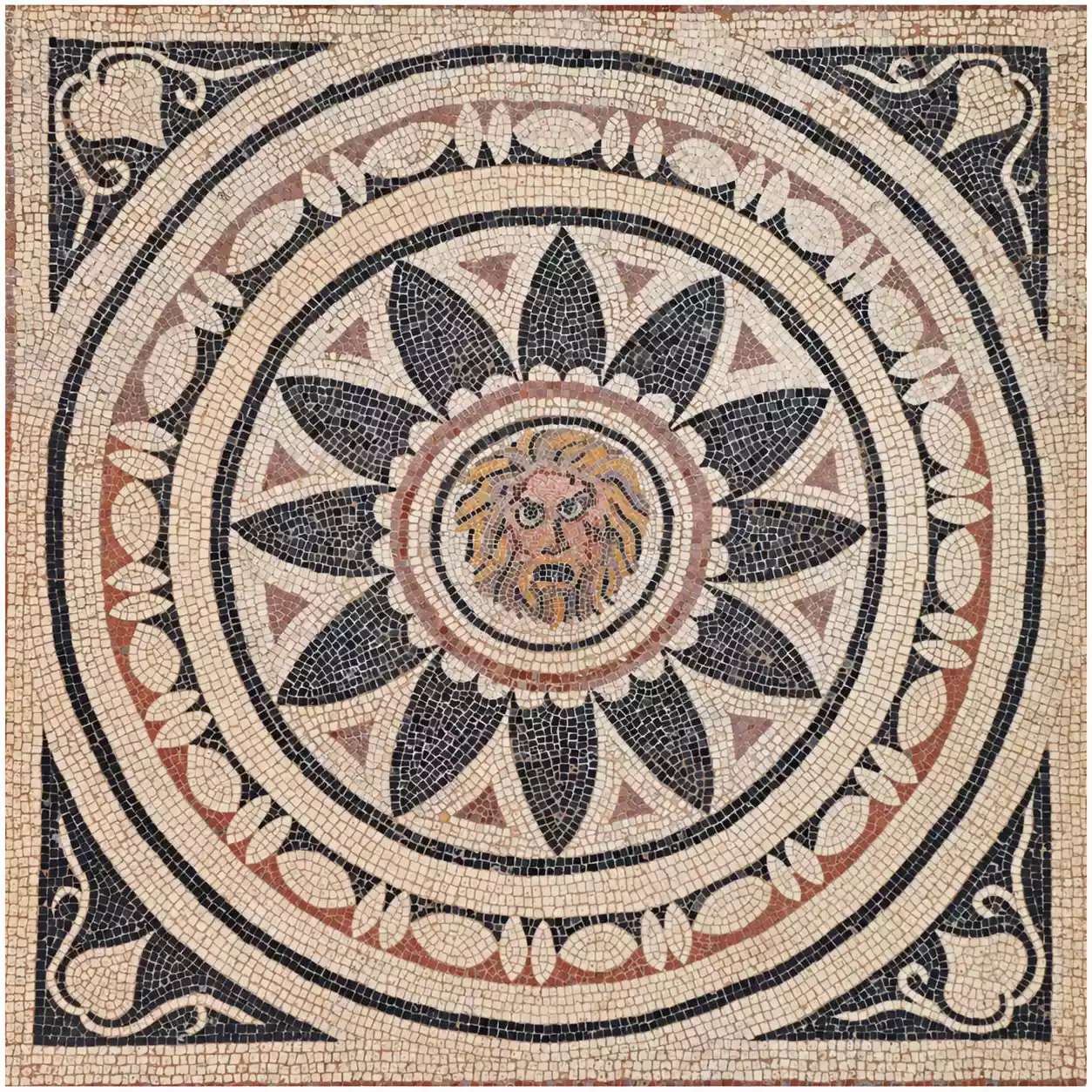
 Mask of Phobos (Fear) within a twelve-petalled rosette. Stone mosaic from Halicarnassus in Asia Minor, 4th century AD. British Museum, inv. no. 1857,1220.416.
Cerberus stands at the entrance to Hades. Beyond Oceanus dwell the Gorgons, while down upon the table of Phineus swoop the Harpies, snatching away his food. The monsters of Greek mythology meet human beings in places where safety runs out. Sometimes a single glance is enough. At other times the threat comes back every day, at mealtime.
These stories do not share a common starting point. Cerberus guards the world of the dead, whereas the principal myths of Medusa and of the Harpies unfold outside it. Their link with fear offers one way of approaching them, provided we leave room for the discrepancies among the ancient sources. Their forms shift from one text to the next, and so do the circumstances in which they appear.
Medusa and the peril of the gaze
Medusa is placed by Hesiod, together with her sisters, beyond Oceanus, towards Night, near the Hesperides. In the Theogony, Stheno and Euryale are immortal; she alone is mortal. When Perseus beheads her, Pegasus and Chrysaor spring from her neck, the offspring of her union with Poseidon.
In the best-known version of the encounter, the hero approaches Medusa as she sleeps and looks at her reflection in a polished shield, avoiding the sight that turns flesh to stone. This detail shifts the weight of the ordeal onto the manner in which one approaches danger. Between Perseus and the Gorgon’s face an image intervenes, and the image is enough to guide his hand.
Petrification invites a modern analogy with the paralysis that terror can bring on, the body freezing before it has had time to react. Such a reading, however, remains an interpretation of the myth, and some caution is needed before we attribute it to the myth’s ancient audiences.
In art, Medusa’s face was frequently used as a protective emblem. The gorgoneion, the Gorgon’s head shown on its own, appears on architectural members and on military equipment. As the Metropolitan Museum explains in its essay on the subject, its apotropaic function is bound up with keeping evil at bay. The frontal face stares back at whoever draws near, even when it has been detached entirely from the story of Perseus.
Cerberus at the boundary of the dead
With Cerberus, menace takes the shape of a guardian. A dog in his basic build, he remains recognisable, yet his monstrous appearance sets him apart from the animal that people know beside the house or the flock. At the gate of Hades his presence makes the boundary between the living and the dead something one can feel.
The number of his heads varies within the tradition. Hesiod presents him as fifty-headed. In the Library, the mythographic work conventionally attributed to Apollodorus, he has three canine heads, a dragon’s tail and the heads of snakes along his back. The three-headed dog so familiar today is just one of his ancient versions.
In Heracles’ labour, Hades allows the hero to take Cerberus on condition that he overpowers him without using the weapons he carries. Heracles subdues him by sheer strength and brings him up into the world of the living. Having shown him to Eurystheus, he returns him to Hades. The guardian’s temporary removal belongs to an ordeal that is complete only once he is back in his place.
What the listener follows, then, is an exceptional crossing. Heracles reaches the realm of the dead and comes back, bringing with him the very creature that guards its entrance. The episode can be read in relation to the fear of death, but the narrative stays tied to the hero’s particular mission and to Eurystheus, who is waiting to see how it ends.
The Harpies and the vanishing meal
With the Harpies, danger comes from the air. Hesiod names Aello and Ocypete, linking their flight to the speed of winds and birds. Sudden movement is already among their defining traits.
In the story of Phineus the threat becomes very concrete. According to the Library, the gods had sent these winged beings to the blind seer. Whenever his table was laid, they swooped down and carried off most of the food. What little was left gave off such a stench that no one could touch it.
The deprivation is repeated in an everyday act on which survival depends. For Phineus the food lies right in front of him, almost within reach. Yet he knows what will follow. One may recognise here the insecurity bred by a threat that keeps returning, even into a space meant for rest.
The Harpies are pursued by Zetes and Calais, the winged sons of Boreas who sail with the Argonauts. The author of the Library preserves different outcomes and credits Apollonius of Rhodes with the version in which they reach the Strophades and are spared, once an oath has been given that they will cease to harm Phineus. The seer’s deliverance comes when they are driven from his table.
Fear acquires a face
Alongside the creatures that inspire terror we also meet Phobos, Fear as a personified power, closely bound up with battle. In Book 15 of the Iliad, Ares orders Deimos and Phobos to yoke his horses. The two figures take part in the epic action as his attendants, as the analysis published by the Center for Hellenic Studies also points out.
Personification gives the emotion the presence of a force able to move about the scene. On the battlefield, fear bears directly on a warrior’s conduct, on whether he can hold the position he occupies. In the narrative it is named, and it acts at the side of the god of war.
Many centuries later, a mosaic from Halicarnassus sets the fearsome face at the centre of a circular composition. The British Museum catalogue identifies the mask with Phobos and dates the work to the 4th century AD, in the late Roman period. Around it opens a twelve-petalled rosette, with black petals and reddish-brown triangles in the spaces between them.
In the photograph, what stands out are the wide-open eyes, the gaping mouth and the wavy locks framing the face. Shades of ochre alternate with reddish-brown and dark tesserae. The small central mask takes up only a limited part of the surface, yet it is there that the eye goes first.
The identification with Phobos is not enough, on its own, to establish what the image was meant to do in its original setting. In the surviving picture, at any rate, we can follow how the decoration is organised around it. Beyond the black petals run concentric bands of ovolo and foliate motifs. In the four corners, pale leaves on curling stems fill the dark fields between the circle and the square frame.


