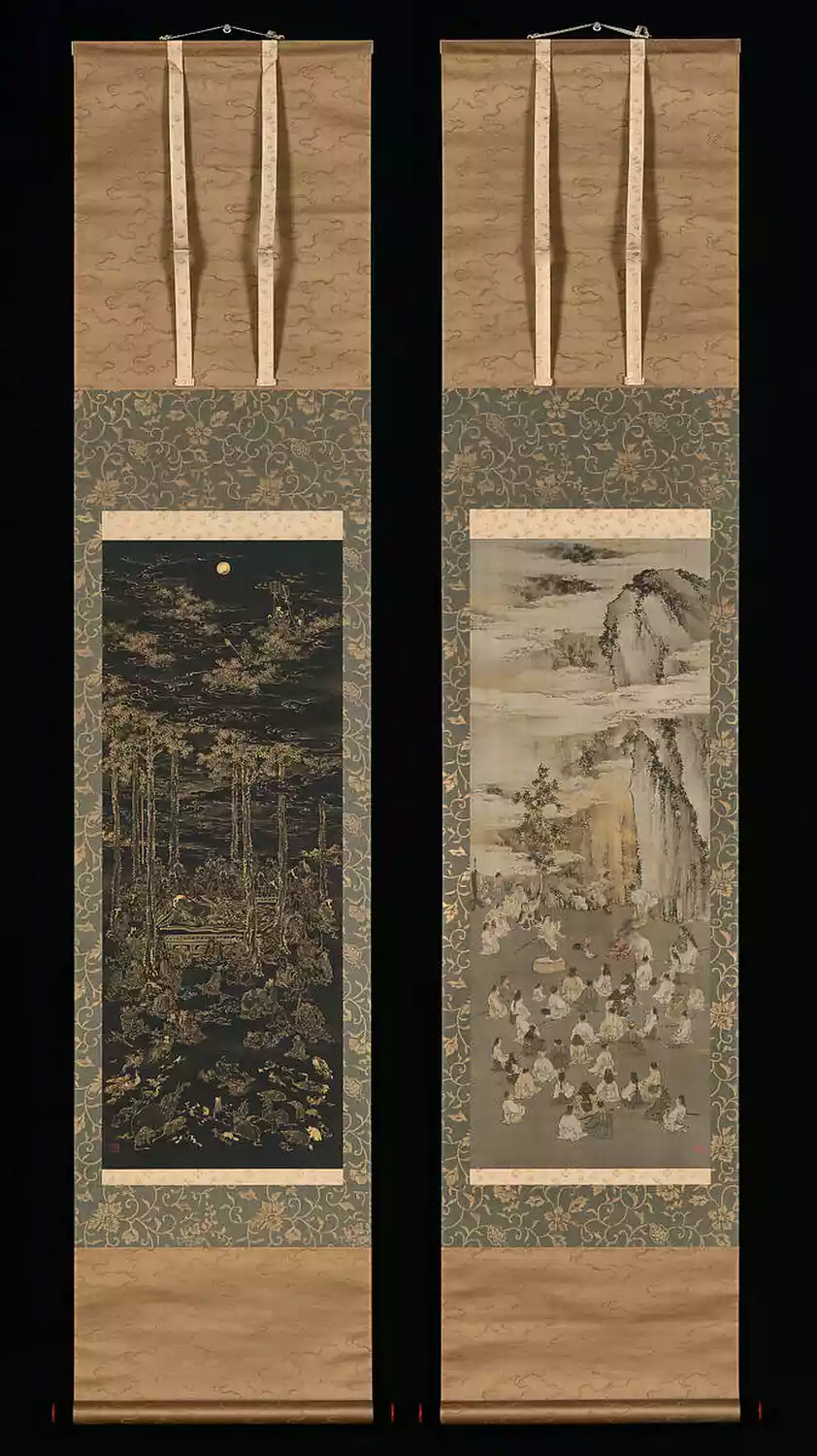
 Kōno Bairei, ‘Luring the Sun Goddess Amaterasu Out of a Cave with Music; Death of the Historical Buddha’, late 19th century, Meiji period. Pair of hanging scrolls, ink, colour and gold on silk. The Metropolitan Museum of Art, New York, Mary Griggs Burke Collection.
What we know of the myth of Amaterasu, the sun goddess who withdraws into a heavenly cave and leaves the world in darkness, comes chiefly from texts compiled in the early eighth century in the milieu of the Japanese imperial court. In these narratives, which drew together older traditions and genealogies, Amaterasu Ōmikami occupies a central place as the divine ancestor of the imperial house. Her concealment in the Ama-no-Iwato, the ‘heavenly rock door’, threatens the very continuity of life, and the attempt to bring her back gathers around it deities connected with the ritual offices of the court.
The sources of the myth and their variants
In the Kojiki, the ‘Record of Ancient Matters’, presented at court in 712 by Ō no Yasumaro, the episode forms part of a continuous mythological narrative. The Nihon shoki, the ‘Chronicles of Japan’, was completed in 720 under the supervision of Prince Toneri and is written mainly in classical Chinese; in its sections on the Age of the Gods it cites, alongside the main text, divergent versions introduced as ‘alternative writings’. As Kokugakuin University’s presentation of the two works points out, the preservation of these traditions is closely bound up with the recording of imperial descent, although the two texts differ in character and composition.
The Kogoshūi of 807, the work of Inbe no Hironari, is later in date. It preserves additional traditions about court rituals and gives prominence to the contribution of the Inbe clan. The clan’s claim to its ritual prerogatives, asserted against the powerful position of the Nakatomi, runs through the work, though it does not account for the whole of its content. The account that follows takes the Kojiki as its basis and notes the divergences of the Nihon shoki wherever the course of the episode changes in substance.
From the siblings’ contest to a night without end
Susanoo, Amaterasu’s brother, ascends to Takamagahara, the Plain of High Heaven, to bid her farewell before his departure. He is often described as a storm god, yet his character in the ancient sources is more complex: in the Kojiki, Izanagi has assigned him the realm of the sea, while the interpretative tradition also associates him with wind and rain.
Suspecting that her brother has come to take possession of her domain, Amaterasu meets him armed. There follows the ukei, a ritual trial in which the two deities bring forth further deities from the objects they exchange, so that the sincerity of his intentions can be established. Susanoo proclaims himself the victor and, carried away by his success, breaks down the dividing ridges of his sister’s rice fields, fills in the irrigation ditches and defiles with excrement the hall in which she holds the feast of the first fruits.
At first Amaterasu excuses these deeds, maintaining that the filth must be vomit from too much drink and that the destruction of the ridges was perhaps meant to put the land to better use. Her tolerance, however, is followed by fresh violence within the hall of sacred weaving. While the garments of the gods are being made, Susanoo breaks a hole in the roof and drops through it a piebald heavenly horse that he has flayed backwards; in her terror, one of the weavers is mortally wounded in the genitals by the shuttle of her loom.
In the main text of the Nihon shoki it is Amaterasu herself who is injured by the shuttle, whereas in another version the goddess Wakahirume dies. These shifts in the identity of the figure who suffers the violence bear on the interpretation of the story, as does the unusual ‘backward flaying’ of the horse, to which Nelly Naumann devoted a dedicated study.
In the Kojiki version, Amaterasu, appalled by these events, shuts herself away in the Heavenly Rock Cave. The sky then turns dark, and with it the Central Land of Reed Plains, the earthly world of the narrative, while night stretches on without a break. The voices of the countless deities are likened to the buzzing of flies in the fifth lunar month, and calamities break out on every side.
The council of the gods and the mirror
Confronted with the absence of the sun, the deities assemble in the bed of the heavenly river Ame-no-Yasu and entrust Omoikane with devising a way to draw Amaterasu out of the cave. The Kojiki speaks of ‘eight hundred myriads of gods’, a number that corresponds literally to eight million; the expression yaoyorozu no kami is a conventional way of denoting the innumerable host of deities.
What emerges from the council is an undertaking made up of many separate tasks. The ‘long-crying birds’, usually identified as cockerels, are brought together, the smith Amatsumara is summoned, and Ishikoridome is charged with making a mirror. Tamanoya prepares strings of magatama, curved beads with a characteristic comma shape, which the narrative will also link to the imperial regalia.
Ame-no-Koyane and Futodama, the divine ancestors of the Nakatomi and the Inbe respectively, carry out divination using the shoulder blade of a deer. A sakaki, the evergreen tree used in Shinto worship, is uprooted from the heavenly Mount Kagu and hung with the beads on its upper branches, the mirror on its middle branches and offerings of cloth further down. Futodama holds the offerings and Ame-no-Koyane recites ritual words, while Ame-no-Tajikarao waits concealed beside the entrance, ready to intervene the moment the door opens.
The dance of Ame-no-Uzume
Before the cave, Ame-no-Uzume turns a wooden tub upside down and dances upon it, so that the stamping of her feet resounds. She is decked with plant ornaments and holds bamboo leaves, and her behaviour is described as a manifestation of divine possession; she bares her breasts and pushes the cord of her garment down low, provoking laughter among the assembled gods. Part of the scene’s power lies in this mismatch: outside there are sounds of festivity, while within the cave Amaterasu expects nothing but the consequences of her absence to hold sway.
Opening the door a little, she asks why Uzume is making merry and why the gods are laughing, when the world has been left without her light. The dancer answers that a deity more radiant than she has appeared, and at that moment Ame-no-Koyane and Futodama hold up the mirror before the entrance. Ever more perplexed, Amaterasu edges forward to look. The text allows us to connect the supposed new deity with her reflection, though it does not set out in detail what exactly passes through her mind as she sees the mirror.
It is then that Tajikarao seizes her by the hand and pulls her out. Behind her, Futodama stretches a sacred rope and declares that she must not go back inside, and light returns to heaven and earth.
Later cultic tradition associates Uzume with the performing arts. The relevant entry in the Encyclopedia of Shinto further notes that the Kogoshūi regards her conduct before the cave as the origin of the Chinkonsai, the rite for pacifying and strengthening the soul, with which the Sarume clan, who claimed her as their ancestor, were connected.
Susanoo, for his part, now receives punishment from the assembly of the gods. They require expiatory offerings of him, rendered as ‘a thousand tables’, cut off his beard, remove the nails of his fingers and toes and banish him from heaven. The narrative will later bring him to Izumo, where he is to slay the eight-headed serpent Yamata-no-Orochi and marry Kushinadahime.
Eclipse, solstice or ritual?
The disappearance and return of the sun have prompted differing interpretations, according to whether the emphasis is placed on natural phenomena or on cultic life. Professor Masahiro Taniguchi sets out the solar eclipse hypothesis and compares it with narratives from Southeast Asia in which a younger sibling turns into a monster and swallows the heavenly bodies. In the Japanese story, too, the aggression of a younger brother causes the sunlight to vanish, although the episode develops along different lines.
Another reading relates Amaterasu’s withdrawal to the winter solstice, when the length of the day reaches its lowest point and then begins to grow again. Seen in this light, the goddess’s return lends itself to an interpretation as the renewal of solar power, particularly when it is considered alongside court ceremonies such as the Chinkonsai and the Daijōsai, the great offering of the new harvest associated with an emperor’s accession.
Correspondences between the mythical preparations and the ritual duties of the court lineages are numerous. The making of the mirror, the cloth offerings and the recitation of ritual words are each given specific agents within the narrative, and these are recognised as the ancestors of families with matching responsibilities. Whether the myth was shaped to explain rites that already existed, or whether certain ritual acts grew out of its reception, nevertheless remains an open question.
The mirror after the cave
Amaterasu later hands the mirror to her grandson Ninigi when he is sent to rule the earthly world. Along with it he receives the beads and the sword that Susanoo had found in the body of Yamata-no-Orochi, and the goddess asks that the mirror be venerated as though she herself were present. In the Kojiki, the passing on of these objects ties the cave episode directly to the divine origin of imperial authority.
The Yata-no-Kagami, as the sacred mirror is called, is associated with the Inner Shrine at Ise, where Amaterasu is worshipped. According to the tradition preserved by the shrine itself, its removal from the imperial palace began under Emperor Sujin, while the establishment of the cult at Ise is placed in the reign of Suinin, after Princess Yamatohime had searched for a fitting site. What we have here is the sacred history of the cult, and its early dates belong to the traditional imperial narrative.
Two worlds in a pair of scrolls by Kōno Bairei
Kōno Bairei (1844–1895), a Kyoto painter trained in the Maruyama and Shijō traditions, was among the founders of the Kyoto Prefectural School of Painting, which opened in 1880 as the first public school in Japan dedicated to painting. In the pair of hanging scrolls now in the Metropolitan Museum of Art in New York, he sets the Amaterasu episode against the parinirvana of the historical Buddha. Painted in ink, colour and gold on silk, the work dates from the late nineteenth century, in the Meiji period, when state policy was pressing for the institutional separation of Shinto from Buddhism.
The pair is read beginning with the right-hand scroll. In pale earthy and greyish tones, a sheer mass of rock defines the space on the right, while lower down figures are gathered sitting on the ground, several of them in tall dark caps. Near the centre of the gathering, Uzume dances on the overturned wooden tub, her light-coloured sleeves standing out against the background; beside her a cockerel and a burning fire can be made out, the smoke rising from it in front of the rock.
In the left-hand scroll, the dark ground is covered with fine lines of gold. The Buddha reclines on a raised couch among tall trees, with mourners crowding around him, while animals and birds spread out towards the lower edge. High above the clusters of trees the disc of the moon and figures in clouds are visible, in a composition that keeps its vertical development even where the crowd grows dense around the couch.
The contrast between the two scenes is underpinned, too, by a different handling of light. In the cave scene the pale landscape lets the figures emerge through slight shifts of colour, whereas in the parinirvana the gold drawing rises out of the black ground, above all in the foliage and in the outlines of the animals near the bottom.


