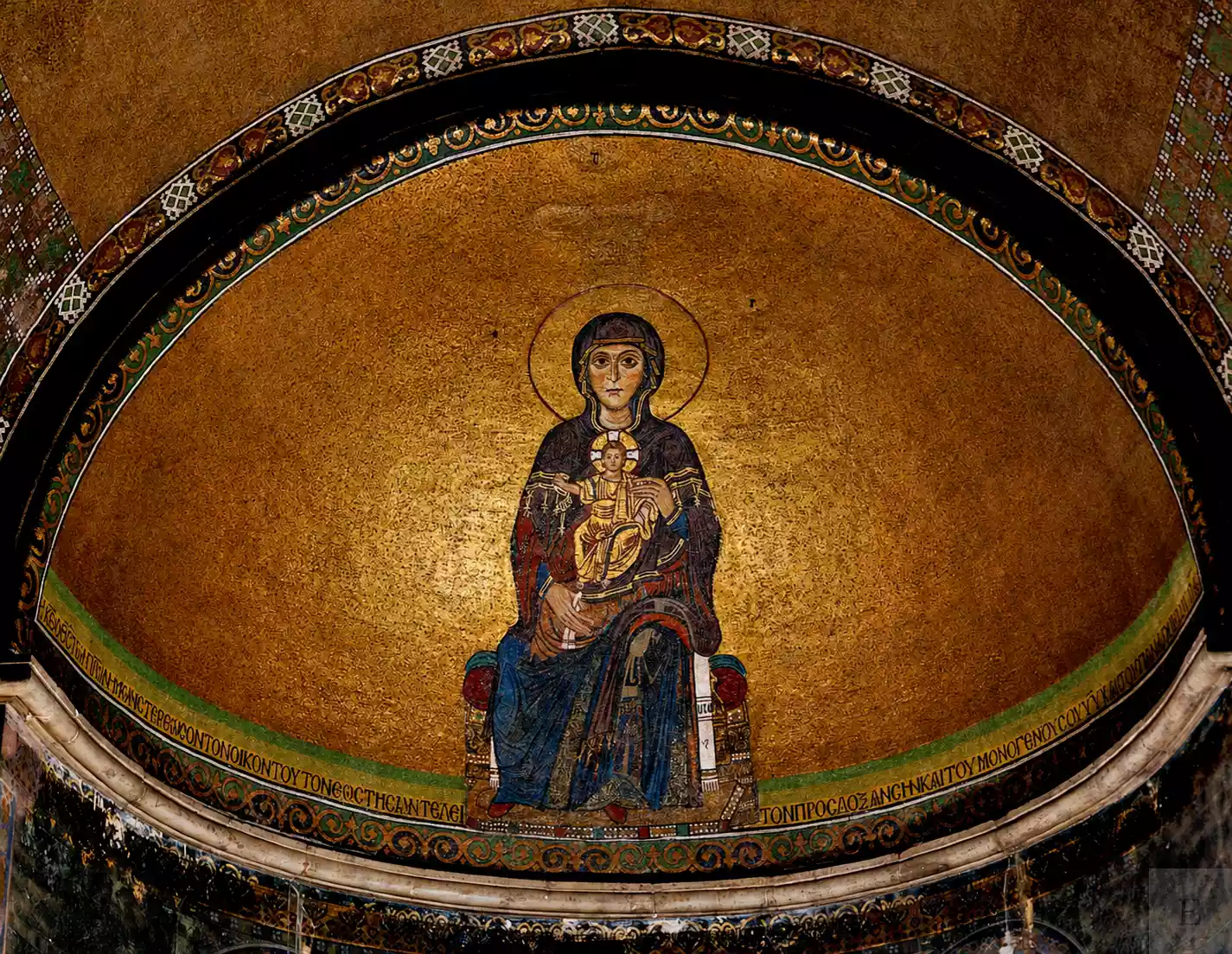
 The enthroned Virgin and Child in the apse of Hagia Sophia, Thessaloniki, where the throne and footstool break into the earlier inscription.
At the foot of the conch, where a line of black lettering runs across the gold mosaic, the Virgin’s throne cuts into the inscription and occupies part of a prayer for the strengthening of the church. It is this encounter between the figure and the older text that reveals the sequence of interventions in the apse of Hagia Sophia in Thessaloniki, where the enthroned Theotokos with Christ replaced a large cross. Faint traces of the cross survive in the gold ground, as the Ephorate of Antiquities of Thessaloniki City points out in its account of the monument’s mosaic decoration.
Within that broad expanse of gold, the group of Mother and Child draws the eye through the frontality of the two faces. Lower down, the folds of drapery and the uneven placing of the hands make the seated body harder to read, above all in the zone between Christ’s feet and the Virgin’s knees.
The earlier decoration and the question of date
The aniconic mosaic decoration of the sanctuary, with its crosses and its geometric and plant motifs, belongs to the time of Constantine VI and his mother, Irene. The imperial monograms, together with that of Bishop Theophilos, give this phase a chronological anchor, and Robin Cormack places it between 780 and 797. To the same decorative scheme he assigns the great cross of the conch and the inscriptions that once accompanied the gold field.
The date of the enthroned Virgin is far less secure. In its archival record of a drawing of the apse, the British School at Athens gives the eleventh century as the probable period in which the cross was replaced. A research database at the University of Sussex likewise assigns the image to that century, while also noting a proposal in the literature for the ninth. What is at stake is the dating of the Virgin and Child itself, which has to be stated with corresponding reserve.
In his study of the apse mosaics, Cormack lays particular weight on the way the throne and footstool intrude into the inscribed band: to make room for the new composition, the central section of the inscription was removed. The observation establishes the order of the work, though on its own it cannot tell us when the replacement took place.
The Virgin of Hagia Sophia, Thessaloniki, within the conch
Much of the semi-dome, that is, the curved surface roofing the apse, is left open around the central figure. From the broad halo down to her shoes and footstool, the Theotokos stands out in a clean outline against the gold, while ornamental bands follow the curve of the architecture and frame the image.
A dark maphorion covers her head and shoulders, its gold borders tracing the face and running down towards the torso. Red appears in the folds at the sides; blues and darker tones fill the lower part of the garment. Towards the knees the fabric falls into broad curves, its creases drawn in fine lines of tesserae, and the anatomy beneath is not everywhere easy to make out.
High up, in front of his Mother’s body, Christ appears in golden-yellow garments with red lines marking the folds. His right hand reaches out towards the viewer’s left, and in his left he holds a pale, rolled scroll. The Virgin’s left hand rests on his shoulder; her right lies much lower, below his feet, on the gathered cloth of her lap, holding a white handkerchief.
The distance between the Child’s feet and the Virgin’s lowered hand makes this unusual arrangement particularly noticeable, and it can be seen more clearly in the close-up of the composition.
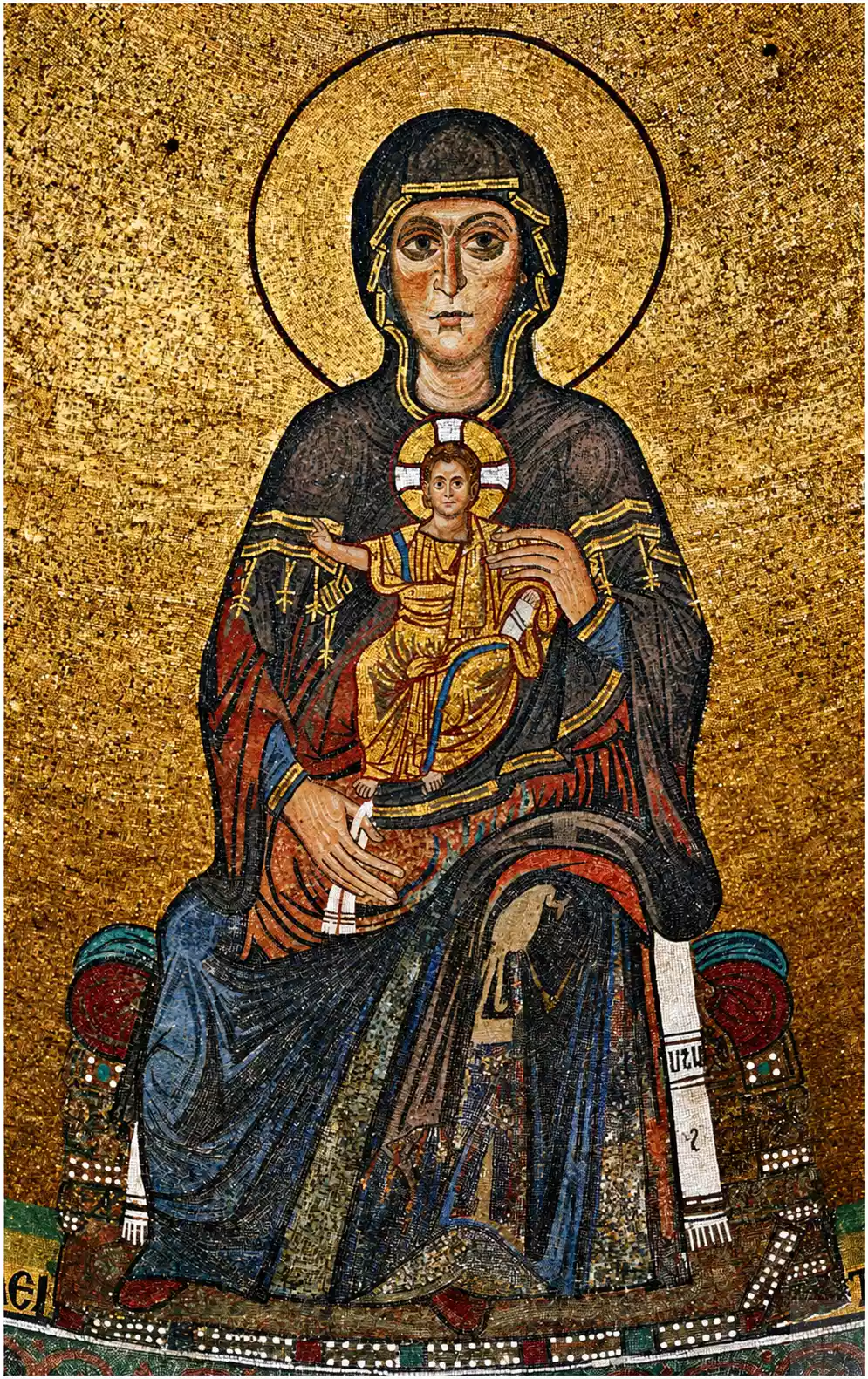 The central group of the Virgin and Child, with the left hand of the Theotokos on Christ’s shoulder and her right hand low in her lap.
At the sides the red cushions, edged in blue, and parts of the decorated throne come into view. White cloths with dark linear patterns hang on either side, and small bright tesserae run along the base, set like rows of precious ornament.
The modelling of the faces
The large eyes of the Theotokos, with their dark pupils and strong outlines, set the stern expression of the face. The brows arch above them, and the long nose catches a bright ridge of light among the warm flesh tones; the mouth stays small and closed, while the red of the lips returns, more intensely, in the cheeks.
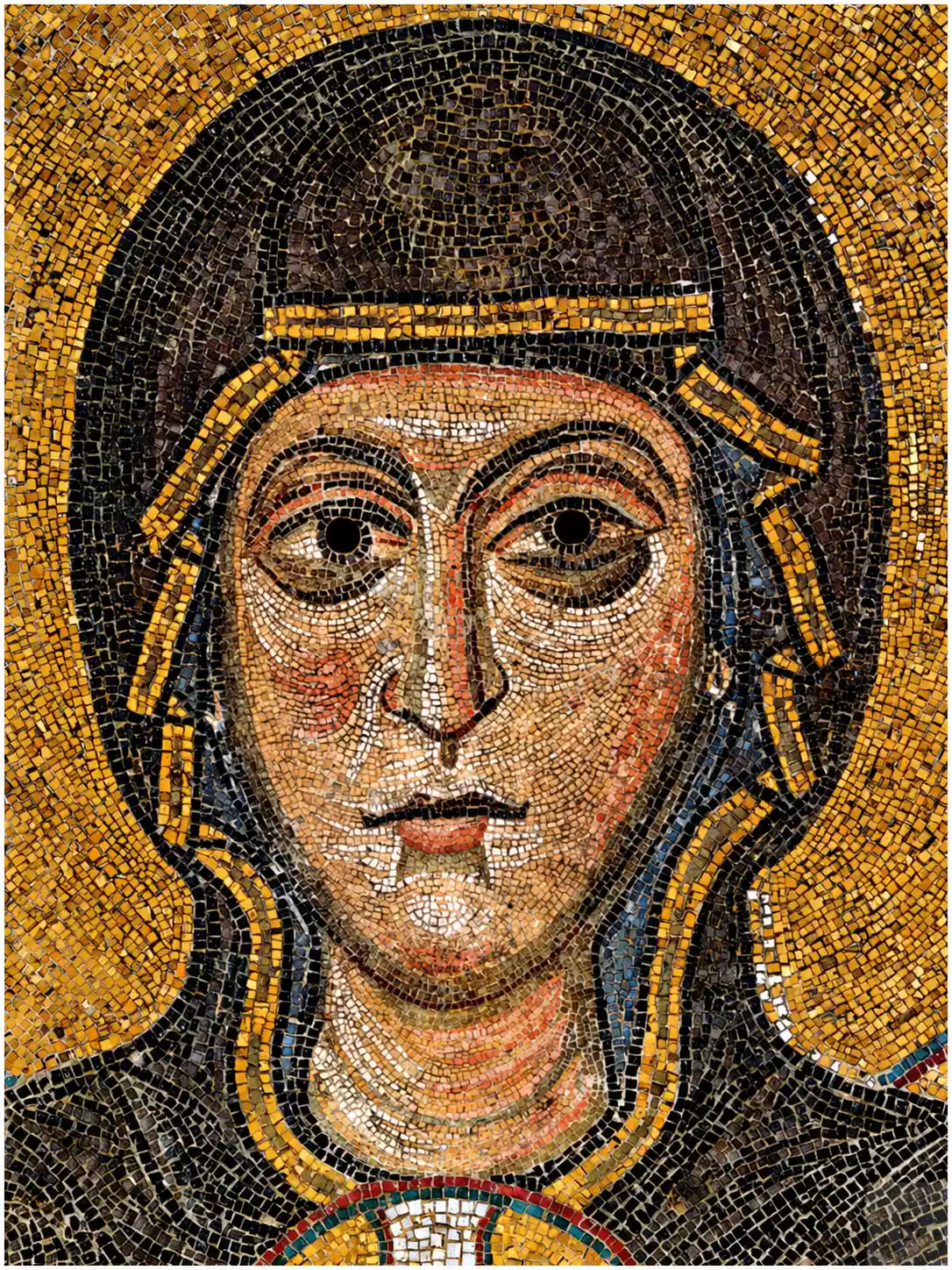 The face of the Theotokos in close-up, showing the curved rows of tesserae beneath the eyes and on the neck.
The close-up lets one follow the mosaicists’ work even in the small changes of direction around the eyelids. Beneath the eyes the rows form successive curves that carry on into the cheeks, and white tesserae gather on the forehead and around the mouth. The modelling remains strongly linear, with the areas of colour keeping clear boundaries, especially along the nose and the lower jaw. On the neck, where light and darker curves alternate, the same technique becomes clearer still.
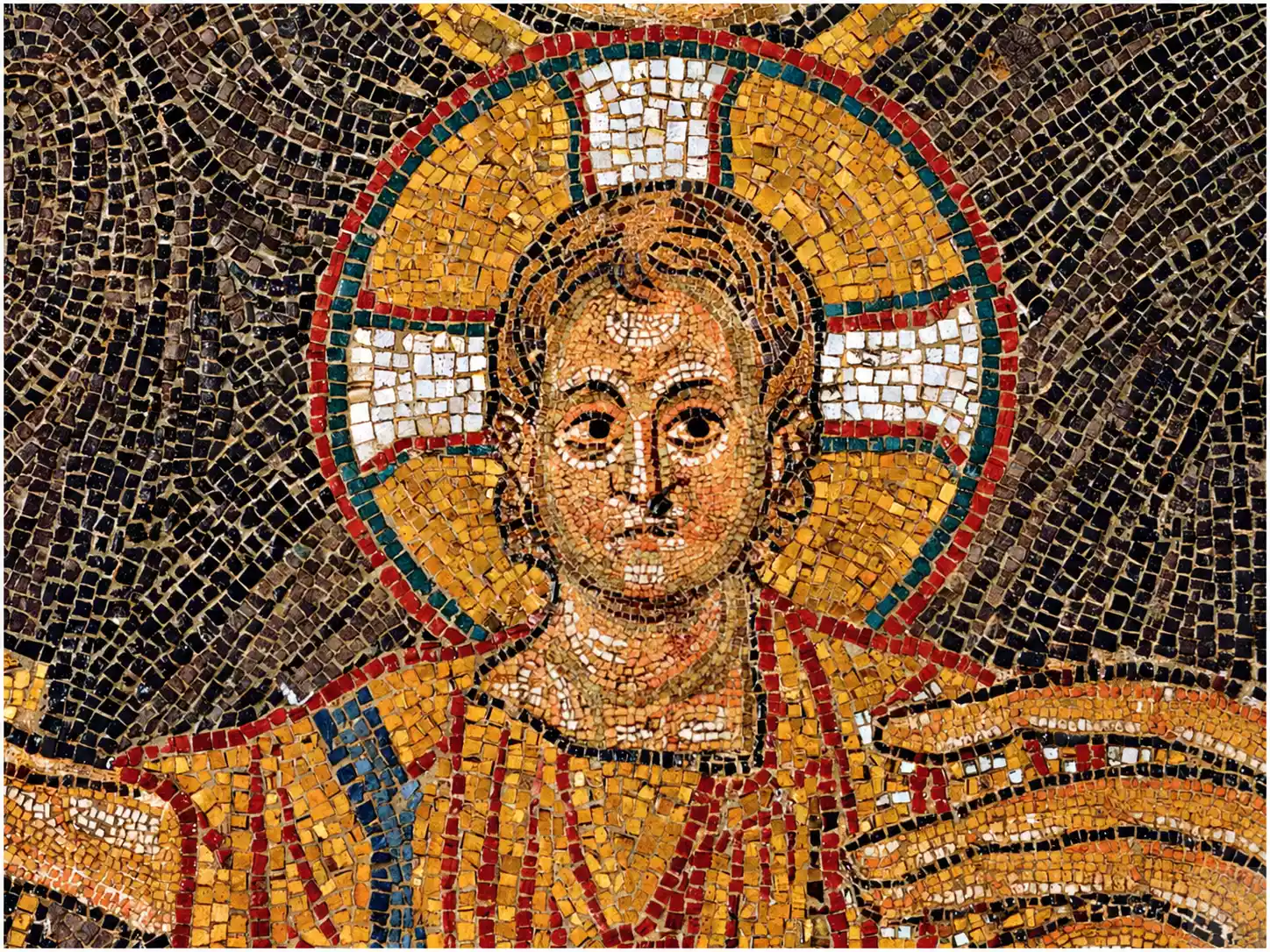 The head of Christ with the cruciform halo, a detail of the Virgin and Child.
Christ’s face is rounder, with large eyes and a small mouth, and the brown tesserae of his hair are laid in wavy rows above the forehead. A gold cruciform halo surrounds the head: the three visible arms of the cross are rendered in white tesserae, framed by rows of red and green that stand out against the dark maphorion.
The scrolling branch and the inscription
Along the base of the conch runs a band with a scrolling gold branch on a green ground, its curving stems ending in ivy leaves. Thin white fillets bound this ornamental zone, and above it follows the inscription in black letters, fitted to the curve of the apse.
The text is given with abbreviations expanded in parentheses, while square brackets mark the restoration of the lost central section:
Κ(ύρι)ε ὁ Θ(εὸ)ς τῶν π(ατέ)ρων ἡμῶν στερέωσον τὸν οἶκον τοῦτον ἕως τῆς συντελεί[ας τοῦ αἰῶνος ἀσάλευ]τον πρὸς δόξαν σὴν καὶ τοῦ μονογενοῦ(ς) σου Υ(ἱο)ῦ καὶ τοῦ Παναγίου σου Πν(εύμα)τος.
Translation
Lord, God of our fathers, make this house firm and unshaken until the end of the age, to your glory and that of your only-begotten Son and of your All-Holy Spirit.
The prayer for the strengthening of the church gives the inscription its liturgical character, and its wording recalls the prayers of the consecration rite. Halfway along its course, just where the reference to the end of the age is restored, the footstool of the enthroned figure now intervenes, and the letters reappear to its right, a little above the plant ornament.


