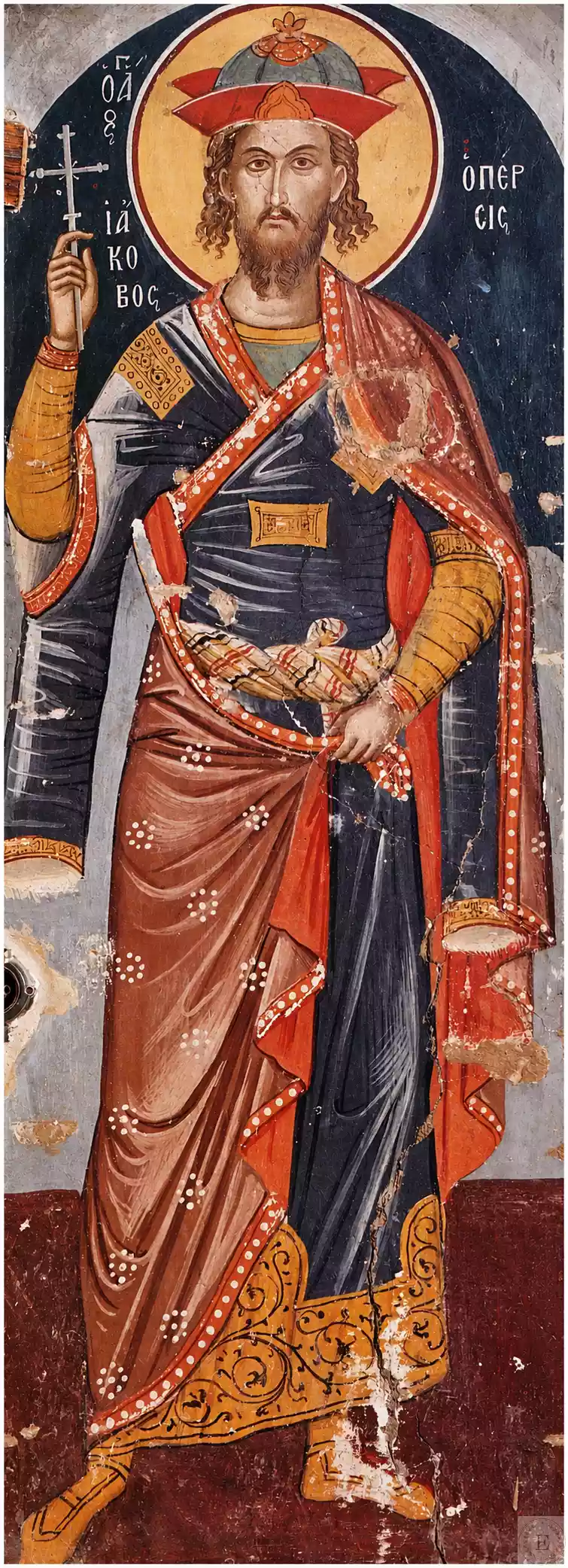
 Theophanes Strelitzas Bathas, Saint James the Persian, 1527. Katholikon of the Monastery of Saint Nicholas Anapafsas, Meteora.
Among the standing saints in the lower register of the katholikon of the Monastery of Saint Nicholas Anapafsas at Meteora, Saint James the Persian catches the eye with his unusual attire: a domed headdress with an upturned red brim, layers of sumptuous fabric and long hanging sleeves, from which the arms emerge in narrower ochre garments. The wall painting is the work of the Cretan monk Theophanes Strelitzas, also known as Bathas or Theophanes the Cretan, and belongs to the decoration of the church completed in October 1527. Beneath the arch that frames him, the saint stands frontally, holding his cross close to his face.
A cramped church and an early signature
The layout of the monastery was dictated by the narrow summit of the rock, which forced the buildings to rise in successive storeys. Among them stands the small katholikon, irregular in plan and laid out as a compressed cross-in-square, with a timber-roofed lite (narthex) to the west. Across the surfaces of this confined interior Theophanes distributes a great many scenes, reserving the lowest zone of the walls, closest to the faithful, for the full-length saints.
The donor inscription preserves his signature: «χείρ Θεοφάνη μοναχοῦ τοῦ ἐν τῇ Κρήτη Στρελίτζας» (“the hand of Theophanes the monk, Strelitzas, of Crete”). According to the entry in Pandektis, this misspelt inscription of 1527 is the earliest known mention of the painter. At the Great Lavra on Mount Athos, in 1535, the wording becomes terser, «διά χειρός κυρού Θεοφάνη μοναχού» (“by the hand of Kyr Theophanes the monk”), and the same entry reads the omission of his family name and place of origin as a sign of the reputation he had gained in the meantime. The difference allows that hypothesis, though it does not in itself reveal the circumstances in which the two inscriptions were composed.
Probably born in Heraklion during the last fifteen years of the fifteenth century, Theophanes had already taken monastic vows when he worked at Anapafsas. He died in the same city in February 1559. The Meteora cycle remains his earliest known signed and dated monumental ensemble.
In the UNESCO documentation, the frescoes of 1527 are recognised as a key point of reference for the iconographic and stylistic features of post-Byzantine painting, with an influence that spread widely and endured for a long time. Their significance therefore extends to the course of ecclesiastical painting well beyond the monastery itself.
Stance, cross and mantle beneath the arch
Against the deep blue ground, almost black, the ochre halo stands out, outlined by a red and a white band. Lower down the background turns greyish and ends in a dark red strip on which the shoes rest. With his feet slightly apart and the toes pointing in different directions, the saint keeps his torso strictly frontal, while the uneven fall of the folds lends the pose a certain freedom.
In his right hand, on the viewer’s left, he holds a slender, light-coloured cross almost vertically. His fingers close around the long shaft, which rises beside his head. The left hand comes down in front of the waist and gathers the decorated border of the mantle, bunching the cloth into small folds.
The slim figure gains its volume chiefly from the costume. In the face, the long brown hair and the beard, clearly divided into two wavy points, add a different, finer movement around the steady features. The gaze remains fixed on the viewer.
The dress of an Eastern nobleman
At the neck a greenish section of an undergarment with an ochre band can be made out. Over it spreads the dark blue robe, its folds incised with bold greyish-white lines: narrow and almost horizontal around the torso, they lengthen further down as the fabric descends towards the shoes. A rectangular ochre appliqué sits in front of the stomach, while a broader band with dark scrolling ornament appears on the saint’s right shoulder.
The sleeves deserve particular attention. The narrow ochre undersleeves cover the forearms and are marked with fine transverse lines, while the outer sleeves, far longer, hang at the sides with open cuffs and decorated ends. Their inner surface is rendered in a light tone. Around the waist is wrapped an off-white cloth with red and dark stripes, knotted in front, one end falling diagonally; its position allows it to be identified as a fabric sash.
The reddish-brown mantle covers the left shoulder and wraps around the lower part of the body, revealing here and there its bright red lining. Clusters of white dots form small floral motifs across the cloth. Rows of larger white dots, like pearl embroidery, follow the borders, crossing diagonally over the chest and continuing down to the lowest folds. At the hem of the blue robe, a broad ochre band is filled with black, twisting tendrils.
Even within this rich attire, the headdress stands apart. Its blue-grey dome, marked with dark vertical lines, carries an ochre floral finial at the top. The wide red brim turns up at the sides into pointed tips flecked with light spots, while over the forehead rises a second, upright ornament, leaf-shaped and ochre.
Through this costume James is presented as an Eastern nobleman, with the caveat that what we see is a painterly rendering of his origin and social standing within the post-Byzantine iconographic tradition. The attire cannot be taken at face value as evidence of what a fifth-century Persian courtier actually wore.
According to the synaxarion tradition, James held high office at the court of Yazdegerd I, who reigned from 399 to 420, and of his successor, Bahram V. Swayed by royal favour, he sacrificed to idols, until a letter from his mother and his wife brought him to repentance. There followed his public confession of faith and a martyrdom by successive amputations, which ended in beheading. The Church commemorates him on 27 November.
In the Anapafsas fresco, his status as a martyr is signalled by the cross. The body is shown intact and the luxurious costume remains dominant, allowing the viewer to connect his position at court with his later confession. That connection is an interpretative reading of the image.
For the painter’s Cretan background, a parallel is offered by Tsigaridas’s study, in which an icon of the Dormition of the Theotokos, originally from Kalambaka and now kept at the Varlaam Monastery, is attributed to Theophanes and dated to 1527. The attribution rests on the iconographic kinship with the Dormition at Anapafsas and on stylistic features that recall Andreas Ritzos. It concerns a different work and subject, yet it sheds light on the relationship between Theophanes’ monumental painting and the tradition of Cretan portable icons.
The face and the inscription of the name
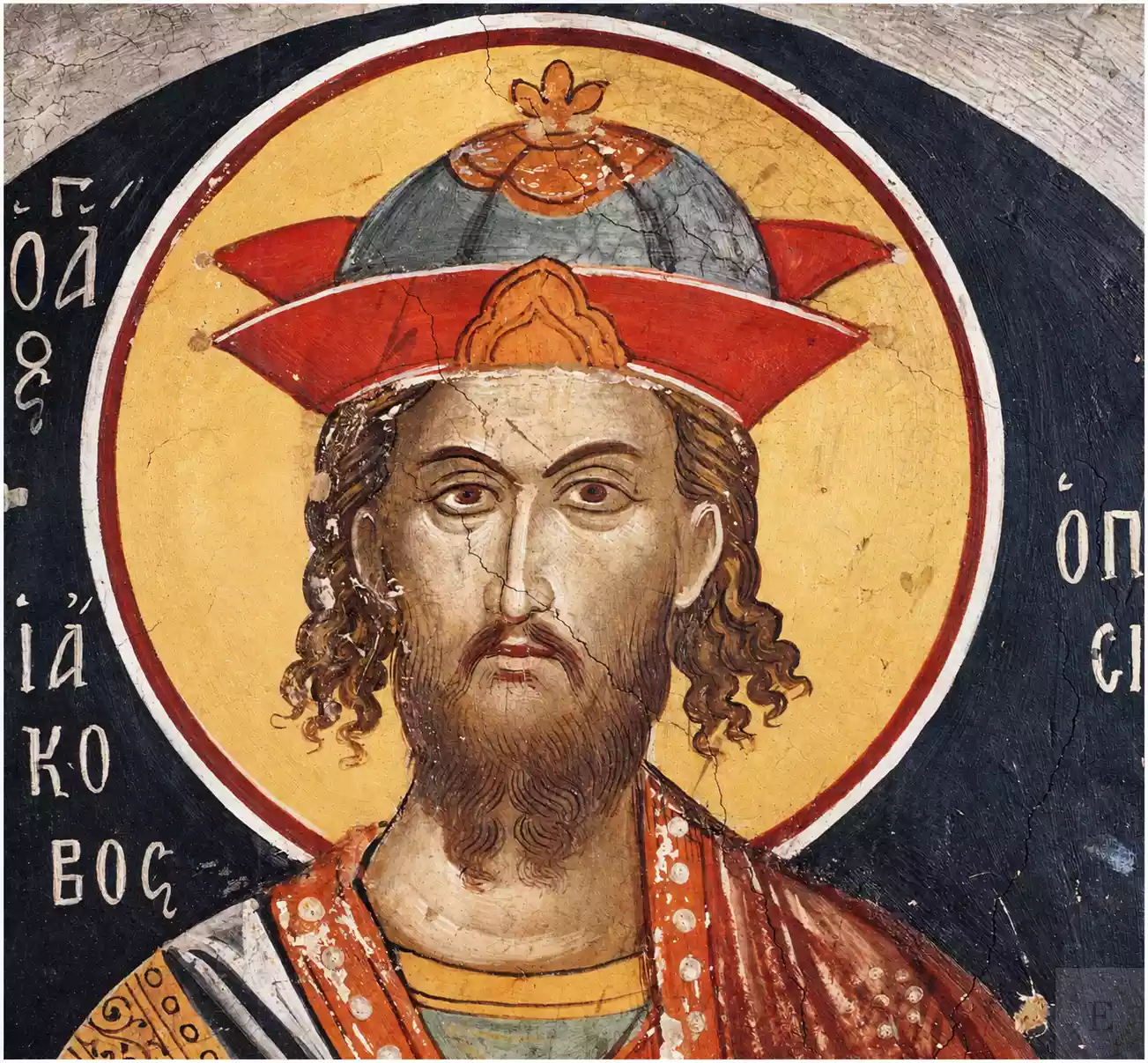 The face and ornate headdress of Saint James the Persian. Theophanes Strelitzas Bathas, 1527, Monastery of Saint Nicholas Anapafsas.
The photographic detail shows the modelling of the face more clearly. The brown proplasmos, that is, the darker base layer of the flesh, remains visible around the eyes and along the cheeks, with lighter ochre tones laid over it. Fine white strokes gather beneath the eyes and along the sides of the nose. The arched eyebrows lift towards the centre of the forehead, above large almond-shaped eyes with reddish-brown irises.
The long, narrow nose reaches almost to the thin moustache that frames the red lips. In the beard, wavy lines follow the growth of the hair and divide lower down into two distinct points. The locks falling on either side of the neck, just above the shoulders, are worked in the same manner.
On the dark ground, outside the halo, white letters declare his identity. To the viewer’s left, arranged vertically, runs «Ο ΑΓ(ΙΟΣ) ΙΑΚΩΒΟΣ». On the right one reads «Ο ΠΕΡCΙC», with lunate sigmas and an iota in place of the eta of the word «Πέρσης».
Rendering in Modern Greek
Read together, the two parts of the inscription give «Ο Άγιος Ιάκωβος ο Πέρσης», that is, “Saint James the Persian”.
Considerable damage is visible in the photographs, although the figure remains perfectly legible. A network of fine cracks spreads across the headdress and the halo, branching on into the face. Larger losses of the paint surface appear on the saint’s left shoulder and around the waist, while lower down a pronounced, almost vertical loss cuts across the robe and reaches the shoe. The photograph allows these alterations to be described; their exact extent and nature would require a conservation survey.
Still preserved, however, are the delicate gradations around the eyes, the lines of the beard and large parts of the textile ornament. Where the left hand gathers the mantle, the white dots of the border still follow the small folds between the fingers.
Sources and Bibliography
- Orthodox Church in America. Greatmartyr James the Persian. Lives of All Saints Commemorated on November 27.
- UNESCO World Heritage Centre. Meteora. World Heritage List, no. 455.
- Institute for Neohellenic Research (NHRF). Στρελίτζας-Μπαθάς Θεοφάνης [Strelitzas-Bathas, Theophanes]. Έλληνες ζωγράφοι μετά την Άλωση (1450-1830) [Greek Painters after the Fall of Constantinople (1450-1830)], Pandektis, National Documentation Centre.
- Tsigaridas, E. N. (2011). An unknown work by Theophanis the Cretan at Meteora. Δελτίον της Χριστιανικής Αρχαιολογικής Εταιρείας 22, 357-364.


