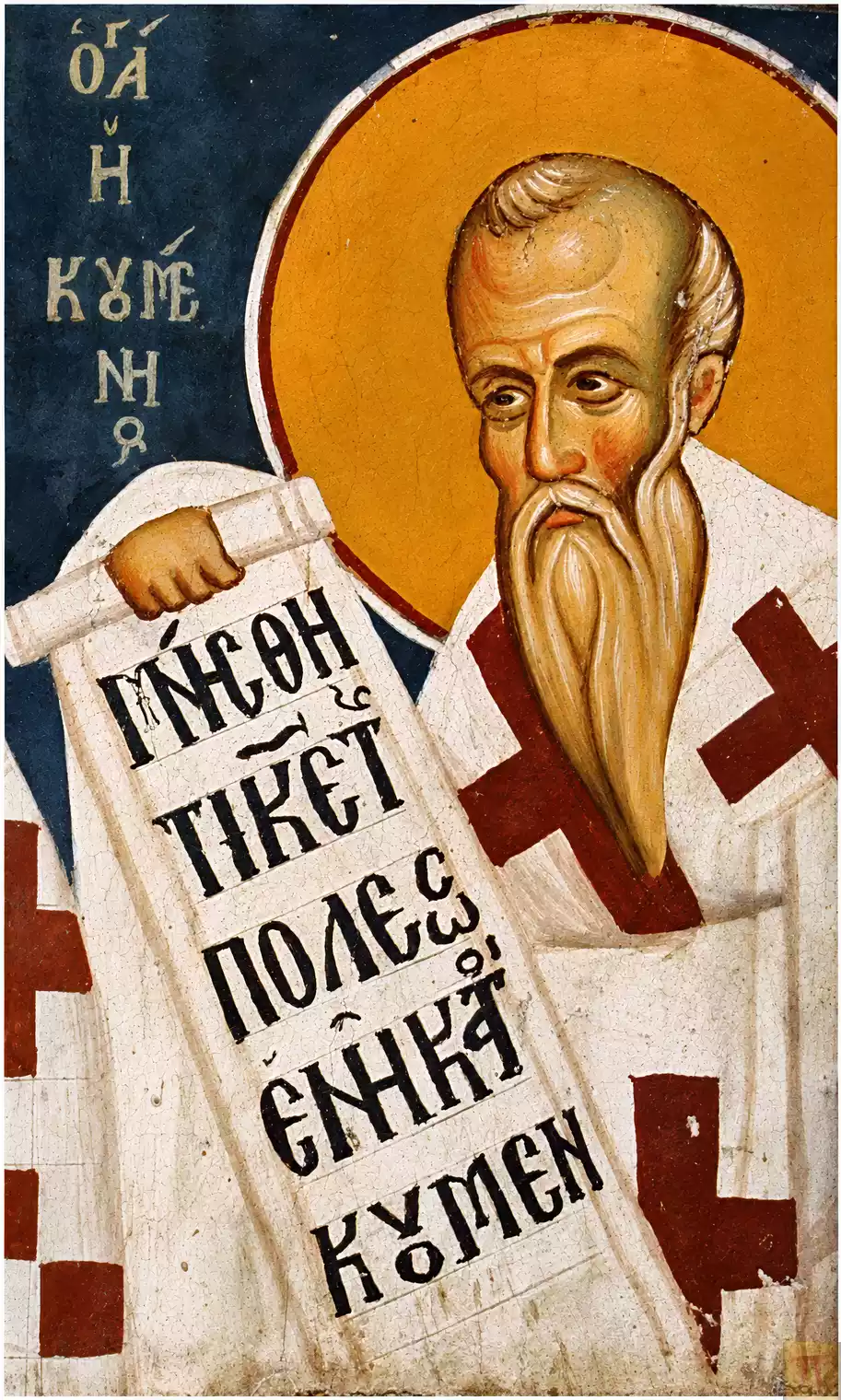
His right hand closed round the rolled upper end of a scroll that unwinds almost to the bottom edge of the picture, Saint Oecumenius, Bishop of Trikka, appears in bust, his head turned slightly towards the viewer’s left. The wall painting belongs to the decoration of the katholikon of the Hypapante Monastery at Meteora. The monastery is built into the hollow of a sheer rock face, and its founder’s inscription places both the building of the church and its painting in the year 6875 from the Creation of the World, that is, 1366/67. A bishop of a Thessalian city holds a text that speaks of a city, inside a hermitage tucked into a cavity in the rock, not far from Trikka. On that coincidence rests the reading of the image that follows.
The katholikon of the Hypapante and the dating of its decoration
The inscription survives on the west wall of the naos, above the door leading from the narthex. It names as founder “kyr Neilos”, a hieromonk, the protos of the Skete of Stagoi and hegoumenos of the Monastery of Doupiani. A second inscription, on the north wall, credits the cost of the painting to one Constantine, who later took the monastic name Kyprianos. According to the first inscription, the church was originally dedicated to the Ascension of the Lord. In its dating clause it names as reigning sovereign Symeon Uroš Palaiologos, “emperor of the Romans, Serbia and Romania”, and as Bishop of Stagoi Bessarion I. The monument thus falls squarely within the years of Serbian rule in western Thessaly. The official website of the Great Meteoron Monastery, in its section on the monastery’s metochia, describes the katholikon as a single-nave, cross-vaulted church with a spacious narthex of later date. The English version dates the paintings of the naos to 1368, while the Greek version gives 1366 and the inscription 1366/67. The narthex paintings, dated 1784, are the work of Demetrios Zoukis of Kalarrytes and his pupil Georgios, and belong to an entirely different layer.
The cramped surfaces of this small cross-vaulted church left no room for the full customary programme. The Fathers of the Church, as the description of the decoration notes, are shown mainly in the sanctuary, and in bust. The inscriptions were published by Nikos Bees in 1909; the monument was later studied more systematically by Gojko Subotić (1966). In the summer of 2003 the 7th Ephorate of Byzantine Antiquities, together with the Great Meteoron Monastery, conserved the decoration, the work being carried out by the conservators Margaritis Mitsatsikas and Stavroula Nakou. Cleaning brought to light details that earlier scholars had missed.
The figure of the bishop
The face dominates the composition. Long and narrow, it has a high, bald forehead crossed by fine white strokes, with a small tuft of hair at the top. White lines pick out the hair at the temples as well. The beard, long and pointed, falls to the chest in locks separated by alternating light and dark lines. The eyes are large and heavy-lidded and look sideways towards the viewer’s left; that glance, together with the slight tilt of the head, loosens the frontality one expects of a hierarchical figure. Behind the head the halo, in bright ochre with a dark red outline and a thin white rim, stands out sharply against the deep blue of the ground.
The vestments are those of a bishop of the period: a white polystaurion phelonion and an omophorion with large dark red crosses. At the edge of the scene, on the viewer’s left, parts of further red crosses can be made out. The saint’s left hand is not visible. His right, fingers curled round the rolled end, holds the scroll up near the shoulder, so that the white sheet falls diagonally across the chest and covers almost half the width of the composition.
The name inscription and the scroll
On the blue ground to the left of the halo, the name inscription runs in stacked lines of light-coloured capitals. The word «ἅγιος» is abbreviated. In the name itself, the letter Η stands both for the initial ΟΙ and for the Ι of the ending. In normalised spelling it reads Ὁ ἅγιος Οἰκουμένιος. The scroll carries five lines of text in a large black majuscule, separated by thin rules, the first word being split across the first two lines. With the abbreviations expanded, the text reads as follows.
Μνήσθητι, Κύριε, τῆς πόλεως ἐν ᾗ κατοικοῦμεν.
English translation
“Remember, O Lord, the city in which we dwell.”
The choice of this text for a hierarch whom local tradition honoured as the protector of Trikka seems a reasonable one, even though the city is not named on the scroll. The wording recalls the intercession in the anaphora of the Divine Liturgy of Saint John Chrysostom, where the form «παροικοῦμεν» occurs. The painter placed in the bishop’s hand a prayer for the city, and that prayer was read in a small monastery close to his see.
Painterly handling and artistic milieu
The modelling of the face begins from a dark, greenish proplasmos, the first dark layer on which the lighter tones are built up, and proceeds with warm ochres. Reddish patches spread over the cheekbones below the eyes, while the highlights fall in fine, almost parallel white lines on the forehead, the bridge of the nose and the beard. The outline of the skull, the curves of the eyebrows and the furrows of the beard are drawn with a sure, almost calligraphic line. Volume is still suggested; what organises the figure, though, is above all the line, and not a continuous gradation of light and shade.
The painter of the Hypapante remains anonymous. Konstantinos Vapheiades, in his study of Byzantine painting at Meteora, links his idiom to fragments of wall paintings in the Great Meteoron Monastery and considers it plausible that the same artist worked there shortly before 1366. He also points to a close kinship with the paintings of the Panagia Olympiotissa at Elassona (1332–1355) and of the katholikon of the Archangel Michael at Lesnovo, and places the whole group within an artistic current that spread through the southern Balkans during the period of Serbian rule. The figure of Oecumenius, strongly linear and bright in its clear colours, fits that description without difficulty, though a single bust is hardly enough to judge an entire workshop.
Who was Oecumenius of Trikka?
The person depicted here has occupied scholars as much as the monument has. Christos Krikonis, in his study Ο Οικουμένιος Τρίκκης, records that research has distinguished three men of the same name from widely separated periods: the first is placed in the first half of the fourth century, the second in the first half of the sixth, and the third in the mid-tenth. A commentary on the Apocalypse is attributed to the sixth-century Oecumenius, while commentaries on Acts and the Epistles have been associated with the tenth-century one. Krikonis argues that the saint and protector of Trikka honoured by local tradition is the fourth-century figure. The principal source for that tradition is the Encomium and the Office composed by Antonios, Metropolitan of Larissa, who, according to Krikonis, lived in Trikka between 1340 and 1362 and is to be identified with the later Patriarch Antonios.
According to the Encomium, Oecumenius came from Cappadocia, was a nephew of Saint Achillius of Larissa, and accompanied him to the First Ecumenical Council in 325. Achillius later ordained him Bishop of Trikka. The same text mentions a hermitage of the saint near the city, the “Katafygion”, which Krikonis places, probably, some eight kilometres to the north. What we have here is a fourteenth-century hagiographical narrative, and a witness to the saint’s cult in Antonios’ day. Krikonis adds one further piece of evidence. Patriarch Philotheos Kokkinos instructed the priest, at the Proskomide, to set aside a portion for Oecumenius too, together with hierarchs such as Achillius; the commemoration ran «Ἀχιλλίου Λαρίσης, Οἰκουμενίου Τρίκκης καὶ πάντων τῶν ἁγίων ἱεραρχῶν» (of Achillius of Larissa, Oecumenius of Trikka and all the holy hierarchs).
These two testimonies, Antonios’ Encomium and Philotheos’ reference, belong to roughly the same decades as the painting of the Hypapante. The presence of Oecumenius in Neilos’ katholikon therefore falls within a period in which veneration of the local saint is attested both in the Metropolis of Larissa and at the Patriarchate. In the list of wall paintings of Oecumenius published by Krikonis, the Hypapante Monastery is mentioned explicitly, alongside churches in Trikala, an old church at Kalambaka and the monasteries of the Saviour and of Rousanou. Part of his relics, which according to the Encomium had been carried off at the end of the tenth century by Tsar Samuel towards the region of Herakleia in Pelagonia, later returned to Trikka. Krikonis reports that it was found in the sacristy of the church of the Panagia Faneromeni, in a silver reliquary dated to 1801 by the inscription inside its lid.
Sources and bibliography
Holy Monastery of Great Meteoron. (n.d.). Metochia – Dependencies, section “Monastery of the Hypapante”. Holy Meteora.
Krikonis, C. Th. (n.d.). Ο Οικουμένιος Τρίκκης. Υπήρξε επίσκοπος, άγιος και πολιούχος της Τρίκκης; [Oecumenius of Trikka: Was he a bishop, a saint and the protector of Trikka?] (pp. 309–331). Pandemos Repository, Panteion University.
Vapheiades, K. M. (2023). Byzantine Wall Paintings and Icons at Meteora. Actual Problems of Theory and History of Art, 13, 291–298.
Cite this article
How to cite this article
Pafilis, T. M. “Saint Oecumenius of Trikka: the wall painting in the Hypapante Monastery at Meteora.” Greek Encyclopedia, November 15, 2026. https://www.elpedia.gr/en/saint-oecumenius-trikka-wall-painting-hypapante-meteora/.
Pafilis, T. M. (2026, November 15). Saint Oecumenius of Trikka: the wall painting in the Hypapante Monastery at Meteora. Greek Encyclopedia. https://www.elpedia.gr/en/saint-oecumenius-trikka-wall-painting-hypapante-meteora/
Pafilis, T. M. “Saint Oecumenius of Trikka: the wall painting in the Hypapante Monastery at Meteora.” Greek Encyclopedia, November 15, 2026, https://www.elpedia.gr/en/saint-oecumenius-trikka-wall-painting-hypapante-meteora/. Accessed .
Pafilis, T. M. (2026) “Saint Oecumenius of Trikka: the wall painting in the Hypapante Monastery at Meteora”, Greek Encyclopedia, November 15. Available at: https://www.elpedia.gr/en/saint-oecumenius-trikka-wall-painting-hypapante-meteora/ (Accessed: ).