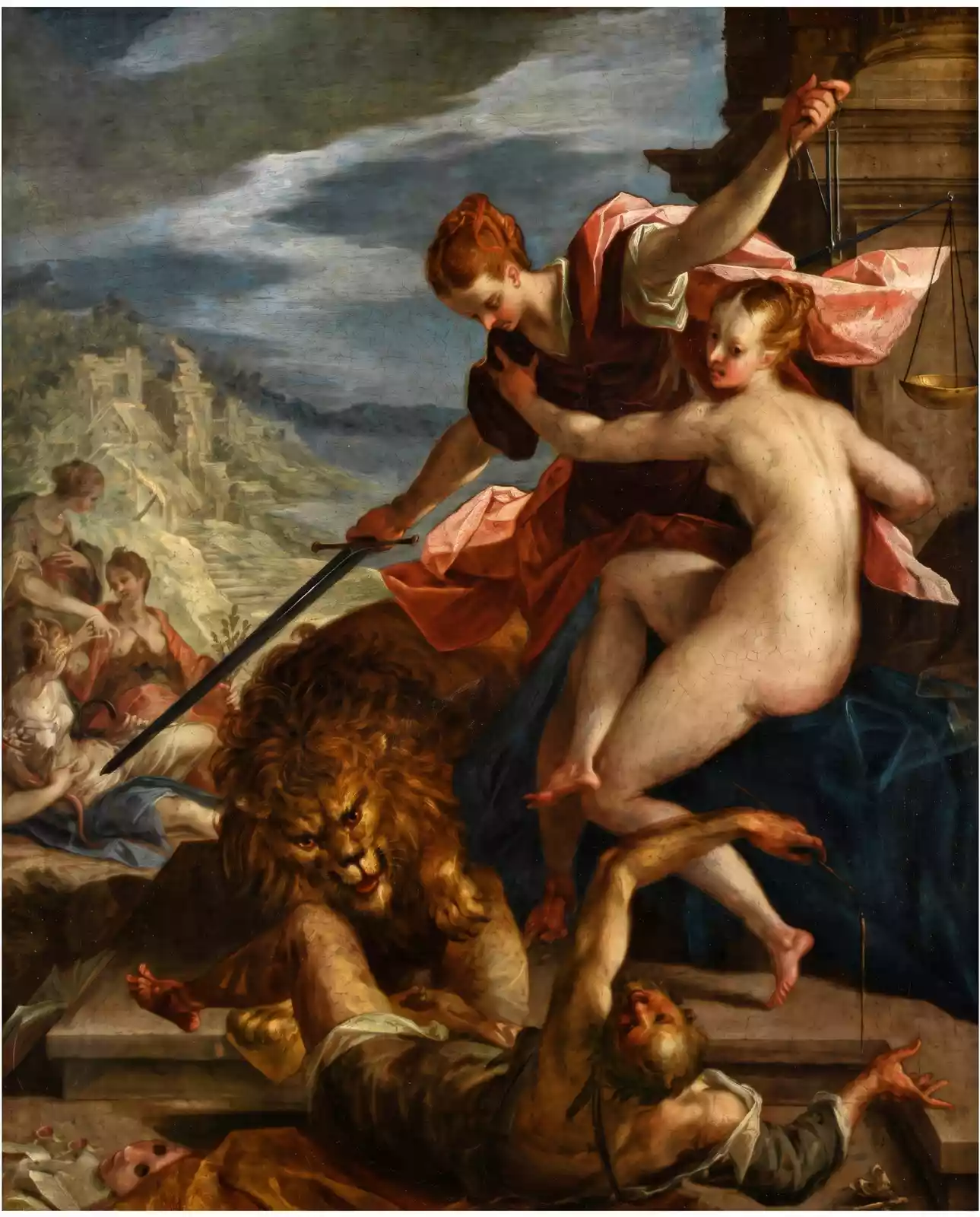
 Hans von Aachen, Allegory of the Triumph of Justice, 1598. Oil on copper, 56 × 47 cm. Alte Pinakothek, Munich, inv. no. 1611.
With her sword turned towards the fallen figures and her scales raised beside the column, Justice dominates Hans von Aachen’s Allegory, a work of 1598 now in the Alte Pinakothek, Munich. Painted in oil on copper and measuring 56 × 47 cm, the composition is recorded in the museum’s catalogue as the Allegory of the Triumph of Justice, under inventory number 1611. Truth, seated naked beside her, reaches out towards her protectress, while lower down, among the bodies of the vanquished, a lion looms into view.
The Allegory of Justice and the movement of the figures
The main mass of the scene is gathered in the right-hand part of the picture, where the two female figures are bound together by counterpoised movements: Justice bends downwards, her gaze following the line of the sword, while Truth, turning her torso, stretches out a hand towards Justice’s breast. This contact holds the figures visually together, despite the reach of the raised arm and the broad sweep of drapery towards the edge of the picture.
Lower down, the tilt of the bodies carries on the oblique thrust of the sword. A man has been thrown back on the steps in the foreground, his head turned upwards and his arms flung open, while a mask can be seen at the lower left edge. The overlapping forms make the contours hard to read at first glance, as the red cloth falls behind the lion.
Truth is shown largely from behind. Against her lit torso, which turns without losing the continuity of its outline, is set the deep shadow of the pale blue drapery. Her face, smaller and partly turned towards the viewer, lies close to the head of Justice, yet the eye keeps returning to the expanse of her back and to the bent legs, where the body approaches the edge of the seat.
On the left the landscape opens out, with small female figures before ruined buildings and the horizon receding beneath broad banks of cloud. Distance is conveyed by the fading of colour and the simplification of forms, whereas in the foreground the lion’s mane keeps a dense, almost solid presence.
Truth and the tempering of severity
Personification, that is, the rendering of an abstract idea in human form, allows the painter to unfold a scene of political and moral content through the relations between bodies. Scales and sword identify Justice, whose action is linked, according to the museum’s interpretation, with the triumph of good government over deceit and vice.
Bubryák’s study also records a reading of the nude Truth as a figure who soothes Justice, bringing clemency into the exercise of power. The lion has been interpreted as the strength of the ruler and as a possible heraldic allusion to the Wittelsbachs. In the background the author identifies Abundance and Peace, together with Concord.
Read in this way, the gesture between the two protagonists gains particular weight. The painter places their contact near the centre of the upper group, between the vertical rise of the scales and the abrupt descent of the blade. Tension remains in the lower zone, where the bodies are pressed together, while above, the movement is briefly arrested in the palm of Truth.
The court of Rudolf II and the possible commission
Born in Cologne, Hans von Aachen had worked in Italy and Bavaria before settling in Prague, where, according to the National Gallery, from 1596 he served Rudolf II as painter and as adviser on the acquisition of works of art. This career brought him into direct contact with the artistic production and the collecting ambitions of several courts of the European Renaissance.
In the Allegory, the elongation of the bodies and their complex twists give concrete substance to the description of the painting as Mannerist. Truth turns towards Justice while her legs point in another direction, and the draperies open into folds that amplify the gestures. In the red garment, especially around the raised arm, light rose-pink surfaces lie next to deep shadows, lending the folds a sharper edge.
The Alte Pinakothek regards the work as a probable gift from Rudolf II to the young Duke Maximilian I of Bavaria. The hypothesis is tied to its reading as a ‘mirror for princes’, a painted statement of the virtues a ruler is bound to practise. Bubryák, however, points out that no written source proves the gift and that the painting’s presence in Munich cannot be documented during Maximilian’s lifetime. It is securely recorded in an inventory of 1748, where it is described as a representation of Peace and Justice.
Sources and Bibliography
- Bayerische Staatsgemäldesammlungen. Allegorie des Sieges der Gerechtigkeit. Alte Pinakothek, online catalogue, inv. no. 1611.
- Bubryák, Orsolya (2022). ‘Hans von Aachens Werke in Augsburger Sammlungen’. Studia Rudolphina, 21–22, esp. pp. 37–42.
- National Gallery. Hans von Aachen. Online biographical note.


