















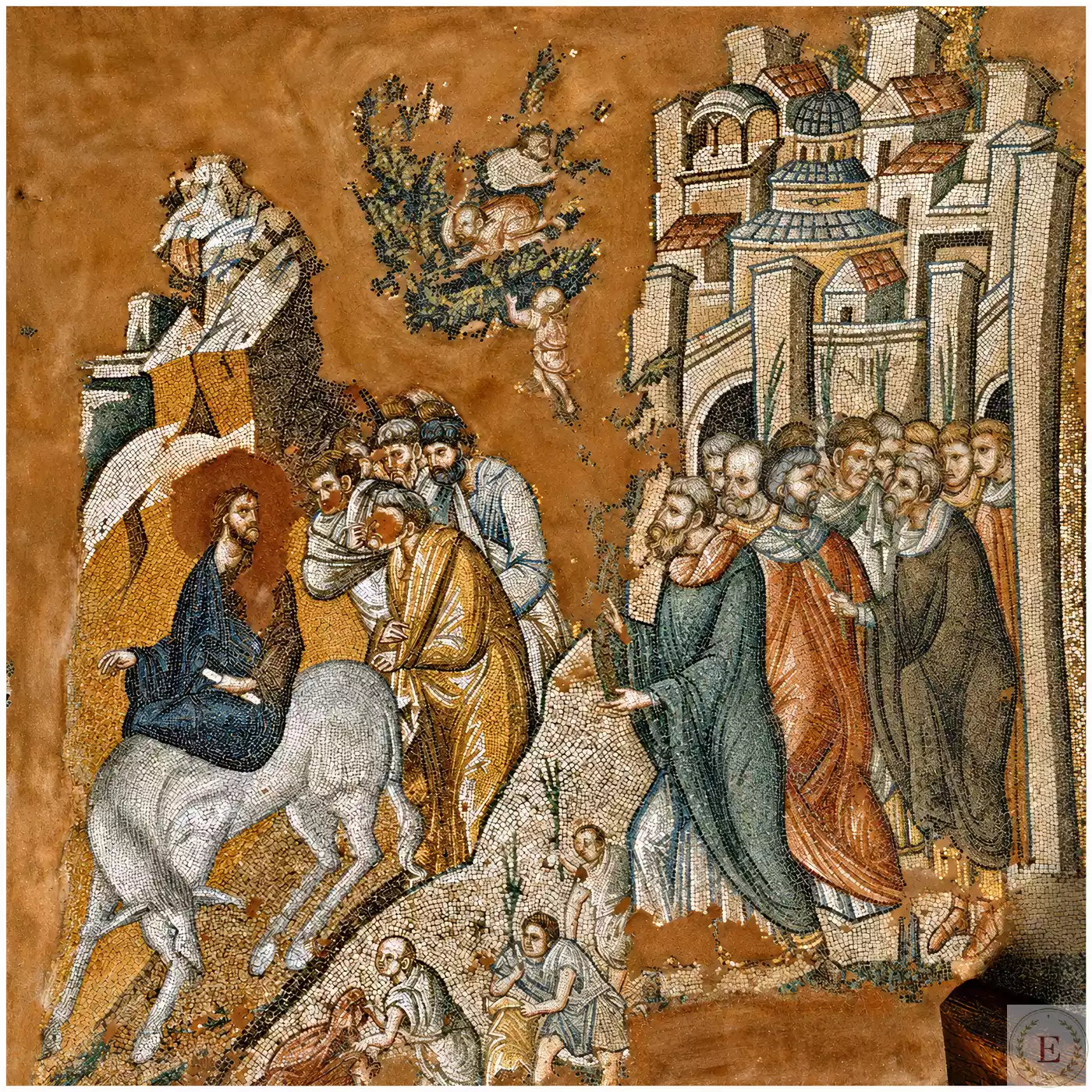
The northern half of the west barrel vault in the Church of the Holy Apostles in Thessaloniki preserves the Vaiophoros, that is, the mosaic of Christ’s Entry into Jerusalem. Facing it, in the southern half, is the Transfiguration. The scene belongs to the decoration attributed to Niphon I, Patriarch of Constantinople, and is traditionally dated to the years of his patriarchate (1310–1314). Dendrochronological analysis of the church’s timbers has, however, also produced a later proposal for its construction, around 1329 or shortly afterwards. Together with the other scenes of the Twelve Great Feasts, the Entry was meant for the upper zone of the naos, above the stone cornice that runs at the level of the column imposts. The University of Sussex’s Mosaic database records these scenes in the vaults of the arms of the cross, on the arches and on the west wall.
Almost the whole of the gold ground has been removed, and in its place there now spreads an ochre-brown surface, much of it covered with plaster from more recent conservation. On it the figures, the rocks and the buildings keep their tesserae like islands, with ragged edges wherever decay has eaten into them. Christ’s halo, too, stripped of its gold, shows only as a darker disc around his head.
Two episodes in a mountain landscape
In laying out the subject the mosaicist followed older Byzantine models, which lived on in Palaiologan representations as well. He kept the two groups that Byzantine iconography had established for the scene. The first is Jesus with his followers, making his way towards the city; the second, the crowd coming out to meet him. The scheme itself, though, he reworked with an invention of his own. A slanting rise of ground with a dark outline climbs from the animal’s feet to the centre of the panel and cuts the landscape into two parts, so that the two groups stand on different levels of one and the same mountainous terrain.
High on the left rises the Mount of Olives, a rocky summit with white highlights along its ridges. At its edge, lower down, a building with a flat cornice may stand for Bethphage, which Matthew the Evangelist (21:1) and Mark the Evangelist (11:1) mention just before the entry. On the right, across almost the full height of the composition, stretches Jerusalem. It is made up of walls with towers and arched openings, red-tiled roofs, vaulted masses stacked one above another, and buildings that show their front and their side at the same time. At the centre of the city a circular building with a drum and a ribbed dome dominates. The pale tesserae of the architecture, white, grey and in shades of ochre, carry light into the upper right of the composition.
Christ and his followers
Christ sits sideways on the animal. His body turns towards the viewer and his gaze to the right, towards the city. He wears a dark blue himation that falls in heavy folds over his knees. In his left hand he holds a closed scroll resting on his thighs. The right, which is on the viewer’s left, reaches out to the side with the fingers bent downwards. The animal, a pale grey that comes close to white, turns onto the descending road towards the lower left, its head lowered between its forelegs. Its modelling shows particular care: the rows of tesserae follow the curves of the muscles in the legs and hindquarters, and the light on its coat is rendered with white lines that break across the grey.
Above the animal and beside Christ a group of men crowds together. They correspond to the disciples. According to Matthew (21:6–7), two of them brought the ass and her colt and laid their garments on them. At the front stands Peter, wrapped tightly in an ochre himation with golden highlights, his head bowed and his hands drawn together in front of him. Beside him a younger figure in a light-coloured garment raises a hand towards his face. Behind them bearded men come into view, one in a pale himation shaded with blue folds. The heads overlap, so that of some of the faces at the back only the upper part can be made out.
The crowd at the city gate
The crowd of Hebrews comes out of the arched gate on the right. Leading the way is an elderly man with a grey beard, wrapped in a green-blue himation, his body leaning forward. He stretches one hand towards Christ, palm turned upwards. Behind him stands a man in a reddish himation, and next to him another, in a dark brown garment, holds a slender green branch. Further back the heads multiply, beardless youthful faces among bearded ones, until the group is lost in the opening of the gate. Above their heads thin green stems can be seen. These branches, the vaia, gave the feast its name. John (12:13) writes that they “took branches of palm trees, and went forth to meet him”.
Children on the road and in the tree
Between the two groups, above the heads of the disciples, rises a tree with dark foliage. The foliage survives in places as dense clusters with gaps between them. Two children can be made out in its branches, one higher up, the other bent almost horizontally along a bough. A third, lower down, stretches a hand towards the leaves. Down below, the road runs diagonally towards the lower left corner, a pale strip of close-set grey and white tesserae. On it two children stoop to spread cloths, one ochre-yellow and one reddish. A little higher a third child appears beside the thin green branches. Matthew writes that “a very great multitude spread their garments in the way; others cut down branches from the trees” (21:8). In the mosaic it is the children who perform these acts. A little later in his narrative the Evangelist mentions children crying out in the temple, “Hosanna to the Son of David” (21:15).
It is this lower part of the scene that natural light from the dome windows reaches once winter has passed. In his study of the lighting of the church, Ioannis Iliadis describes the phenomenon. At about nine in the morning the beams fall first on the western inner face of the dome drum and then on the north-western pendentive. A few minutes later they move to the northern half of the west vault and travel across the lower part of the Entry into Jerusalem. In summer, at about 6.50 in the morning, the beams light the Evangelist Mark first. As the sun climbs, the light shifts to the southern half of the vault and falls on the three disciples at the bottom of the Transfiguration.
The lost gold and the mosaicists
The mosaic decoration seems to have been left unfinished, and the halt in the work has been linked to Niphon’s removal from the patriarchal throne. The conch of the apse seems to have remained undecorated, while the sanctuary preserves wall paintings attributed to the hegumen Paul, the church’s second founder. When the building was turned into a mosque, between 1520 and 1530, the images were covered with plaster; by then the gold ground had already been almost entirely removed. Maria Yakovleva notes the view that the gold was most probably taken away by Christians, since the figural scenes were carefully spared. The mosaics were conserved in 1952 by Fotis Zachariou, and further work followed in 2002–2004. The church is one of the Paleochristian and Byzantine Monuments of Thessaloniki, inscribed on UNESCO’s World Heritage List in 1988. The listing counts it among the monuments of the Palaiologan Renaissance and mentions the consolidation of its mosaics.
Opinions differ on where the craftsmen came from. As Maria Yakovleva sums up, Andreas Xyngopoulos assigned the mosaics to a local Thessalonian workshop. Paul Underwood argued that they were the work of craftsmen from Constantinople, and his view later prevailed. Some scholars went further and held that the same workshop from the capital also worked at the Chora Monastery. Yakovleva herself proposes a more cautious position. She rests it on the expressive plasticity of the figures, the archaising character of the decoration and, above all, the cool, soft, silver-grey colouring, which sets it apart from the darker and denser colours of the Chora. Her conclusion is that some of the craftsmen may have been local. In the Entry into Jerusalem grey returns in many gradations, in the animal, in the himatia of Christ’s followers, in the road and in the stones of the city. Beside the towers of Jerusalem, at the upper right edge, a few gold tesserae from the once golden ground can still be seen.
Sources and Bibliography
- Iliadis, I. (2009). The Church of the Holy Apostles in Thessalonike: A study of the natural light. Jahrbuch der Österreichischen Byzantinistik, 59, 95–105.
- UNESCO World Heritage Centre. Paleochristian and Byzantine Monuments of Thessalonika (no. 456).
- University of Sussex, Sussex Centre for Byzantine Cultural History. Holy Apostles (Thessaloniki). Mosaic database.
- Yakovleva, M. (2016). Мозаики церкви свв. Апостолов в Фессалонике: проблемы иконографии, стиля и происхождения мастеров. Вестник РГГУ. Серия «Философия. Социология. Искусствоведение», 1, 127–139.
Cite this article
How to cite this article
Pafilis, T. M. “The Entry into Jerusalem at the Holy Apostles, Thessaloniki.” Greek Encyclopaedia, November 21, 2026. https://www.elpedia.gr/en/entry-into-jerusalem-holy-apostles-thessaloniki/.
Pafilis, T. M. (2026, November 21). The Entry into Jerusalem at the Holy Apostles, Thessaloniki. Greek Encyclopaedia. https://www.elpedia.gr/en/entry-into-jerusalem-holy-apostles-thessaloniki/
Pafilis, T. M. “The Entry into Jerusalem at the Holy Apostles, Thessaloniki.” Greek Encyclopaedia, November 21, 2026, https://www.elpedia.gr/en/entry-into-jerusalem-holy-apostles-thessaloniki/. Accessed .
Pafilis, T. M. (2026) “The Entry into Jerusalem at the Holy Apostles, Thessaloniki”, Greek Encyclopaedia, November 21. Available at: https://www.elpedia.gr/en/entry-into-jerusalem-holy-apostles-thessaloniki/ (Accessed: ).