


















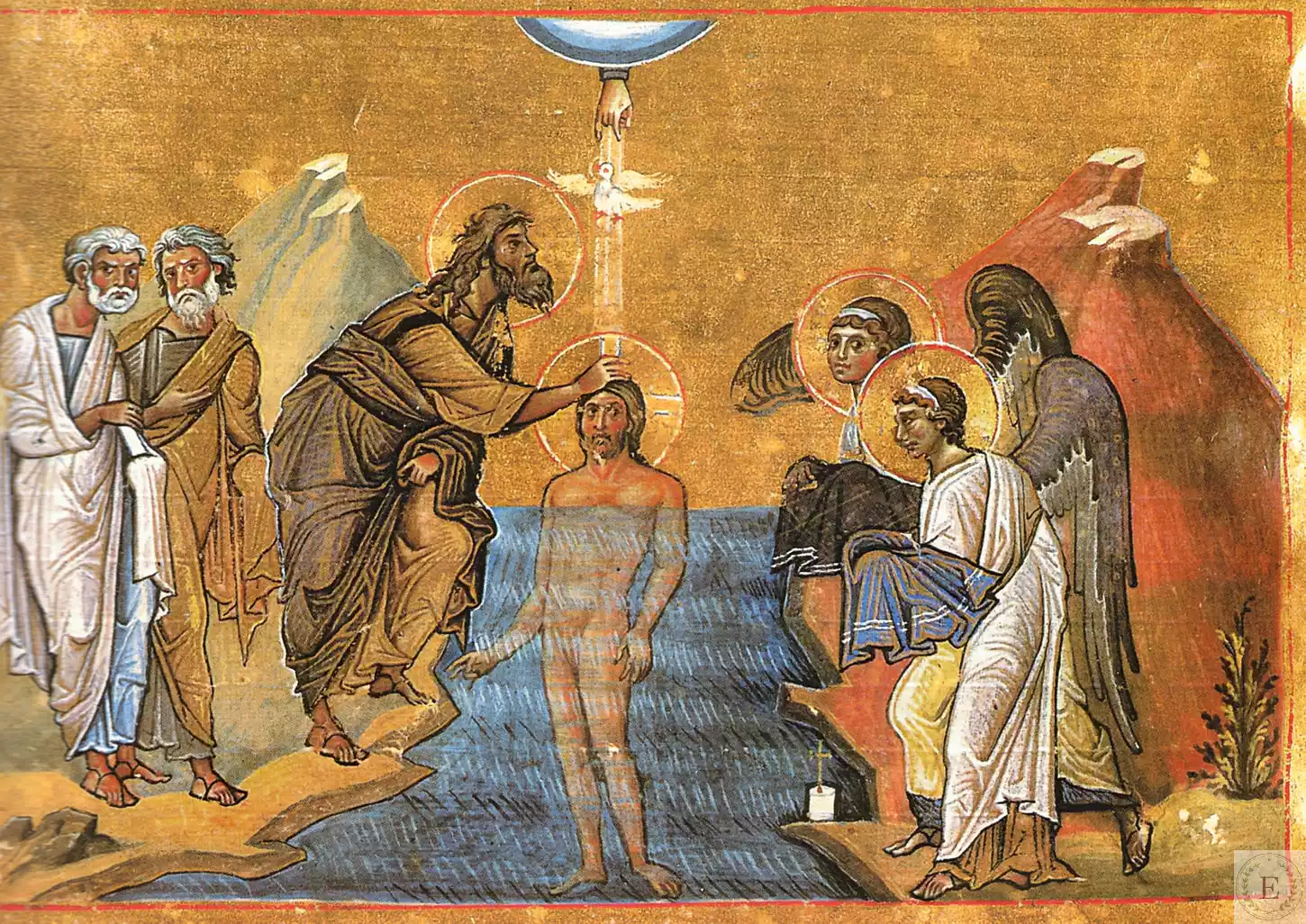
On page 299 of the Vatican Library’s Vat. gr. 1613 is painted the Baptism of Christ in the Jordan, the event the Church celebrates at Theophany on 6 January. The miniature occupies the lower half of the page, beneath a short text recounting the day’s commemoration. The manuscript is known as the Menologion of Basil II: an illustrated synaxarion covering the first half of the ecclesiastical year, from September to February, with 430 miniatures, and its verse prologue connects it with the Emperor Basil II (976–1025). Each of its eight painters is credited with a particular group of miniatures. Ann Powell, in her 1963 doctoral thesis at the University of Edinburgh, attributes the Baptism to the painter George; Anna Zacharova later proposed assigning it to Symeon.
Christ in the stream, and the heavens opening
At the centre of the composition stands Christ, upright, frontal and naked, in the Jordan, the water reaching to his chest. The river, a deep blue, is worked over with dense, short white strokes that convey its movement. Yet it does not hide the body. The colour of the water lies like a transparent layer over torso and legs, so that the feet and hands remain visible beneath the surface. His hair is long, his beard short; the arms of the cross can be made out in his halo. His right arm, on the viewer’s left, slants downwards, fingers spread towards the water, while the left hangs close to the body, slightly bent at the elbow.
Above, a segment of a circle in graded blues rests against the upper red line of the miniature’s frame. From it emerges a hand with a dark cuff at the wrist, its fingers pointing down. From the fingers a pale band of light descends vertically as far as Christ’s halo, enclosing, a little below the hand, a white dove with outspread wings and a small halo of its own. The entry for this page in Princeton University’s Index of Medieval Art describes the same arrangement: the Holy Spirit descends in rays from the Hand of God, which emerges from an arc of heaven. On this vertical axis, at the level of the halo, the beam of light meets the hand of the Forerunner.
The Forerunner and the witnesses on the left bank
John the Forerunner stands on the left bank, on a ledge of rock. One leg is bent and set higher than the other, and he leans forward with his whole body to lay his right hand on Christ’s head. We see him almost in profile – long, tousled hair, a thick beard, a halo. He wears sandals and a brown himation in dark tones, its many deeply shadowed folds following the bend of the knee, and with his other hand he gathers part of the garment at thigh height. The figure holds together two things at once: the impetus of a step towards the water and the caution of a movement made on a narrow foothold.
Further back, at the edge of the composition, stand two elderly men with white hair and beards, both in sandals. The first wears a white himation over a light blue chiton and holds a fold of the himation in front of him; the second is wrapped in an ochre himation. Their faces are grave – the first’s almost stern – and both are watching the scene. The Index of Medieval Art calls them disciples, whereas Powell speaks of two apostles. Zacharova identifies them as Peter and Andrew.
The angels and the garments
On the opposite bank, which rises steeply towards a reddish mountain, stand two haloed angels with white fillets in their hair. The one in front, in a white himation, inclines his head slightly towards Christ and holds a folded, striped blue garment that covers his hands. The second, higher up and further back, turns his face to the viewer and holds a dark cloth with white bands, which hangs down over the rock. Behind them spread wings in greyish-brown tones: one opens high up, against the reddish mountain, another reaches down almost to the ground. The Index of Medieval Art records the same disposition – the Forerunner and the two men on the left, the two angels with the garments on the right. Powell points out that this scheme, with the angels on one bank and the apostles on the other, already appears on a painted reliquary lid of the sixth century from the Lateran, as well as in the mosaics of Daphni.
The cross in the Jordan, and the landscape
Low down on the right, where the water meets the stone ledge beneath the angels’ feet, rises a small white column topped by a cross. The Index of Medieval Art records it as a column surmounted by a cross standing in the Jordan. It notes a similar column in another Baptism, in Vat. gr. 1156 (fol. 290v), where, however, the Forerunner stands on the right bank and the garments are held by three wingless angels on the left.
Powell links the motif to sixth-century pilgrims’ descriptions of the site of the Baptism. Theodosius (c. 530) mentions an iron cross on a marble column; the anonymous Piacenza Pilgrim (c. 570) speaks of a wooden cross set up in the water. She dates the earliest examples of the cross in depictions of the Baptism to the tenth century and observes that the motif becomes common in the eleventh, as at Hosios Loukas. At Daphni the Jordan is personified by a river god. On her reading, in the Menologion miniature a topographical detail has taken the place of that classical motif.
The landscape is spare. Two rocky peaks rise above the banks, sharply outlined against the gold ground: the left one, grey-blue, stays behind the two men, while the right, larger and reddish, enfolds the angels. A small shrub grows in the lower right-hand corner, and a thin red line marks the inner frame of the miniature. Between the banks the river forms a broad expanse of blue that runs from Christ’s chest down to the lower edge of the image.
Page 299 and its text
On the pages of the synaxarion the miniature takes up roughly half the height and the text the other half. D’Aiuto’s study describes the ruling of the pages in 32 lines, 16 for the text and 16 for the image. It also identifies a single scribal hand, writing in one column in an elegant and highly regular minuscule. This script is usually classed as “Perlschrift”, the rounded “pearl” script – a term about which D’Aiuto has reservations. On page 299 the text comes first and the picture follows. The heading is written in Alexandrian majuscule, and the first sentence opens with a large decorated initial B projecting into the left margin. The whole page can be studied in the Vatican Library’s digitised copy.
The heading reads «Μηνὶ τῷ αὐτῷ ϛ΄. Ἡ βάπτισις τοῦ Κ(υρίο)υ ἡμῶν Ἰ(ησο)ῦ Χ(ριστο)ῦ». The text begins «Βουλόμενος ὁ Κ(ύριο)ς ἡμῶν καὶ Θ(εὸ)ς πληρῶσαι πᾶσαν δικαιοσύνην…». The phrase echoes Christ’s words to John in the Gospel of Matthew (3:15).
Translation
The translation covers only the heading and the opening of the first sentence, as transcribed above. “On the sixth of the same month. The Baptism of our Lord Jesus Christ.” “Our Lord and God, wishing to fulfil all righteousness…”
The painters and the question of dating
Beside the miniatures the scribe has written in the margins, in majuscule, the names of the eight painters or the note «τοῦ αὐτοῦ» (“by the same”). All these notes are by the same hand. D’Aiuto, following Ihor Ševčenko’s 1962 study of the manuscript’s miniaturists, regards Pantoleon as the head of the team; among the others he mentions Michael of Blachernae and Michael the Younger.
In the margin of page 299 one reads «τοῦ αὐτοῦ», a note referring back to the name of George on page 296. Powell attributes the Baptism to George. Zacharova, examining the arrangement of the leaves and the style of the miniature, assigns it to Symeon; among the evidence she cites are the way the faces are rendered and the oblique white strokes in the waters of the Jordan.
The dating is still debated. In its digital record the Vatican Library places the manuscript at the end of the tenth century. Powell accepts execution between 979 and 989, following Sirarpie Der Nersessian, who based her view on identifying a stylite on page 238 as Saint Luke the Stylite – who, by her chronology, died in 979 – and on the absence of the earthquake of 989 from the calendar. Ševčenko, as D’Aiuto summarises, proposed 1001–1016, on the strength of a reference to the painter Pantoleon in the Life of Saint Athanasios the Athonite. D’Aiuto himself places the manuscript later still. He connects it with the Psalter of Basil II in the Biblioteca Marciana in Venice, written by the same scribe, and most probably assigns both manuscripts to the second decade or the beginning of the third decade of the eleventh century, provided that the Psalter’s link with the victory at Kleidion (1014) or with Basil II’s triumphal entry into Ohrid (1018) holds. The proposed dates for the Baptism miniature thus range from the last decades of the tenth century to the final years of Basil II’s reign.
Sources and Bibliography
Biblioteca Apostolica Vaticana. Vat. gr. 1613, Menologium Basilii II (digitised copy). DigiVatLib.
Index of Medieval Art, Princeton University. Calendar: January 6.
Zacharova, A. (2008). “Los ocho artistas del Menologio de Basilio II”. In F. D’Aiuto (ed.), El «Menologio de Basilio II», Città del Vaticano, Biblioteca Apostolica Vaticana, Vat. gr. 1613. Libro de estudios con ocasión de la edición facsímil (pp. 131–195).
Cite this article
How to cite this article
Pafilis, T. M. “Theophany in the Menologion of Basil II.” Greek Encyclopaedia, November 20, 2026. https://www.elpedia.gr/en/theophany-menologion-basil-ii/.
Pafilis, T. M. (2026, November 20). Theophany in the Menologion of Basil II. Greek Encyclopaedia. https://www.elpedia.gr/en/theophany-menologion-basil-ii/
Pafilis, T. M. “Theophany in the Menologion of Basil II.” Greek Encyclopaedia, November 20, 2026, https://www.elpedia.gr/en/theophany-menologion-basil-ii/. Accessed .
Pafilis, T. M. (2026) “Theophany in the Menologion of Basil II”, Greek Encyclopaedia, November 20. Available at: https://www.elpedia.gr/en/theophany-menologion-basil-ii/ (Accessed: ).