

















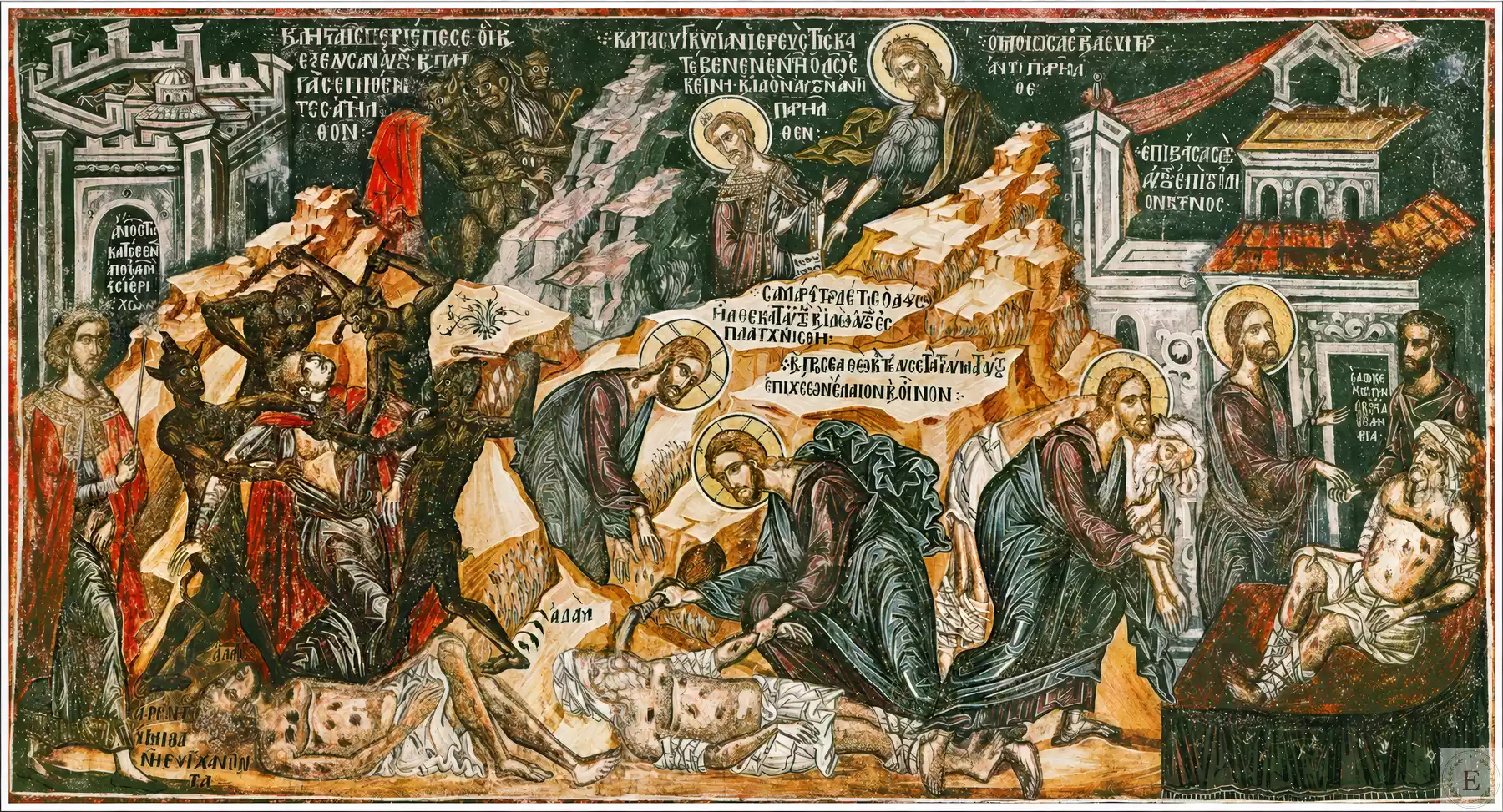
On the north side of the sanctuary vault, in the katholikon of Saint Nicholas at the Philanthropinon Monastery on the Island of Ioannina, the parable of the Good Samaritan unfolds along a long, narrow band. The band reads from left to right, from the gate of a fortified city to the inn, and the successive episodes of Luke’s narrative (10:30–35) are joined within one and the same rocky landscape. It belongs to the second painting phase of the church, that of 1542, as recorded in the Aristotelis Mentzos Archive of the Aristotle University of Thessaloniki. Four times the Samaritan returns, bearing the face of Christ, while the traveller who fell among robbers has, written beside his head, the name Adam.
The Philanthropinon Monastery and the three phases of its wall paintings
In 1291/92 Michael Philanthropenos, scion of a distinguished Byzantine house originating from Constantinople, renovated the church of Saint Nicholas, as the inscription above the doorway of the katholikon states. The monastery is also known as the Monastery of Spanos. It stands at the south-western tip of the island, on a rise higher than the lake’s other monasteries, next to the Monastery of Dilios. It belongs to a small monastic settlement of seven houses which flourished in the sixteenth century, when Ioannina became the chief cultural and economic centre of north-western Greece, as the relevant page of the University of Ioannina observes.
The katholikon, a single-aisled basilica, was painted in three phases over roughly three decades. The first decoration most probably dates from 1531/32 and is credited to the initiative of the hieromonk Neophytos Philanthropenos. Its painter remains unknown. In this phase Myrtali Acheimastou-Potamianou recognised the first masterpiece of the local Epirote school. In her study of sixteenth-century monumental painting she sets that school against the more restrained, closed compositions of Theophanes the Cretan, and credits the Epirote painters with ‘a vivid sense of the dramatic’ and ‘narrative eloquence’.
Ten years later, in 1541/42, the abbot Ioasaph Philanthropenos renovated the church. The timber roofs of the nave and the narthex gave way to vaults, and the iconographic programme, faithful to the style of the first phase, spread over the tympana, the arches, the vaults and most of the narthex. This painting, too, bears no signature. The University of Ioannina attributes it to Frangos Katelanos. Charikleia Koilakou, in a study of the Kontaris workshop, refers to Manolis Chatzidakis and Eugenia Drakopoulou, who assign to him the paintings in the vault of the nave, on the tympana of the walls and in the upper part of the narthex. She notes, however, that scholars do not agree on the authorship of some of the ensembles attributed to him. About the sanctuary vault, where the parable is found, neither source says anything explicit.
In 1560 the three exonarthexes were built from the foundations and painted. Here the University of Ioannina names the Theban painters Frangos and Georgios Kontaris. Acheimastou-Potamianou connected them with the monastery more cautiously, as the ‘most probably’ authors of that year’s painting.
From the city gate to the inn
The narrative opens with a crenellated city, inside which rises a domed building. In the dark opening of the gate, in narrow lines, is written the beginning of the verse about the man who went down from Jerusalem to Jericho. Directly below, standing upright in front of the wall, is a figure in a red mantle over a green tunic with an embroidered collar. He wears a wreath of leaves in his curly hair and holds a slender stem that ends, high up, in a small spray of foliage. His position beneath the inscription points to the traveller before the disaster, still clothed and still on his feet.
Beside him violence erupts. Four dark figures surround a pale-faced man whose head tilts back. Some raise clubs; others seize him and tear at his garment. The robbers of the Gospel have become demons. Higher up, behind a hill, a group of similar figures makes off with the red garment, and one of them holds a staff that curls over at the top. Next to them the inscription speaks of the stripping, the blows and the robbers’ departure. The man is left on the ground, flat on his back beneath the feet of his attackers, his naked body spattered with dark marks of wounds and a white cloth about his waist. In the lower left corner the verse is completed with the words that they left him half dead.
Above the scene, between steep rocks, pass the priest and the Levite, each with his own inscription and both with haloes. The priest wears a garment with a richly decorated band across the chest; his palms are open and his gaze is turned downwards. The Levite has long, unkempt hair and a thick beard, and his garment is rendered with a texture that recalls animal hair. Haloes for figures whom the story brings on stage only to show them passing by are most likely explained by the allegorical reading which the wounded man’s name discloses.
From the centre onwards the composition belongs to the Samaritan. First he stoops low from the slope towards the spot where the wounded man lies, and in his halo the arms of the cross can be made out. Immediately afterwards, kneeling, he grasps the man’s wrist with one hand and with the other tilts a dark vessel, pouring liquid over his face. The wounded man’s head is already wrapped in white cloth, and his beard has by now turned grey. The Samaritan’s dark himation breaks into angular folds with white highlights and billows over his back, far bulkier than the pose would require.
In the third episode he carries him on his shoulders. The wounded man’s head leans next to his own, the bare arm hangs down, and behind the Samaritan the legs project, bound with bandages. No animal appears anywhere, even though the inscription higher up, between a tower and the inn, speaks of the beast on which the Samaritan set the injured man. The inn is a two-storey building with arched openings and a tiled roof, and a red cloth stretches from its roof to the tower opposite. In front of it the Samaritan, standing now, hands the innkeeper the coins of the story. In the lower right corner the wounded man sits half-reclining on a bed, bandaged on the head, the arms and the legs.
The same man thus appears six times, the Samaritan four. There are no frames to separate the episodes. They are marked off by the ridges of the rocks, by the buildings and by the inscriptions.
Adam on the road to Jericho
The name is written twice beside the man’s head: the first time as he lies abandoned beneath the demons’ feet, the second as the Samaritan pours the oil and wine over him. The identification has a long prehistory in the interpretation of the parable. Origen, in the thirty-fourth of his Homilies on Luke, hands down the explanation of one of the elders. According to that explanation, the man going down is Adam, Jerusalem is paradise, Jericho the world and the robbers the hostile powers. The priest is the Law, the Levite the prophets and the Samaritan Christ. The wounds signify disobedience, the beast the body of the Lord, and the inn, which receives whoever wishes to enter, the Church. The Samaritan’s promise to return signifies the Second Coming.
Several of these points became visible in the wall painting. The robbers are painted as demons, the Samaritan bears a cross-inscribed halo and the wounded man is named Adam. By the same reasoning, the haloes of the priest and the Levite become intelligible if the two figures are read, as in the allegory, as the Law and the prophets.
Less certain is the link with the absence of the animal. The inscription mentions the beast, yet the image shows the Samaritan carrying Adam on his own shoulders. Since the allegory identified the animal with the body of the Lord, the painting appears to fold the two into a single figure. This reading rests solely on a comparison of image and text; it does not derive from any testimony about the intentions of the painter or of the abbot Ioasaph.
The inscriptions from the Gospel of Luke
Nine inscriptions accompany the episodes with the words of the Gospel, each placed beside the scene it comments on. On the dark ground they are written in white letters, on the light surfaces of the rocks in dark ones. In two places the name of Adam is added. The painter copies freely. The verb κατέβαινεν is spelt phonetically, ΚΑΤΕΒΕΝ at the gate and ΚΑΤΕΒΕΝΕΝ in the verse of the priest, which also lacks the particle δέ. The participle ἐκδύσαντες becomes a finite verb (ΕΞΕΔΥΣΑΝ). The Levite’s verse is abridged, leaving out both the phrase about the place where he came and the words καὶ ἰδών. On the door of the inn one reads the sum the Samaritan gave the innkeeper: two denarii.
The transcription is given in capitals, without the breathings and accents marked in the original. Abbreviations are expanded in round brackets, while letters that are only imperfectly legible are supplied in square brackets. The inscriptions follow the reading order of the composition.
- At the city gate
ΑΝ(ΘΡΩΠ)ΟΣ ΤΙΣ ΚΑΤΕΒΕΝ ΑΠΟ Ι(ΕΡΟΥΣΑ)ΛΗΜ ΕΙΣ ΙΕΡΙΧΩ - Above the demons
Κ(ΑΙ) ΛΗΣΤΑΙΣ ΠΕΡΙΕΠΕΣΕ ΟΙ Κ(ΑΙ) ΕΞΕΔΥΣΑΝ ΑΥ(ΤΟ)Ν Κ(ΑΙ) ΠΛΗΓΑΣ ΕΠΙΘΕΝΤΕΣ ΑΠΗΛΘΟΝ - Lower left
ΑΦΕΝΤΕΣ ΗΜΙΘΑΝΗ ΤΥΓΧΑΝΟΝΤΑ - Above the priest
ΚΑΤΑ ΣΥΓΚΥΡΙΑΝ ΙΕΡΕΥΣ ΤΙΣ ΚΑΤΕΒΕΝΕΝ ΕΝ ΤΗ ΟΔΩ ΕΚΕΙΝΗ Κ(ΑΙ) ΙΔΩΝ ΑΥ(ΤΟ)Ν ΑΝΤΙΠΑΡΗΛΘΕΝ - Beside the Levite
ΟΜΟΙΩΣ ΔΕ Κ(ΑΙ) ΛΕΥΙΤΗ(Σ) ΑΝΤΙΠΑΡΗΛΘΕ - On the rocks at the centre
ΣΑΜΑΡ(ΕΙ)ΤΗΣ ΔΕ ΤΙΣ ΟΔΕΥΩΝ ΗΛΘΕ ΚΑΤ ΑΥ(ΤΟ)Ν Κ(ΑΙ) ΙΔΩΝ ΑΥ(ΤΟ)Ν ΕΣΠΛΑΓΧΝΙΣΘΗ - Directly below
Κ(ΑΙ) ΠΡΟΣΕΛΘΩΝ ΚΑΤΕΔΗΣΕ ΤΑ ΤΡΑΥΜΑΤΑ ΑΥ(ΤΟ)Υ ΕΠΙΧΕΩΝ ΕΛΑΙΟΝ Κ(ΑΙ) ΟΙΝΟΝ - Between the tower and the inn
ΕΠΙΒΑΣΑΣ ΔΕ ΑΥ(ΤΟ)Ν ΕΠΙ ΤΟ ΙΔΙΟΝ ΚΤΗΝΟΣ - On the door of the inn
ΕΔΩΚΕΝ ΤΩ ΠΑΝΔΟΧ[ΕΙ] ΔΥΟ ΔΗΝΑΡΙΑ - Beside the wounded man’s head
ΑΔΑ[Μ] and ΑΔΑΜ
English translation
The translation covers the inscriptions of the scene, that is, passages from Luke 10:30–35 and the two occurrences of the name of Adam, in the order of the transcription.
- A man was going down from Jerusalem to Jericho.
- And he fell among robbers, who stripped him and, having beaten him, went away,
- leaving him half dead.
- By chance a priest was going down that road and, when he saw him, passed by on the other side.
- Likewise a Levite also passed by on the other side.
- But a Samaritan, as he journeyed, came to where he was and, when he saw him, had compassion on him.
- And he went to him and bound up his wounds, pouring on oil and wine.
- And having set him on his own beast…
- He gave the innkeeper two denarii.
- Adam, twice.
Sources and bibliography
- Aristotle University of Thessaloniki, Aristotelis Mentzos Archive. Monastery of Agios Nikolaos of Philanthropinoi, Lake Pamvotida, Ioannina, Greece: Interior, The good Samaritan, sanctuary vault, north side (1542). BYZART Project.
- Αχειμάστου-Ποταμιάνου, Μ. (1992). Ζητήματα μνημειακής ζωγραφικής του 16ου αιώνα. Η τοπική ηπειρωτική σχολή. Δελτίον της Χριστιανικής Αρχαιολογικής Εταιρείας, 16, 13–32.
- Κοιλάκου, Χ. (2001). Επισήμανση τοιχογραφιών του εργαστηρίου των θηβαίων ζωγράφων Γεωργίου και Φράγκου Κονταρή στην περιοχή της γενέτειράς τους. Δελτίον της Χριστιανικής Αρχαιολογικής Εταιρείας, 22, 191–208.
- University of Ioannina, Department of History and Archaeology. St Nicholas Monastery (Philanthropene Monastery).
Cite this article
How to cite this article
Pafilis, T. M. “The parable of the Good Samaritan in the Philanthropinon Monastery.” Greek Encyclopaedia, November 21, 2026. https://www.elpedia.gr/en/good-samaritan-parable-philanthropinon-monastery/.
Pafilis, T. M. (2026, November 21). The parable of the Good Samaritan in the Philanthropinon Monastery. Greek Encyclopaedia. https://www.elpedia.gr/en/good-samaritan-parable-philanthropinon-monastery/
Pafilis, T. M. “The parable of the Good Samaritan in the Philanthropinon Monastery.” Greek Encyclopaedia, November 21, 2026, https://www.elpedia.gr/en/good-samaritan-parable-philanthropinon-monastery/. Accessed .
Pafilis, T. M. (2026) “The parable of the Good Samaritan in the Philanthropinon Monastery”, Greek Encyclopaedia, November 21. Available at: https://www.elpedia.gr/en/good-samaritan-parable-philanthropinon-monastery/ (Accessed: ).