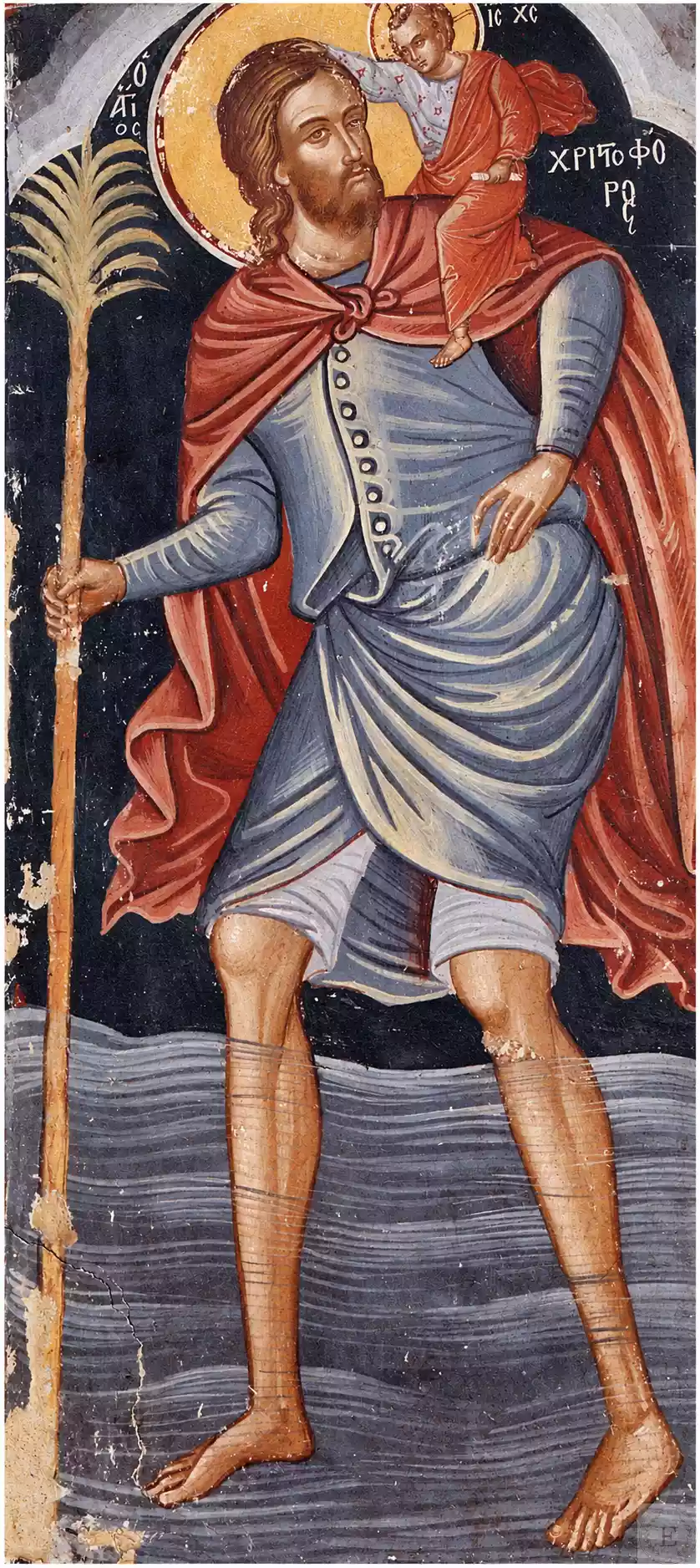
 Theophanes Strelitzas Bathas, Saint Christopher, 1527. Wall painting in the katholikon of the Monastery of Saint Nicholas Anapafsas, Meteora.
Standing in the waters of the river, the young Christ seated on his left shoulder, Theophanes’ Saint Christopher leans on a tall, leafy staff and turns his face towards the child he carries. The wall painting belongs to the decoration of the katholikon of the Monastery of Saint Nicholas Anapafsas at Meteora, a work by the Cretan painter Theophanes Strelitzas Bathas dated 1527. Here a subject that enjoyed wide currency in Western art is drawn into the painted scheme of an Orthodox church, and the eye is held by the bond between the two figures and by the saint’s progress through the transparent water.
The 1527 signature and the painter
In the founder’s inscription of the katholikon Theophanes records his name and his monastic status, together with his Cretan origin. Anapafsas is the earliest surviving signed and dated ensemble of his wall paintings, and with it the securely documented course of his monumental work begins. The great Athonite commissions follow, at the Great Lavra in 1535 and at the Stavronikita Monastery in 1546, where he worked together with his son Symeon.
The epigraphic evidence for this career is examined by Hieromonk Theophanes Stavronikitianos in a study of 2025, centred on the discovery of part of the painter’s signature in the katholikon of Stavronikita. The find added material testimony to the attribution of the wall paintings there, which already rested on stylistic research and on a manuscript note recording that Theophanes and Symeon completed them in January 1546.
Less settled are the questions about his activity before Meteora. Maria Constantoudaki-Kitromilides proposes attributing the wall paintings in the katholikon of the Monastery of Saint Neophytos in Cyprus to Theophanes, whom she places roughly between 1485 and 1559. She further connects the painter with the Theophylaktos who signs the icon of the Panagia Enkleistriani in the same monastery, and suggests identifying him with a member of the Strelitzas-Bathas family of that name, attested in Crete in 1509 and 1517. This remains a research hypothesis; within it, the change of name from Theophylaktos to Theophanes is linked to his monastic tonsure, which had taken place before the work at Anapafsas.
Meteora was inscribed on the World Heritage List in 1988. In the UNESCO documentation, Theophanes’ wall paintings of 1527 are acknowledged as a key point of reference for the iconographic and stylistic features of post-Byzantine painting, with an influence that spread well beyond this particular monastic complex.
The figure beneath the lobed arch
A painted lobed arch, rendered in pale greys, frames the upper part of the scene. Below it the almost black ground lets the gold halo and the outlines of the garments stand out sharply. The full view reveals losses of the paint layer along the left edge, while lower down a crack runs obliquely close to the staff and continues towards the water.
Christopher is shown as a robust figure, in a wide stride and with bare shins. His right foot, on the viewer’s left, points in the direction of travel, while the other stays further back; against the movement of the legs, the head turns towards the shoulder that bears Christ. That small turn gives the figure an inner animation, while the torso keeps the steadiness that walking requires.
The river fills the lower part of the composition and rises to a little below the knees. With successive wavy lines in grey-blue tones the painter marks its surface, leaving the shins and feet visible through the water. The lines run across the legs, at times denser and at times sparser, and continue to the edges of the scene.
The child on the shoulder and the staff that blossomed
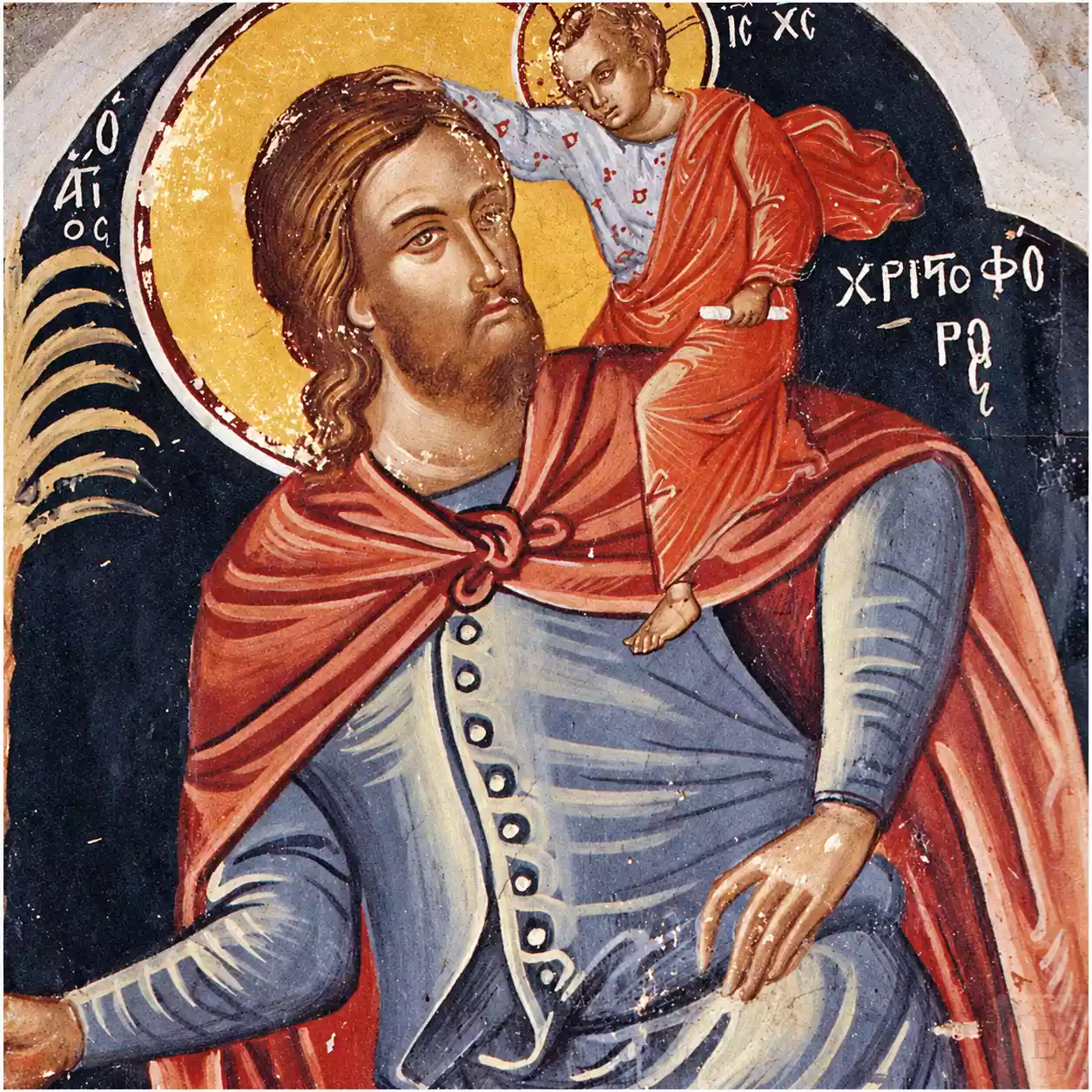 Detail of Theophanes’ Saint Christopher at Anapafsas (1527), with Christ on the saint’s shoulder and the Greek inscriptions.
High on the saint’s left shoulder sits Christ, his body turned towards him. He wears a pale blue-grey chiton with small red geometric ornaments and a red himation, whose loose end folds back behind him, towards the right of the picture. His right hand reaches over Christopher’s head and rests on his hair; in the left he holds a small white scroll, rolled up. A bare foot hangs down in front of the saint’s chest, below the hem of the red garment.
The staff is held in Christopher’s right hand. Its shaft runs almost the full height of the scene and ends in leaves that open out like a small palm crown beside the halo. The foliage is tied to the miracle of the flowering staff, the sign of the child’s divine identity in the hagiographical narrative. Within the same image of the river crossing, then, room is found for a detail that points to the revelation of Christ.
The inscriptions
The identities of the figures are written in white letters on the dark ground. To the left of the large halo «Ο ΑΓΙΟΣ» is set out vertically in abbreviated form, while to the right the name of Christopher unfolds over several levels, with ligatures and elongated terminals. How the lettering is arranged depends on the uneven distribution of the space available between Christ’s garment and the edge of the scene.
Beside the child’s head «ΙϹ ΧϹ» can be made out, the established abbreviations of the name Jesus Christ, with the lunate sigma taking the form of a C. Lines of the inscribed cross are also visible in his halo. The photographic detail allows the names to be identified, but it offers no sufficient basis for secure conclusions about the accentuation of the saint’s name or the identity of the scribe.
Rendering in Modern Greek
The inscriptions, with the abbreviations expanded:
- «Ο ΑΓΙΟΣ ΧΡΙΣΤΟΦΟΡΟΣ»: Ο Άγιος Χριστόφορος, that is, “Saint Christopher”.
- «ΙϹ ΧϹ»: Ιησούς Χριστός, that is, “Jesus Christ”.
Dress, folds and face
Closed down the front with a row of round buttons, the blue-grey outer tunic follows the torso and is hitched up lower down, leaving the legs free for the crossing. A light-coloured band emphasises its opening, while the gathered fabric falls into large curving folds, more fully developed on the right-hand side of the photograph, where the saint’s left hand rests. Beneath the tunic a light-coloured garment appears, covering the thighs and ending at about the knees.
The red mantle is tied high on the chest with a large knot. It spreads across the shoulders and descends behind the figure to the level of the knees, its edges turning outwards. Above, its red surface comes close to Christ’s himation; lower down it frames the blue-grey tunic. The highlights on the fabrics follow the changing directions of the folds, above all around the elbow and in the large fold beneath the left hand.
In the face the handling grows finer. Wavy brown hair frames the cheeks and reaches the nape of the neck, and the beard parts into small tufts around the chin. Warm flesh tones, with deeper shadows around the eyes and along the nose, build up the volume of the head. The gaze is directed towards Christ, with no marked change in the expression of the mouth.
Euthymios Tsigaridas has examined a portable icon of the Dormition of the Theotokos, which comes from the church of the same dedication at Kalambaka and is kept at the Varlaam Monastery; he attributes it to Theophanes and dates it to 1527. Its almost identical iconography to the Dormition at Anapafsas and its stylistic kinship with Andreas Ritzos support his proposal. In the Christopher, on our reading, the restraint of expression becomes especially perceptible once one notices how sparing the means are by which the communication with the child is conveyed: the turn of the head and the direction of the eyes are enough, while the hands remain busy with the staff and the gathered garment.
Theophanes’ Saint Christopher and Western iconography
The story of Christ carried across the river was disseminated very widely in the Western medieval tradition. The Metropolitan Museum of Art documentation for the related painting by Giovanni Battista Piazzetta summarises the account given in the Golden Legend (Legenda aurea): the unusually tall Christopher bears a small child to the far bank, before the child reveals to him that he is Christ. Piazzetta’s painting belongs to the 1730s; the museum’s entry serves here for the hagiographical narrative and is not evidence for the immediate pictorial model used by Theophanes.
In the Cretan milieu, contact with Western subjects and manners of painting was already well established. Angeliki Lymberopoulou examines commissions for icons in forma latina and in forma greca through the notarial records of Candia. Among the painters she studies is Nicolò Gripioti, active from 1491 to 1525, who had painted a Saint Christopher for the chapel of the Bono family in the Dominican monastery of Saint Peter Martyr. The record shows that the subject was circulating in commissions to Cretan workshops before Anapafsas was painted.
It is against this background that Theophanes’ choice can be understood. The composition is related to the Western iconography of the saint carrying Christ, while its painterly treatment belongs to the ensemble of the Orthodox katholikon. Pinning down a specific Venetian model would call for more detailed comparative evidence than the sources cited above provide.
The object in the child’s hand deserves attention too. In the small panel of Saint Christopher that the Philadelphia Museum of Art associates with the school of Jan van Eyck and dates to about 1460–1470, Christ holds a crystal orb, which relates to the weight of the world borne by the saint together with his small passenger. In the Anapafsas wall painting he holds a closed scroll, visible as a small white touch of the brush against the red himation, beside the fingers of his left hand.
Sources and Bibliography
- Lymberopoulou, A. (2023). Post-Byzantine Cretan Icon Painting: Demand and Supply Revisited. Arts, 12(4), 139.
- Metropolitan Museum of Art (n.d.). Saint Christopher Carrying the Infant Christ (Giovanni Battista Piazzetta). The Met Collection, New York.
- Philadelphia Museum of Art (n.d.). Saint Christopher, c. 1460-1470. Collection, Philadelphia.
- UNESCO World Heritage Centre (1988). Meteora. World Heritage List, no. 455.
- Theophanes Stavronikitianos, Hieromonk (2025). Η ὑπογραφὴ τοῦ Θεοφάνους τοῦ Κρητὸς στὴν Ἱ.Μ. Σταυρονικήτα Ἁγίου Ὄρους [The signature of Theophanes the Cretan in the Holy Monastery of Stavronikita, Mount Athos]. Βυζαντινά Σύμμεικτα, 35, 349-373.
- Constantoudaki-Kitromilides, M. (2023). Οι τοιχογραφίες στο καθολικό της μονής Αγίου Νεοφύτου: εικονογραφία, καλλιτεχνική ταυτότητα και ο κρητικός Θεοφάνης στη βενετική Κύπρο [The wall paintings in the katholikon of the Monastery of Saint Neophytos: iconography, artistic identity and the Cretan Theophanes in Venetian Cyprus]. Δελτίον της Χριστιανικής Αρχαιολογικής Εταιρείας, 42 (2021), 197-238.
- Tsigaridas, E. N. (2001). Άγνωστο έργο του Θεοφάνη του Κρητός στα Μετέωρα [An unknown work by Theophanes the Cretan at Meteora]. Δελτίον της Χριστιανικής Αρχαιολογικής Εταιρείας, 22, 357-364.


