
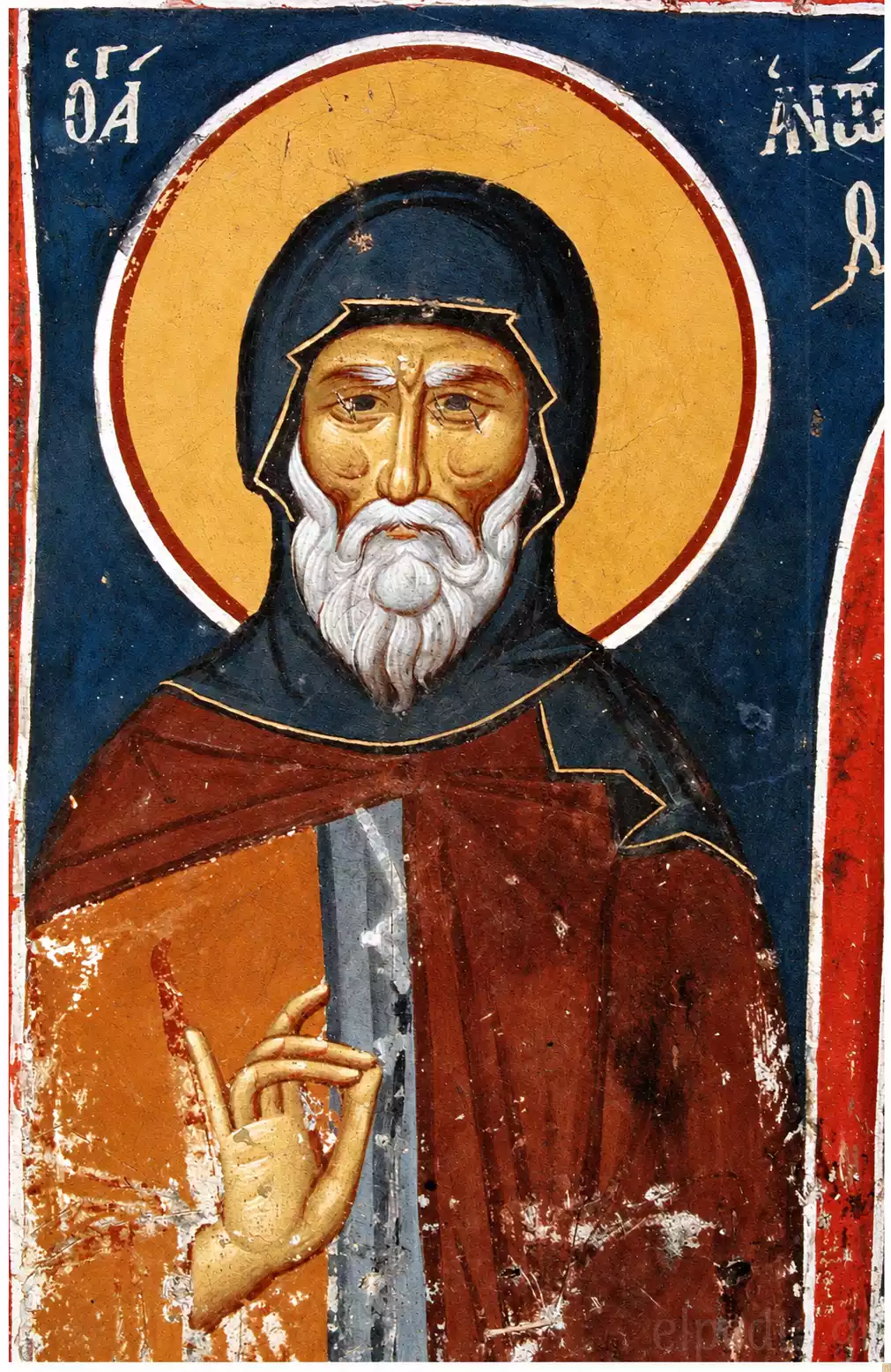
On the south wall of the katholikon of the Ypapanti Monastery, a small house built into a hollow in the rock on the northern side of Meteora, Saint Anthony the Great stands full length to the left of the niche with the enthroned Virgin Eleousa. His broad white beard spreads over the dark cowl, and the face, strictly frontal, meets head-on the gaze of whoever stands before it. The painting belongs to a programme completed, according to the church’s founder’s inscription, in the year 6875 from the Creation of the World, that is 1366/67, through the support and at the expense of the hieromonk Neilos, protos of the Skete of Stagoi and abbot of the Monastery of Doupiani; a second inscription records that the cost of the painting was met by the monk Kyprianos. The painter’s name has not survived. His work, however, part of one of the most important painted ensembles of the second half of the fourteenth century, lets us read in the figure of the anchorite both his debts to the so-called “Macedonian School” and a leaning towards simplification that sets him apart from the great workshops of the day.
Beside the Eleousa and the Stylite
The church is small and of the cross-in-roof type, a single nave crossed by a transverse barrel vault so that the roof forms a cross, with no dome, and it left the painter little room. The Christological cycle is confined to the intersecting arms and the sanctuary. From the life of the Mother of God only the Annunciation, on either side of the Platytera, and the Dormition on the west wall are depicted, while the remaining surfaces are taken up by saints and prophets, some in bust, others full length. In the eastern part of the south wall a standing Christ bears the unusual epithet “Ο ΑΝΑΛΗΨΙΜΗΟΤΗΣ”, which, together with the Ascension above the Platytera, recalls the church’s original dedication to that feast, before the monastery later came to be called after the Ypapanti, the Presentation of Christ in the Temple.
Further west on the same wall opens the niche with the enthroned Virgin Eleousa, holding in her lap the Christ Child, who blesses with both hands. To the left of the niche, on his column, stands Saint Symeon the Stylite; further left again is Anthony, and on the left side of the throne kneels Neilos, the founder, in supplication, as the official presentation of the Monastery of the Great Meteoron, to which the Ypapanti now belongs as a dependency, also notes (that same presentation dates the paintings of the nave to 1368, a discrepancy that cannot be reconciled with the year 6875 in the inscription). At the right-hand edge of Anthony’s figure a curved red band can be made out, apparently part of the frame of the niche. This arrangement, with the two anchorites attending the Mother of God and the abbot prostrate at her feet, has been read as a statement of the monastic ideal of the house’s first inhabitants, an interpretation that finds some support in the narthex of 1784 as well, where Dimitrios Zoukis of Kalarrytes and his pupil Georgios painted a crowd of saints from the monastic ranks.
Anthony was not someone the painter needed to explain to the monks of the Ypapanti. The Life of Antony, attributed to Athanasius of Alexandria, presents him as an Egyptian by birth who gave away his inheritance after his parents died and withdrew by degrees: first to the tombs outside his village, then to an abandoned fort, and later to the “inner mountain”, while around him multiplied the cells of the disciples he guided like a father. It is this hagiographical narrative, and no historical evidence about his appearance, that underpins the established type of the aged ascetic, which the Meteora painter repeats in his turn.
The anchorite’s face and the monastic habit
A high forehead, furrowed between the brows by a deep vertical line; thick white eyebrows, built up from short bright strokes above heavy lids that half close over small dark eyes, slightly sunk in their sockets. The nose, long and narrow, catches a fine light line along its ridge. The cheeks are modelled in gradations from the dark, greenish proplasmos (the first, dark layer of paint on which the flesh is built up) towards ochre tones, and on each of them a red semicircle is traced, a detail to which we shall return. The beard, broad and rounded at its tip, opens into curls rendered with greyish-white curving lines; the moustache covers the corners of the mouth and leaves visible a small red lower lip.
The cowl, a deep blue that is almost black, encloses head and shoulders and is outlined with a thin light line, repeated around the opening that frames the face. Over the shoulders falls a reddish-brown mantle, its few folds given in a handful of lines over broad, flat areas of colour. From the side of the figure’s right shoulder (on the viewer’s left) spreads a lighter, ochre-red band, which probably corresponds to the inner face of the mantle or to another garment, though it cannot be identified with certainty. Between the two halves of the mantle a grey-blue strip descends vertically: the garment worn beneath, as its position in the opening shows. The halo is an ochre-yellow disc with a thin red outline and a wide white outer ring, which lifts the head off the dark blue ground.
The saint’s right hand, the only one visible in the upper part of the figure, is raised before the chest, right at the edge of the mantle’s opening, palm turned towards the viewer, the index finger extended upwards and the other fingers flexed in a complex arrangement. The sources concerning the monastery do not comment on the gesture, and its mere formal resemblance to other familiar gestures is not enough to assign it a particular meaning. The shoulders, at any rate, turned slightly towards the right-hand side of the scene, where the niche lies, suggest together with the position of the hand a movement towards the Eleousa, while the face remains frontal.
The inscriptions: the saint’s name and the founder’s testimony
On either side of the halo, in white capitals on the blue ground, the name is written. On the left one reads the article and the abbreviation of “ἅγιος”, with the gamma placed above the alpha as a mark of contraction; on the right, the beginning of the name, ΑΝΤΩ, with nu and tau in ligature, while the continuation on a second line is only partly legible. The inscription may therefore be transcribed as “Ὁ ἅγ(ιος) Ἀντώ(νιος)”, the name being confirmed also by descriptions of the decoration.
Of greater historical weight is the founder’s inscription of the nave, written in dark ink on a white ground above the door leading from the narthex into the church. The transcription in circulation, which goes back to the copies made by Nikos Veis, runs as follows (slashes mark line breaks, parentheses the expansion of abbreviations):
ΑΝΗΓΕΡΘΕΙ ΕΚ ΒΑΘΡ(ΩΝ) Κ(ΑΙ) ΑΝΗΣΤΟΡΙΘΕΙ Ο ΠΑΝΣΕΠΤΟΣ Κ(ΑΙ) ΘΕΙΟΣ ΝΑΟΣ Τ(ΗΣ) ΑΝΑΛΕΙΨΕΩΣ ΤΟΥ ΚΥΡΙΟΥ Κ(ΑΙ) Θ(ΕΟ)Υ Κ(ΑΙ) Σ(ΩΤΗ)Ρ(Ο)Σ ΗΜ(ΩΝ) Ι(ΗΣΟ)Υ Χ(ΡΙΣΤΟ)Υ ΔΙΑ Σ(ΥΝ)/ΔΡΟΜ(ΗΣ) Κ(ΑΙ) ΕΞΟΔΟΥ ΤΟΥ ΤΗΜΕΙΟΤΑΤΟΥ ΕΝ ΙΕΡΟΜΟΝΑΧΟΙΣ ΚΥΡ ΝΕΙΛΟΥ Κ(ΑΙ) ΠΡΟΤΟΥ Τ(ΗΣ) ΣΚΗΤΕΩΣ ΣΤΑΓΩΝ Κ(ΑΙ) ΚΑΘΗΓΟΥΜΕΝΟΥ ΤΗΣ ΣΕΒΑΣΜΙ(ΑΣ) ΜΟΝ(ΗΣ) ΔΟΥ/ΠΕΙΑΝΟΥ ΒΑΣΙΛΕΒ(ΟΝ)ΤΟΣ ΔΕ ΤΟΥ ΕΥΣΕΒΕΣΤΑΤΟΥ ΗΜ(ΩΝ) ΒΑΣΙΛΕΟΣ ΚΥΡ ΣΥΜΕ(ΩΝ) ΤΟΥ ΠΑΛΑΙΟΛΟΓΟΥ Κ(ΑΙ) ΑΥΤΟΚΡΑΤΟΡ ΡΟΜΑΙΩΝ ΣΕΡΒΕΙ(ΑΣ) Κ(ΑΙ) ΡΟΜΑΝΕΙ(ΑΣ) ΤΟΥ ΟΥΡΕΣΙ: ΕΠΕΙΣΚΟΠΕ/ΒΟΝΤΟΣ ΔΕ ΤΟΥ ΠΑΝΑΓΙΟΤΑΤΟΥ ΔΕΣΠΟΤΟΥ ΗΜΩΝ ΒΗΣΑΡΙΟΥ ΕΤΟΥΣ ϚΩΟΕ
The spelling, with forms such as “ΑΝΗΓΕΡΘΕΙ”, “ΤΗΜΕΙΟΤΑΤΟΥ” and “ΡΟΜΑΙΩΝ”, follows the phonetic orthography often met in painted church inscriptions of the period and is retained as transmitted.
English translation
The full inscription reads: “Erected from its foundations and painted was the all-venerable and divine church of the Ascension of our Lord and God and Saviour Jesus Christ, through the support and expense of kyr Neilos, most honourable among hieromonks, protos of the Skete of Stagoi and abbot of the venerable Monastery of Doupiani, in the reign of our most pious king kyr Symeon Palaiologos, emperor of the Romans, of Serbia and of Romanía, Uresis [Uroš], and while our most holy lord Bessarion was bishop, in the year 6875 [= 1366/67 AD].”
Three authorities intersect in this text: the local monastic leader, the bishop, and the ruler of Thessaly, Symeon Uroš Palaiologos, half-brother of Stefan Dušan, who according to Vapheiades’ study had confirmed by decree the rights of the ascetic community of Doupiani. The reference to his imperial standing, “of the Romans, of Serbia and of Romanía”, reflects the style the ruler himself used in the fluid political landscape of mid-fourteenth-century Thessaly, where Byzantine and Serbian claims coexisted.
The painter of 1366/67 and the “Macedonian School”
The two red semicircles on Anthony’s cheeks, which the painter repeats on almost every face in the church, have been singled out as the most characteristic sign of his Macedonian models, since the same device is used by Manuel Panselinos in the Protaton on Mount Athos and by Michael and Eutychios at Staro Nagoričino. In Anthony it is no mere schematic signature, for it forms part of fairly careful modelling, with short white strokes on the forehead, the brows and beneath the eyes, sometimes a single thick one, sometimes two or three finer ones. The garments, with their few, almost diagrammatic folds, show the same hand choosing economy elsewhere.
This coexistence has occupied those who have studied the decoration. Andreas Xyngopoulos recognised many elements, chiefly iconographic, drawn from Macedonian art, yet observed that the craftsman had simplified them and blended them with features continuing an older tradition, and he placed the Ypapanti in a group of fourteenth-century monuments, mainly on the Greek mainland, sharing the same tendency. Dimitrios Pallas, more briefly, saw in the painter someone living within a tradition of bright tones and deeper proplasmoi, where elements of the “Macedonian” and the so-called “Cretan” trends meet, and who strove to give his figures plasticity without always mastering the folds of the drapery. The homogeneity of technique throughout the church (the same proplasmoi, the same bright colours, the same sparing white highlights) makes the hypothesis of two different painters less likely, and more likely that of a single craftsman, perhaps with an assistant, who chose how much modelling to devote to each figure, keeping the fullest for Christ, the Mother of God and a few saints, and the simplest, with lines for cheekbones, eyes, noses and beards, for the secondary ones.
Konstantinos Vapheiades has recently shifted the question from style to workshop. He linked the Ypapanti painter with fragments of saints in medallions from the church of the Venerable Athanasios at the Great Meteoron, which he must have painted shortly before 1366, and with four icons from the templon of the first katholikon of the same monastery: Christ Euergetes, the Hodegetria, Saint Nicholas and the Archangel Michael. Of the painter himself, he notes, nothing is known, yet his art shows a close kinship with the wall paintings of the Panagia Olympiotissa at Elassona (1332-1355) and of the katholikon of the Archangel Michael at Lesnovo (1341-1346/47, 1349). This leads him to propose, with the caveat of “very likely”, the existence of an artistic circle with works both in the Prespa region and in southern Serbia, connected with the patronage of the Serbian leadership in the mid-fourteenth century. If the proposal holds, the Anthony of the Ypapanti belongs to a network of workshops moving between Thessaly, Macedonia and Serbian patronage, and the “simplification” noted by earlier scholars may be read as an idiom of that circle rather than as an individual shortcoming.
From Veis’ ascent to the conservation of 2003
Nikos Veis first climbed up to the monastery on 7 October 1908, guided by the hieromonk Prokopios Grigoriadis, on a ladder that by his own account was broken and rotten in many places; he copied the inscriptions then and checked them again on 8 June 1909. Brief mentions by Xyngopoulos and Pallas followed, while the only extended study of the katholikon’s painting until the early twenty-first century remained the article published in 1966 by the Serbian Byzantinist Gojko Subotić.
In the summer of 2003 the 7th Ephorate of Byzantine Antiquities, in collaboration with the Monastery of the Great Meteoron, undertook the conservation of the decoration with the conservators Margaritis Mitsatsikas and Stavroula Nakou, and the cleaning brought to light details that earlier researchers had been unable to see. In the figure of Anthony the clarity of colour in the face and halo sits alongside losses that were not restored: white abrasions in the ochre-red band and around the hand, scattered lacunae in the mantle and the ground, and, above the pupils of the eyes, small, fine incisions in the shape of a cross, about whose origin and date the available sources say nothing.
Sources and Bibliography
- Athanasius of Alexandria. Life of Antony. Trans. H. Ellershaw, in P. Schaff & H. Wace (eds), Nicene and Post-Nicene Fathers, Series II, vol. 4. Internet History Sourcebooks, Fordham University.
- Holy Imperial Monastery of the Holy and Great Meteoron. Metochia, Dependencies. Official website of the Holy Monastery of the Great Meteoron.
- Vapheiades, K. M. (2023). Byzantine Wall Paintings and Icons at Meteora. Actual Problems of Theory and History of Art, 13, 291-298.
Cite this article
How to cite this article
Pafilis, T. M. “Saint Anthony the Great: The Wall Painting in the Ypapanti Monastery at Meteora (1366/67).” Greek Encyclopedia, October 26, 2026. https://www.elpedia.gr/en/saint-anthony-the-great-wall-painting-ypapanti-monastery-meteora/.
Pafilis, T. M. (2026, October 26). Saint Anthony the Great: The Wall Painting in the Ypapanti Monastery at Meteora (1366/67). Greek Encyclopedia. https://www.elpedia.gr/en/saint-anthony-the-great-wall-painting-ypapanti-monastery-meteora/
Pafilis, T. M. “Saint Anthony the Great: The Wall Painting in the Ypapanti Monastery at Meteora (1366/67).” Greek Encyclopedia, October 26, 2026, https://www.elpedia.gr/en/saint-anthony-the-great-wall-painting-ypapanti-monastery-meteora/. Accessed .
Pafilis, T. M. (2026) “Saint Anthony the Great: The Wall Painting in the Ypapanti Monastery at Meteora (1366/67)”, Greek Encyclopedia, October 26. Available at: https://www.elpedia.gr/en/saint-anthony-the-great-wall-painting-ypapanti-monastery-meteora/ (Accessed: ).
Related articles
Byzantine Art
The Virgin of Hagia Sophia, Thessaloniki
Post-Byzantine Art
Theophanes Strelitzas Bathas: Saint James the Persian
Modern and Contemporary History