
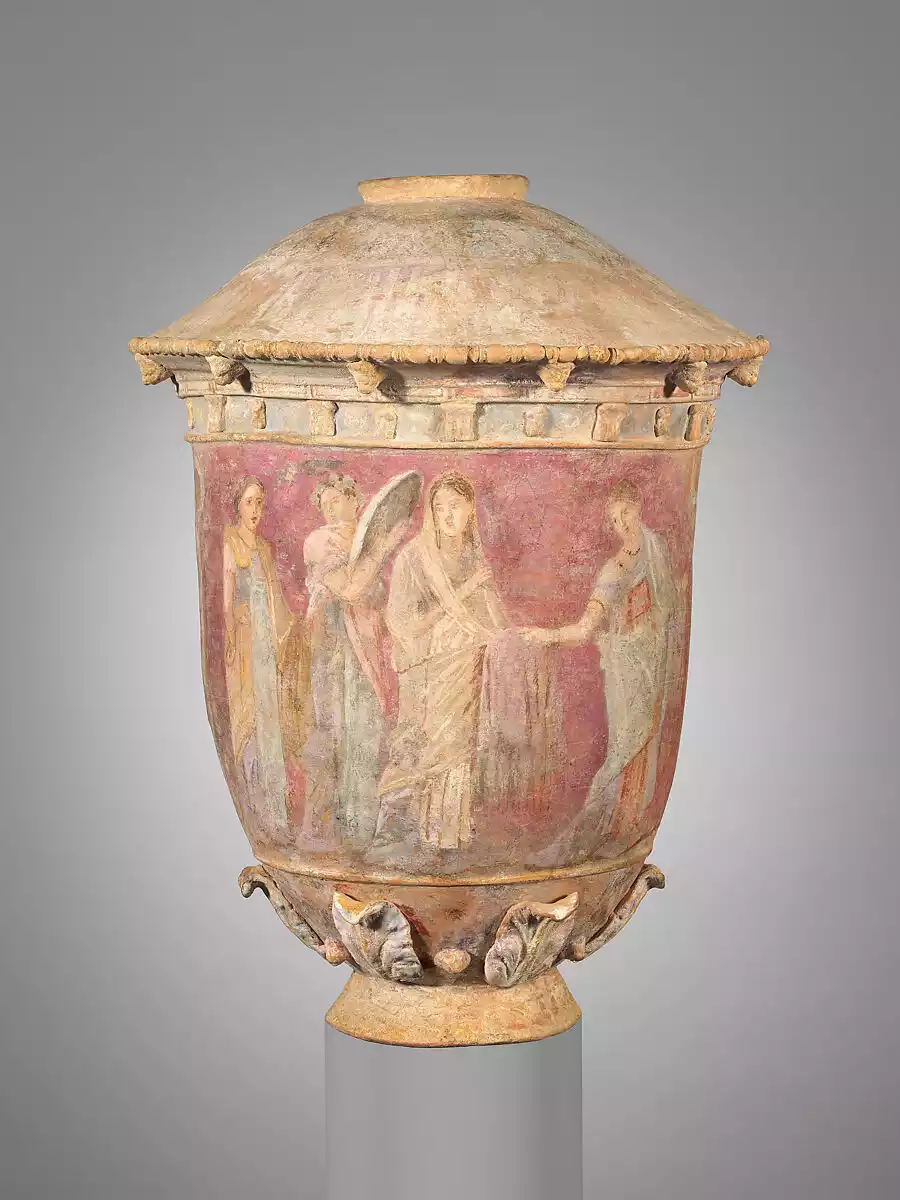
The lid of this vase does not lift. Modelled in one piece with the body, so that the interior remains permanently closed, it turns a shape that might have held something into an object that merely displays; and this constructional detail, together with the painting spread over the surface after the clay had already been fired, places the terracotta Centuripe vase in the Metropolitan Museum of Art, New York (acc. no. 53.11.5), among objects made for the tomb. A Hellenistic work of the 3rd–2nd century BC, 39.4 cm high, it belongs, according to the Met’s catalogue entry, to a group of pottery associated with Centuripe in eastern Sicily and characterised by elaborate, finely worked relief decoration and by polychromy applied after firing; its main field shows a bride among her attendants.
Vases of this group, which the literature calls simply ‘Centuripe vases’, raise questions that reach beyond any single object: how exactly they were painted, how much of their colour is ancient, what the image of a bride meant for the dead of a Sicilian city. On the New York vase, whose scene survives in relatively good condition, these questions take on a concrete form.
The construction of the Centuripe vase
The body, ovoid and broad at the shoulder, narrows towards a low, spreading foot. On it sits a conical lid with a wide, projecting rim that recalls a roof rather more than the cover of a vessel; it ends in a small cylindrical knob at the top, and faint pinkish-violet traces of radiating brushstrokes remain on its surface. A beaded cord in relief runs round the edge of the lid, and from it small relief masks hang at intervals, too worn to be identified with certainty; lower still, on the shoulder of the vase, a band of small rectangular projections on a grey-blue ground forms something like a cornice. This superstructure of roof, cornice and frieze gives the vase the look of a small building.
It is no whim of this particular potter. In Heuer’s essay, written for the Met’s timeline of art history, Centuripe vases are described as enriched with complex relief elements of vegetal and architectural inspiration, and Rosario Patané notes that their edges are often accentuated with mouldings (kymatia), triglyphs and rows of lion heads or Erotes, motifs which in his view clearly derive from metal prototypes. The row of rectangular projections on the shoulder of the New York vase belongs, with all the caution that its worn state demands, to this same vocabulary.
The lower part of the body, set off from the painted zone by a horizontal ridge, carries relief leaves painted in violet and grey-blue tones with yellowish highlights, a small round boss between them and, at the sides, spiral tendrils that bend into an S; the foot keeps an ochre-yellow tint. Heuer calls the vase a lebes and observes that, unlike the lekanides of the same production, which were assembled from separate parts (foot, bowl, lid, handle, finial) and for that reason seldom survive intact, here the lid was made together with the body, so that the vase could not serve as a container. In her view, the construction and the fragile, unstable decoration of these vases indicate that they were intended as grave goods. The integral lid is not an isolated solution: a Master’s dissertation from the University of Évora describes a lebes gamikos of the same production in the ‘A. Salinas’ Archaeological Museum in Palermo, made up of the body and a lid that cannot be removed.
The bride and her attendants
Four female figures, all standing, are spread across a single field of deep pink that covers only the front of the vase, while the rest of the surface is left in the colour of the clay, with grey stains and traces of wear. On the left, a woman in an ochre-yellow himation over a pale blue chiton stands quietly, her arms lowered and her face in three-quarter view. Beside her the second figure, with a wreath of leaves or flowers in her hair and a pink mantle, holds up a large round drum, raised to the height of her head and turned towards the bride, so that we see its light-coloured surface at an angle.
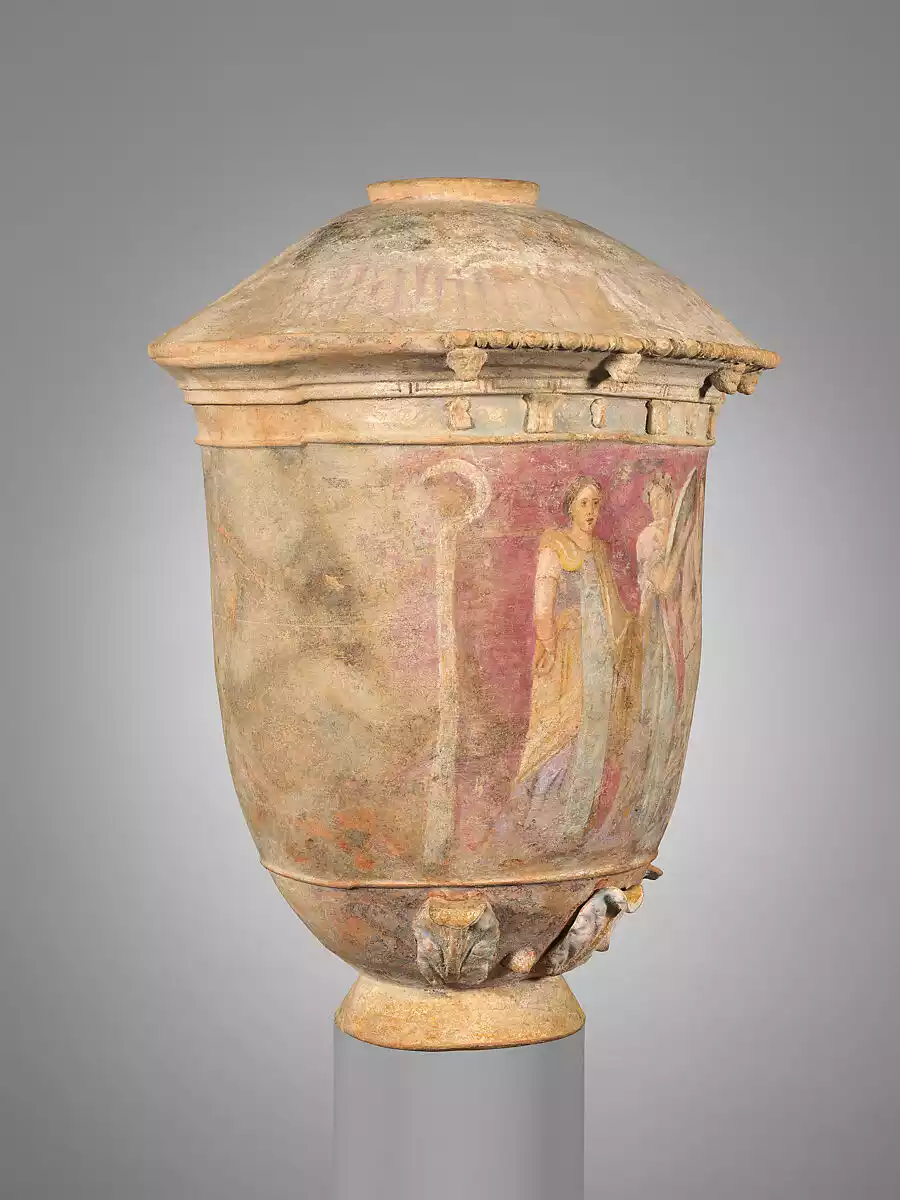
In the centre stands the bride, wrapped entirely in a whitish-yellow garment and covered by a veil that falls from her head to her shoulders. She inclines her head slightly, eyes lowered, and brings one hand to her breast, close to the edge of the veil, while the garment draws tight around her body in diagonal folds picked out with white brushstrokes. The fourth figure, on the right of the scene, wears a red necklace, a grey-green himation and beneath it a chiton with vertical red bands; these show more clearly in the photograph taken from the right of the vase, which also reveals that with her other hand she holds the edge of her mantle. She leans towards the bride and, reaching out, seems to take the bride’s hand at a low level, a gesture that could be read as leading or escorting, though the image allows no more precise reading.
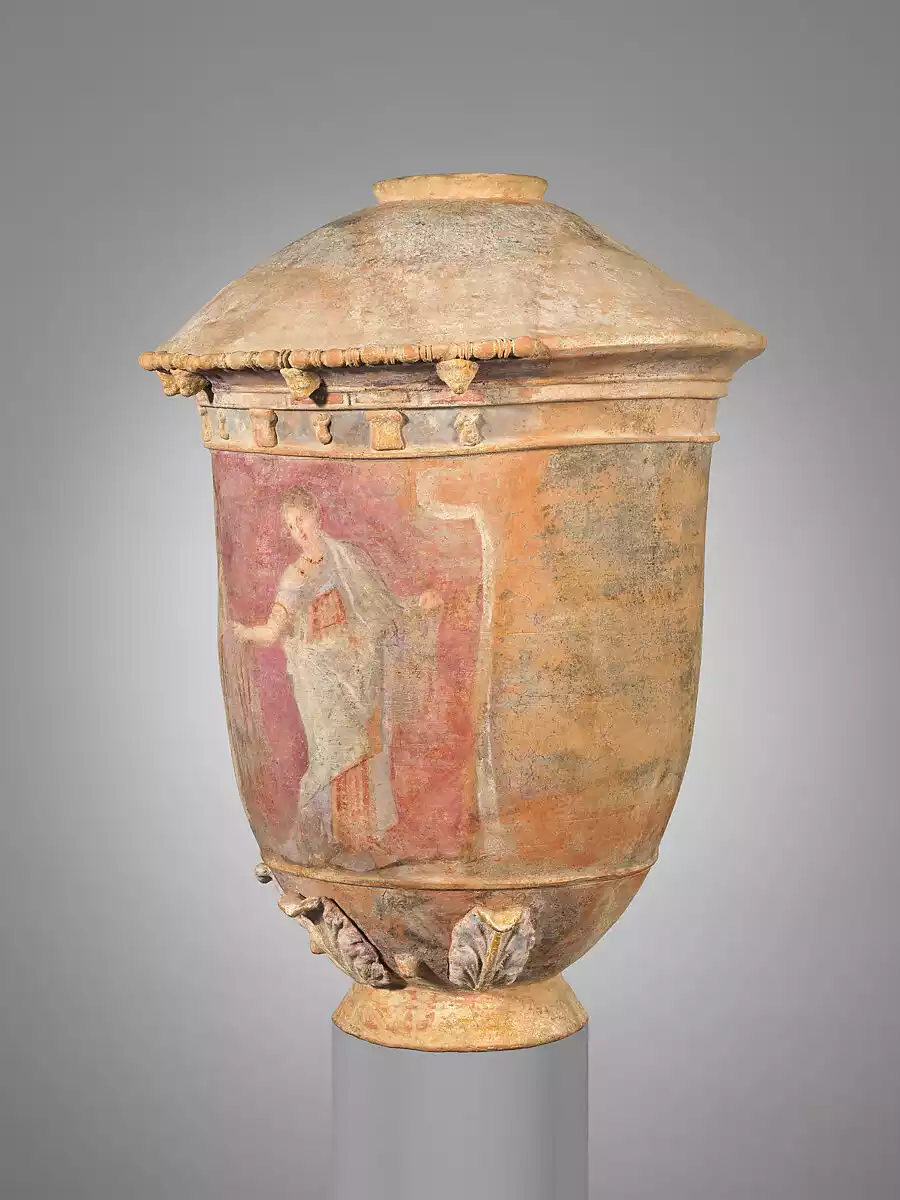
At either end of the pink field rise white vertical elements: on the left a stem with a circular terminal, on the right a band that curves over at the top. Whether these are objects in the setting, architectural members or simply framing lines, the photographs do not settle; all that is certain is that they mark the limits of the painted field, and that beyond them the vase is silent.
The faces, turned in different directions, with large dark eyes and pale, luminous flesh, are built up less by line than by gradations of tone, with lights and shadows modelling the cheeks and neck. Patané describes the painting of this production as tempera applied after firing, using blending and hatching to render light and shade, with denser or contrasting strokes for the details. His description fits what can be made out here, above all the white highlights on the folds, which sit on the colour like a final layer.
The drum
The instrument raised by the second attendant is a frame drum (tympanon), that is, a membrane stretched over a hoop. Bellia’s study of figurines of women holding one, from Sicilian finds of the 4th and 3rd centuries BC, links it with sanctuaries of Demeter and Kore, and of Artemis, where, according to the literature she cites, girls dedicated objects from their childhood before marriage, drums among them. In those figurines the drum is usually held at the side, resting against the body. Here it is lifted high, in a livelier movement that brings sound into an otherwise quiet composition, though the image itself does not decide whether the music belongs to a wedding procession or points to some cult ritual.
Tempera on fired clay
The polychromy of Centuripe vases differs fundamentally from the painting of Greek vases, because the colours never went into the kiln: they were laid with a binder onto an already fired surface and remained exposed, friable and vulnerable to damp, to abrasion and, as it turned out, to the interventions of later times. An early systematic technical observation of a vase in the Met comes from Richter’s study of 1932. Examining a lekanis with a tall conical lid that the museum had acquired shortly before, she noted that the pink ground had been painted directly onto the clay and that a white preparatory layer was present only beneath the figures. The pigment analysis, carried out at the time by C. F. Binns of Alfred University, identified yellow ochre, umber, chalk, crushed glass containing copper for the blue, cinnabar, soot, and red ochre mixed with chalk for the pink, while the flesh tone could be obtained by mixing the pink and the yellow. These findings concern a different vase, yet the palette they describe is the same one seen in the bridal scene of 53.11.5.
More recent archaeometric methods have made a finer picture possible. In archaeometric research using portable XRF and FTIR spectroscopy on two vases in Palermo, a pyxis and a lebes gamikos, Elisa Chiara Portale and her colleagues confirmed the tempera technique and identified two calcium sulphate phases in the layer beneath the painting. The presence of bassanite indicates, according to the researchers, that this layer was fired at a low temperature before the painting proper was applied, whereas gypsum in other areas coincides with retouching or with traces of later pigments. The same study singles out the Palermo lebes gamikos for its use of rarer pigments, such as cinnabar and most probably azurite, and for the quality of its drawing. The Évora dissertation likewise describes a three-layer sequence, a white layer of calcium carbonate and sulphate, a red one containing iron oxides and an outer one carrying the pigments, and bases its identification of tempera on the detection of protein residues.
No comparable technical examination of the New York vase has been published in the museum’s online record, and how much of the surface we see today is ancient, and how much has possibly been made up, cannot be judged from photographs. Paint losses can nevertheless be made out in the lower parts of the field, along with damage to the reliefs and the grey staining of the unpainted back.
Marriage, soul and tomb
The bridal theme is not isolated in Centuripe production. Heuer notes that the painted imagery of these vases relates either to marriage or to the cult of Dionysus, whose mysteries were widespread in southern Italy and Sicily, most probably because they promised initiates a blessed afterlife. The balance struck between the two readings has a history of its own, which Portale reconstructs in a 2021 article: the original ‘Bacchic-Orphic’ explanation, which rested on the discovery in the early 20th century of two vases showing Dionysus in a relaxed pose, gave ground from the second half of the century to the view that the nuptial theme was the most important in the repertoire, and some scholars later admitted mythological or theatrical figures as well.
What meaning, though, did a wedding scene have inside a tomb? In a 2016 paper in the proceedings of the Rei Cretariae Romanae Fautorum, Rosario Patané observes that the subjects of the vases regularly belong to the world of the women’s quarters (gynaikonitis) and depict various moments of the wedding ceremony, with male figures in a secondary role apart from Dionysus, and that the presence of such vases in at least some male burials shows that the imagery was unrelated to the sex of the deceased. He explicitly rejects the ‘realistic’ explanations of Paul Deussen, who saw the vases as wedding gifts kept until the wife’s death and then buried with her, and prefers a symbolic reading in which the young woman may be understood as a personification of Psyche. He also mentions Portale’s proposal to connect the young female figures with the cult of the Nymphs, playing on the double meaning of the Greek word nymphē (νύμφη), both a nymph, that is a deity, and a bride. In the 2017 study the Palermo team adds an observation that bears directly on the appearance of the New York vase: the colour effects, the researchers write, are more than a question of taste, since they work together with the iconography and the overall construction to produce a prestigious grave good of great symbolic weight, one that hints at some hope of immortality for the deceased.
In this scene the bridegroom is missing, as is any indication of place, and the whole weight falls on the silent, veiled figure whom the attendants frame and, it seems, guide. Such economy is compatible with every reading set out above, without imposing any of them.
Dating, provenance and open questions
The dating of these vases shifted considerably during the 20th century. In 1932 Richter placed them provisionally in the 2nd–1st century BC, on the strength of the similarities between their painting and the Pompeian wall paintings and of a polychrome amphora from Olbia, and she looked to future excavations to resolve the problem. Today the Met dates the work to the 3rd–2nd century BC, and Patané cites the proposal of Ulrike Wintermeyer (1975) that the production lasted about eighty years from the middle of the 3rd century BC. This was the period in which Roman influence gradually spread across Sicily, and Patané, referring to Diodorus, recalls that in 263 BC Roman consuls had taken Adrano and were besieging Centuripe when envoys from many cities sued for peace. The city, in his account, depended culturally on Syracuse, but it developed an autonomy of its own in the production of terracotta figurines and pottery, with patrons drawn from the local ruling class.
The Met’s record states that the vase is said to have been found at Centuripe and that until 1953 it was in the possession of Elie Borowski in New York, from whom the museum bought it with funds from the Joseph Pulitzer Bequest. The phrase ‘said to have been found’ means that there is no evidence of an excavated context, and this gap is not peculiar to the New York piece. As Portale observes in a 2022 study of the question of authenticity, the cemeteries of Centuripe were already being looted in the 19th century; until recently many vases were regarded as doubtful and some have proved to be forgeries, while so-called ‘restorers’ working for the illicit trade could either reproduce shapes and decoration or ‘refresh’ the painted surfaces, creating misleading palimpsests that sometimes look more ‘convincing’ than genuine decoration. Patané, for his part, holds that the automatic attribution to Centuripe of the many vases without provenance needs to be reconsidered, with the help of laboratory analysis among other means, since comparable pottery has been found elsewhere in eastern Sicily as well, particularly at Morgantina, where, however, it shows differences.
The loss of contexts has also affected hypotheses about how the vases should be grouped. Deussen had argued that the two Palermo vases and two others, acquired by the same dealer and now in the Metropolitan Museum, came from a single tomb; the Palermo team, however, found that the palette, style and secondary decoration of the two Palermo vases do not match, which tells against the hypothesis. The available abstract of the study does not name the two New York vases, so any connection with 53.11.5 cannot be made without access to the full text. In his doctoral thesis of the early 1970s the same scholar had tried to organise the production into four workshops with painters whom he named after their favourite subjects, such as the Dionysus Painter, a picture that Portale and Chirco (2024) regard as weakened, despite its objective basis, by interpretative missteps and by a lack of close attention to technical features. The museum’s record does not attribute the New York vase to any painter or workshop, and its bride, eyes lowered beneath the veil, remains the work of an anonymous craftsman from a Sicilian city of the 3rd or 2nd century BC.
Sources and bibliography
- Abboud, R. (2016). Characterization of the pigments of Siceliot pottery decoration: the Centuripe ceramics. Master’s dissertation, Universidade de Évora.
- Bellia, A. (2012). Iconografia e culti: statuette di suonatrici di tympanon. In M. Albertocchi, A. Pautasso, U. Spigo (eds.), Philotechnia. Studi sulla coroplastica della Sicilia greca (pp. 253-263). Catania: CNR-IBAM.
- Heuer, K. (2010). Funerary Vases in Southern Italy and Sicily. Heilbrunn Timeline of Art History. New York: The Metropolitan Museum of Art.
- Patané, R. P. A. (2016). «Ceramica centuripina» e terracotte teatrali. Per le credenze sull’aldilà nella Sicilia romana. Rei Cretariae Romanae Fautorum Acta, 44, 255-265.
- Portale, E. C. (2021). Dioniso a Centuripe: iconografia «teatrale» e imagerie dionisiaca in contesto funerario. Ocnus, 29, 87-118.
- Portale, E. C. (2022). Old controversies and new data: assessing again the polychrome vases from Centuripe. In M. Salvadori, E. Bernard, L. Zamparo, M. Baggio (eds.), Beyond Forgery. Collecting, Authentication and Protection of Cultural Heritage (pp. 265-279). Padova University Press.
- Portale, E. C., & Chirco, G. (2024). The Craft of Centuripe Vases: Techniques, Colors, Patterns. In D. Elia, E. Hasaki, M. Serino (eds.), Technology, Crafting and Artisanal Networks in the Greek and Roman World (pp. 241-254). Berlin/Boston: De Gruyter.
- Portale, E. C., Chillura Martino, D., Saladino, M. L., Caponetti, E., & Chirco, G. (2017). «vasi di Centuripe»: per un approccio integrato. In E. C. Portale, G. Galioto (eds.), Scienza e archeologia (pp. 75-99). Pisa: ETS.
- Richter, G. M. A. (1932). A Polychrome Vase from Centuripe. Metropolitan Museum Studies, 4(1), 45-54.
- The Metropolitan Museum of Art (n.d.). Terracotta vase, 53.11.5. Greek and Roman Art, The Met Collection.
Cite this article
How to cite this article
Pafilis, T. M. “Centuripe vase with a bride and attendants in the Metropolitan Museum.” Greek Encyclopedia, October 27, 2026. https://www.elpedia.gr/en/centuripe-vase-bride-attendants-metropolitan/.
Pafilis, T. M. (2026, October 27). Centuripe vase with a bride and attendants in the Metropolitan Museum. Greek Encyclopedia. https://www.elpedia.gr/en/centuripe-vase-bride-attendants-metropolitan/
Pafilis, T. M. “Centuripe vase with a bride and attendants in the Metropolitan Museum.” Greek Encyclopedia, October 27, 2026, https://www.elpedia.gr/en/centuripe-vase-bride-attendants-metropolitan/. Accessed .
Pafilis, T. M. (2026) “Centuripe vase with a bride and attendants in the Metropolitan Museum”, Greek Encyclopedia, October 27. Available at: https://www.elpedia.gr/en/centuripe-vase-bride-attendants-metropolitan/ (Accessed: ).
Related articles

Post-Byzantine Art
Theophanes Strelitzas Bathas: Saint James the Persian
Byzantine Art