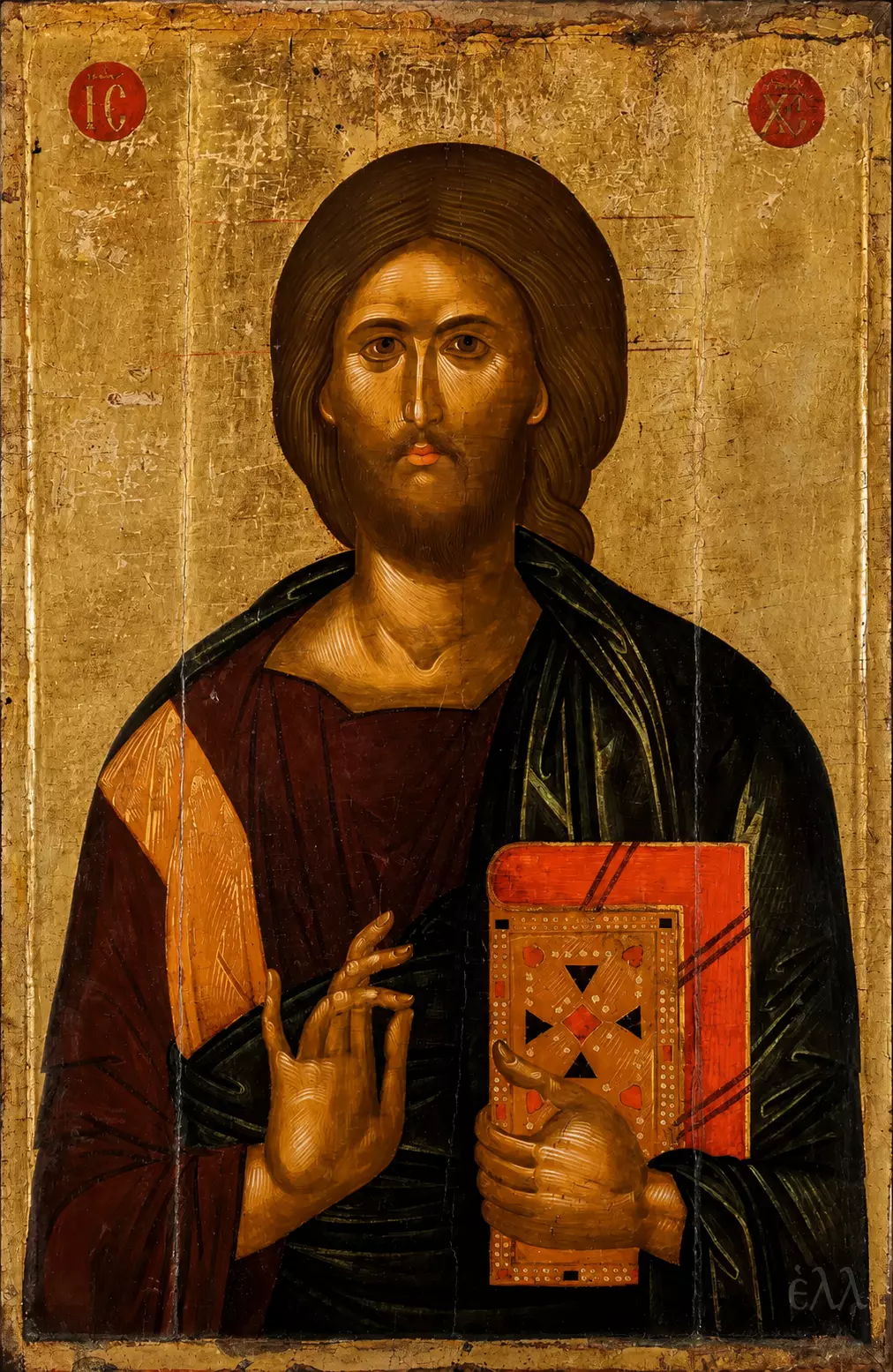
Among surviving examples of Cretan hagiography, few combine technical maturity as clearly as the icon of Christ Pantokrator attributed to Angelos Akotantos, arguably the most important painter of Venetian-dominated Candia in the first half of the 15th century. Known also by the signature “Hand of Angelos” (Cheir Angelou) inscribed upon his works, this artist is regarded today as the first Byzantine painter who dared to step out from the anonymity of tradition. In the icon under study, Christ is depicted in a frontal posture, raising His right hand in blessing and holding a closed Gospel book with His left, within a composition where every detail appears measured. Related to the subject, a recent analytical study examined another work attributed to the same painter using spectroscopic methods, shedding light on techniques he systematically followed in his workshop.
Dating of the Pantokrator belongs to the mature period of Akotantos’s artistic career, between 1425 and 1450, when the painter had already achieved renown beyond the borders of Crete. Wood, gesso, gold leaf, and egg tempera form the material substrate upon which the figure was built. The choice of colors—deep red beside dark green—is far from accidental, following a logic of contrast that enhances the plasticity of the body. Nor is this a mere repetition of an established iconographic type, much as the Pantokrator model traces back to prototypes far older than the 15th century. It represents rather a personal reading, imbued with the classicizing spirit that the Cretan School would develop more fully in subsequent decades.
Technique, Color, and Iconography in Akotantos’s Pantokrator
The initial impression conveyed by the composition is balance. The gold ground, worn today in several areas with traces of earlier incisions visible under light, serves not merely as decorative embellishment but as the bearer of the uncreated light that Byzantine theology attributes to the divine. Set against this gold background, two red metallic medallions bearing the monograms IC and XC organize the surface naturally into three zones that the viewer reads smoothly from top to bottom. Christ’s long, wavy hair is rendered with fine parallel lines that create a sense of movement without disturbing the overall stillness of the figure—an equilibrium not easily achieved.
The garment presents two primary tones: the deep burgundy of the tunic and the dark green of the mantle, with drapery folds rendered through alternating light and shaded surfaces. Here one ought to pause. The folds are not simple linear incisions as in earlier, more stylized works; they unfold with progressive gradations reminiscent of the way light naturally falls on fabric. Achieving this required, beyond technical training, an observation surpassing purely symbolic representation. The gold clavus running diagonally across the shoulder, with its crisp, geometric patterns, betrays a mastery of chrysography matched by few contemporaries.
The Gospel Book and the Gesture of Blessing
Positioned near the center of the composition, the closed Gospel book held in Christ’s left hand acts as a secondary focal point for the viewer’s eye. Its cover, red with gold decorative borders and a central cross, faithfully mimics the luxurious bound Gospels found in the major treasuries of the era, reflecting the painter’s deep familiarity with ecclesiastical goldsmithing. On the right, the blessing hand forms the fingers with precision in the traditional gesture—thumb touching the ring finger while index and middle fingers remain extended—an iconographic convention rendered here with anatomical accuracy rare for its time. Similar attention to detail appears in other panel icons attributed to the artist, reinforcing the image of a workshop with a consistent, recognizable style.
The Face of Christ in Detail
Turning attention to the face, where Akotantos’s art reaches its peak, one observes a structure built upon delicate, almost linear brushstrokes over a deeper brown underpainting. The large, almond-shaped eyes with strong outlines and intense gaze do not fixate on a single point, but encompass the space before them, creating the penetrating presence Byzantine iconography systematically sought in Pantokrator figures. A long, slender nose divides the face into virtually symmetrical halves, while lips painted in vivid red stand out against the overall brownish-yellow skin tone, adding a touch of vitality to an otherwise austere countenance. One might discern an underlying tension between theological rigor and a subtle human presence that eludes complete definition.
The short, well-groomed beard is rendered with the same linear texture characterizing the hair, establishing visual continuity between the two. Across the forehead and cheeks, bright highlights defining the facial volume are worked in carefully graded tones of ochre—a technique known as proplasmos upon which lighter layers are gradually built. Many consider this handling of light on the face to be Akotantos’s strongest link to earlier Byzantine models, without diminishing his distinct personal stamp.
The Place of the Work in the Cretan School
The Cretan School of painting developed under unique historical conditions, where Byzantine tradition continued to thrive after the Fall of Constantinople under Venetian administration. Akotantos, alongside a few contemporaries, laid the foundation upon which artists like Andreas Ritzos would later build; Ritzos notably purchased working drawings (anthivola) from Akotantos’s workshop following his death. This line of influence extends through successive generations of painters to Doménikos Theotokópoulos (El Greco), who referenced Akotantos with profound respect.
That the painter signed his works—an uncommon practice when anonymity was the rule in religious art—reveals an artistic self-awareness going beyond the traditional artisan iconographer. Within this context, the Pantokrator stands not merely as a functional devotional object, but as historical evidence of an artist conscious of the value of his signature.
Studying a work like Akotantos’s Pantokrator is an ongoing process, as each view reveals details previously unnoticed. Between theological rigor and individual mastery, this icon remains a testament to an era when Cretan art was shaping its distinct identity while remaining rooted in its Byzantine heritage. The gold background, fine facial lines, and deliberate color contrast combine to create both an object of devotion and a vital historical record of Post-Byzantine painting.