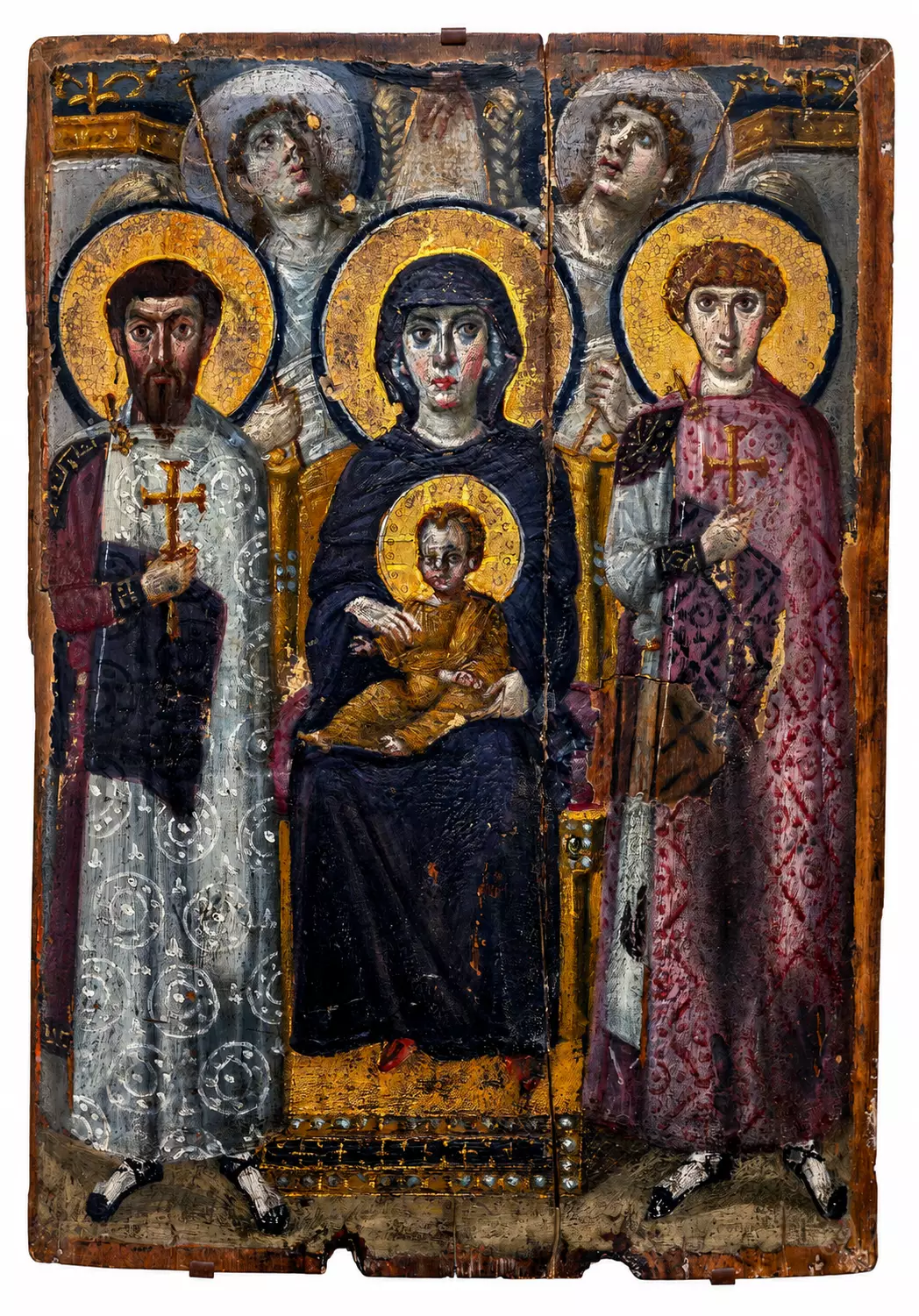
Among the surviving images of Early Byzantine Christianity, the Virgin and Child Sinai icon preserved at Saint Catherine’s Monastery occupies an exceptional place. The anonymous panel is generally dated to the second half of the sixth century or, in broader cataloguing, to the sixth or early seventh century. Painted in encaustic on wood, it measures about 68.5 × 49.7 cm. At the centre the Theotokos sits on a jewelled throne with the Christ Child on her lap; beside her stand the military saints Theodore and George, while two angels rise behind the throne and turn toward the divine hand above. The monastery identifies Theodore at the Virgin’s right and George at her left. This is one of the small group of pre-Iconoclastic panel icons that give direct evidence for sacred painting before the upheavals of the eighth and ninth centuries.
Across the panel, age is conspicuous. A deep vertical split passes through the wooden support, the borders are worn, and losses expose the support in several areas. Yet the principal faces remain remarkably legible. Large golden haloes, the dark mass of the Virgin’s maphorion, Theodore’s pale ceremonial dress and George’s patterned reddish garment still establish the composition with considerable force. A Constantinopolitan origin has often been proposed, although the painter, patron and original setting are unknown; a court connection therefore remains a plausible possibility.
Virgin and Child Sinai Icon: Encaustic Painting and Early Byzantine Presence
Encaustic gives the surface much of its unusual character. Pigment bound in wax can be handled in dense or thin applications, and the faces retain a varied, tactile modelling that differs from the more linear treatment familiar from many later panel icons. The technique had a long Mediterranean history. Modern scholarship has often looked toward the panel portraits of Greco-Roman Egypt when discussing the material ancestry of early icons, though continuity of technique does not imply continuity of function. Bissera V. Pentcheva has also stressed that the Byzantine word eikon carried meanings broader than the modern idea of a painted holy portrait on wood.
Most strongly in the flesh is that inheritance felt. The Virgin’s face is built from cool grey-green passages, rose and red accents, pale highlights and dark contours around the eyes. Her cheeks are unevenly modelled; the vivid mouth sits beneath a long, narrow nose. The Child has a warmer complexion, while Theodore’s beard and George’s smooth youthful face establish two sharply differentiated physiognomic types. Even the angels, paler and partly screened by the figures in front, possess distinct heads, necks and glances.
The Enthroned Theotokos and Child
On the central axis, the enthroned Theotokos provides the dominant mass. A very dark blue maphorion encloses her head and shoulders and descends in broad folds across her knees, absorbing light so strongly that the face and hands seem to emerge from the garment. The throne behind her is more elaborate: gold-toned posts, pearl-like ornament, coloured settings and a raised footrest establish a ceremonial seat. Beneath the heavy mantle, the slight turn of the knees gives the body real volume.
Her face is nearly frontal, although the eyes move subtly away from the strict axis. That displacement is small but important. The pose remains hieratic; the gaze introduces a private, almost inward note. The Christ Child likewise avoids rigid frontality. Seated across his mother’s lap in a warm ochre-gold garment, he turns his head and upper body slightly, one hand raised toward the Virgin’s resting hand while the other lies lower across his body. His rounded cheeks and compact limbs retain the physical presence of a child, the contact between mother and son held within the broader ceremonial arrangement of the throne.
Saints Theodore and George: Courtly Military Martyrs
At the Virgin’s right stands the bearded Saint Theodore; at her left, the youthful Saint George. Both face outward with large golden haloes and hold crosses before their bodies. Their military identity is conveyed through established iconographic tradition and ceremonial dress, while the crosses foreground their status as martyrs. The official account of the monastery likewise identifies the two standing figures as George and Theodore.
Theodore wears a pale mantle covered with scrolling and circular ornament over darker garments. George’s costume is more chromatically emphatic: reddish-purple fabric patterned with small round motifs, a darker section falling over one shoulder, narrow pale sleeves visible beneath. Such clothing has long encouraged comparison with the ceremonial dress of imperial officials and guards, a feature consistent with the proposed Constantinopolitan setting of the work. Costume by itself provides insufficient evidence for identifying either a particular workshop or a patron.
Strikingly still, the two saints raise their long bodies almost vertically from a narrow strip of ground, their feet projecting only slightly into the foreground. Theodore’s mature, bearded physiognomy and George’s broad-eyed youth form a deliberate pair of contrasting types. Both look directly outward. Around the enthroned group, their fixed gazes establish a formal boundary between the spectator and the more mobile celestial register behind them.
Angels, the Hand of God, and the Direction of the Gaze
Behind the throne, largely concealed by the saints and the high back of the seat, appear two angels. Their heads break the frontal discipline of the lower figures. Each turns sharply upward, neck extended, eyes directed toward the small heavenly segment at the top centre, from which the hand of God emerges. A shaft of light descends toward the Virgin, completing a vertical axis through the composition.
The movement of sight is unusually complex. Theodore and George address the world in front of the panel; the Virgin’s eyes shift from the centre; the Child turns within her lap; the angels look beyond every earthly participant. Gaze becomes a structural device. It carries attention upward while overlapping haloes and tightly packed bodies keep the sacred assembly within a shallow pictorial space. Through superimposition, scale and the throne comes most of the depth, without an extended architectural or landscape setting.
Naturalism and Hieratic Order
Within this compressed arrangement, two visual languages coexist. The faces retain strong Late Antique naturalism: irregular modelling, individual colouring, soft transitions around the cheeks, occasional asymmetry. The composition as a whole follows hierarchy, frontality and axial order. Theodore and George stand as ceremonial attendants; the Virgin is larger and enthroned; the Child occupies the centre of her body; the angels belong to a more distant, elevated plane. Corporeal immediacy remains embedded within this carefully regulated sacred structure.
The drapery works in a similar way. Broad folds around the Virgin create weight, while the saints’ garments provide pattern and surface richness. George’s reddish fabric is especially dense with ornament; Theodore’s pale clothing carries looping forms still visible through abrasion. Around the faces the handling becomes finer and more responsive, preserving minute shifts of tone across cheeks, brows and mouths.
Survival at Sinai and the Condition of the Panel
The icon’s exceptional status also depends upon its place of preservation. Saint Catherine’s Monastery holds an extraordinary concentration of sixth- and seventh-century encaustic panels. The monastery attributes their survival to Sinai’s dry climate, the continuity of the monastic community and its position beyond the effective reach of the Byzantine Iconoclast emperors after the region had passed under Muslim rule. It also records the scholarly suggestion that some icons may have been sent to Sinai for safekeeping during Iconoclasm, a possibility for which definitive evidence is lacking.
Material survival has come with substantial surface damage. The central fracture divides the panel from top to bottom. Abrasion has reduced passages of drapery, the borders are chipped, and significant losses occur beside George and toward the lower right. Elsewhere the ageing support and preparation assert themselves through the thinned paint. Beneath the sacred image the physical object remains visible: timber, layered paint, golden haloes, exposed wood, old damage.
From Late Antiquity to the Byzantine Icon
The historical importance of the panel lies partly in this meeting of traditions. Encaustic technique, individualized physiognomy and a concern for bodily volume connect it with Late Antique painting; centralized hierarchy, sacred assembly and regulated frontality belong fully to Early Byzantine visual culture. A simple linear evolution cannot account for the result. Drawing upon classical modes of modelling, the painter organized the figures according to a Christian ceremonial order whose hierarchy is visible in scale, placement and direction of gaze.
For the early history of the Byzantine icon, that coexistence is especially valuable. The image already possesses concentrated frontal address, hierarchical scale and a strong devotional focus, yet its figures retain markedly separate rhythms: Theodore’s beard, George’s youthful face, the Virgin’s off-axis eyes, the Child’s compact body, and, above the throne, the two angels still turning their heads toward the small hand in the heavens.
(The translation was edited by A. Orfanos.)