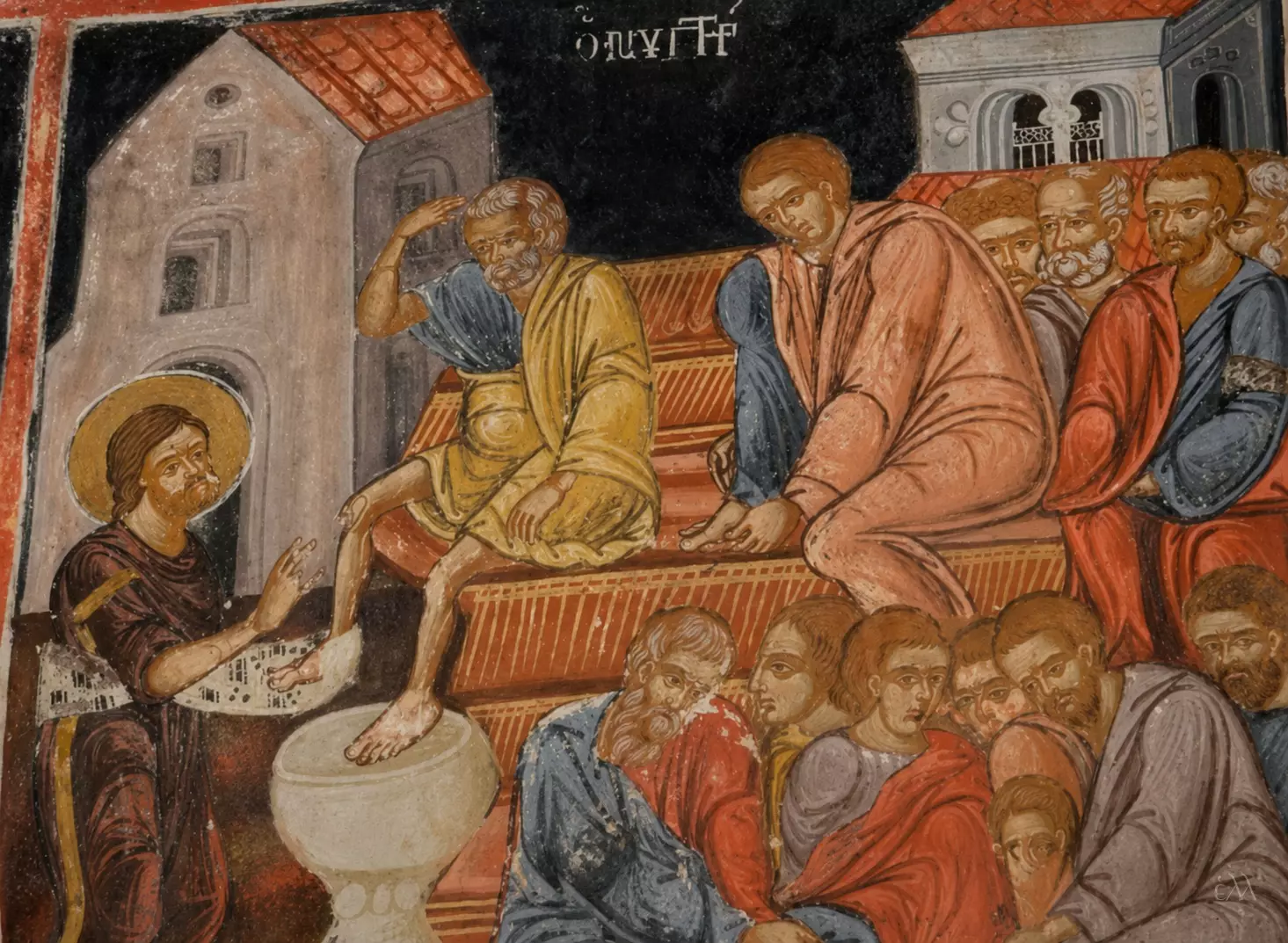
In the catholicon of the Holy Monastery of the Holy Trinity in Meteora, the fresco of the Washing of the Feet was painted in 1741, one of the most characteristic scenes of the Dodekaorton, inspired by the Johannine evangelical narrative concerning the washing of the disciples’ feet by Christ. The fresco painting of the entire church was undertaken by the priest Antonios and his brother Nikolaos, painters who, under the metropolitan of Stagoi Theophanes and the abbot Parthenios, continued the tradition of post-Byzantine ecclesiastical painting in an era when the monasteries of Meteora remained living workshops of religious art.
The composition is organised around the moment of humility, when the teacher kneels before his disciples.
The Visual Narrative of the Meteora Washing of the Feet Fresco in Post-Byzantine Art
Christ is depicted bowed, with both hands wrapped around the foot of a disciple, his gaze fixed upon the basin that stands before him, upon a tall white small column. He wears a deep, dark-coloured chiton, with a gold band on the sleeve, while around his head a thin halo is delineated. Opposite him, seated on the uppermost step, Peter raises his hand near his head, a gesture that alludes to his words unto the master: not my feet only, but also my hands and my head (John 13:9). His beard is white, the chiton yellow over a light blue undergarment, the bare foot extended toward the basin.
Behind and higher up crowd the remaining disciples, some standing with red and light blue garments, others seated lower in postures of silent observation; the youngest of them with a rosy mantle leans forward. Two buildings with tiled roofs frame the composition, between them the dark ground where the inscription naming the event is preserved. The alternation of ochre, terracotta, and light blue gives the fresco a warmth rare among its contemporary works of the region.
(Translated from the Greek text by K. Pappas.)


