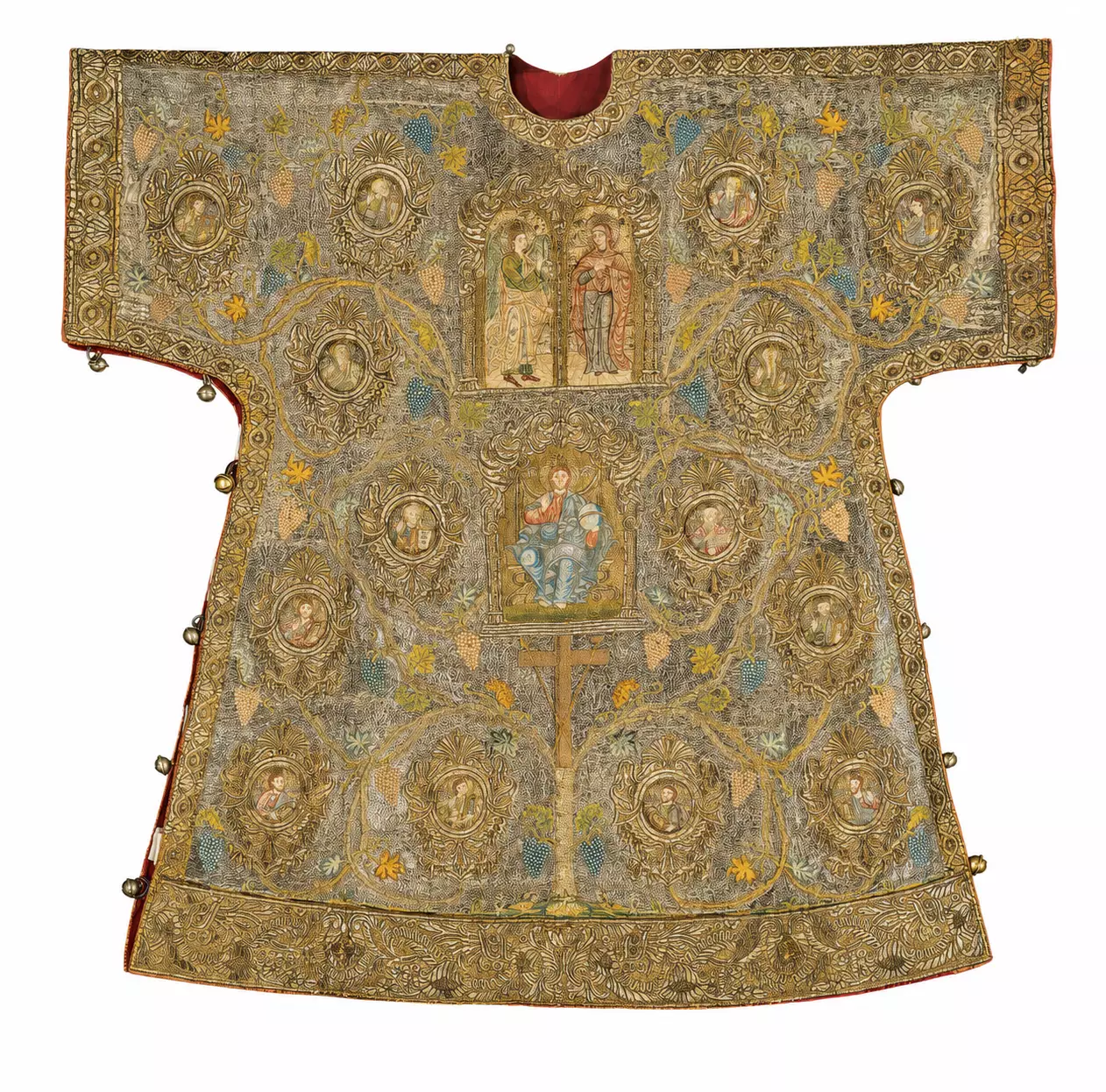
The Sakkos of the Bishop of Melenikon Ioannikios, dated to 1745–1753, is an exceptionally rich eighteenth-century episcopal vestment associated through its embroidered inscription with Christophoros Zefar. Preserved in the Museum of Byzantine Culture in Thessaloniki, it measures 133.5 cm in height and 65 cm in width and is made from silk and linen enriched with gold and silver thread. Across its broad T-shaped surface, dense embroidery transforms the garment into a continuous pictorial and ornamental field.
On the front, scrolling vine shoots laden with grapes spread between oval medallions containing the Apostles. Dominating the surface are the metallic threads, while restrained passages of blue, green, red and ochre give definition to figures and vegetation. Within this intricate pattern, two larger rectangular compositions establish a clear visual hierarchy: the Annunciation occupies the upper centre and the enthroned Christ Pantokrator appears below. Elaborate foliate frames surround both scenes, their curling forms merging almost seamlessly with the surrounding vine ornament.
Repeated apostolic medallions, varied in scale and placement, punctuate the textile from the sleeves to its lower section — small suspended bells remain visible along the edges — while densely worked ornamental borders define the garment’s silhouette. Figures, foliage, grapes, metallic scrollwork: the accumulation of embroidery leaves very little unworked space.
Sakkos of the Bishop of Melenikon Ioannikios: Embroidery and Iconography
On the reverse, the iconographic programme develops the Tree of Jesse. Jesse lies at the base, a vine growing upward from him, its branches terminating in prophets and ancestors of Christ. Higher above appears the enthroned Theotokos holding the Christ Child.
A golden double-headed eagle occupies the upper section, incorporating an oval polychrome enamel medallion representing the Holy Trinity. A minute gold-embroidered inscription identifies Ioannikios, Bishop of Melenikon, as the owner and names Christophoros Zefar as the craftsman responsible for the sakkos.
(The translation was edited by A. Orfanos)