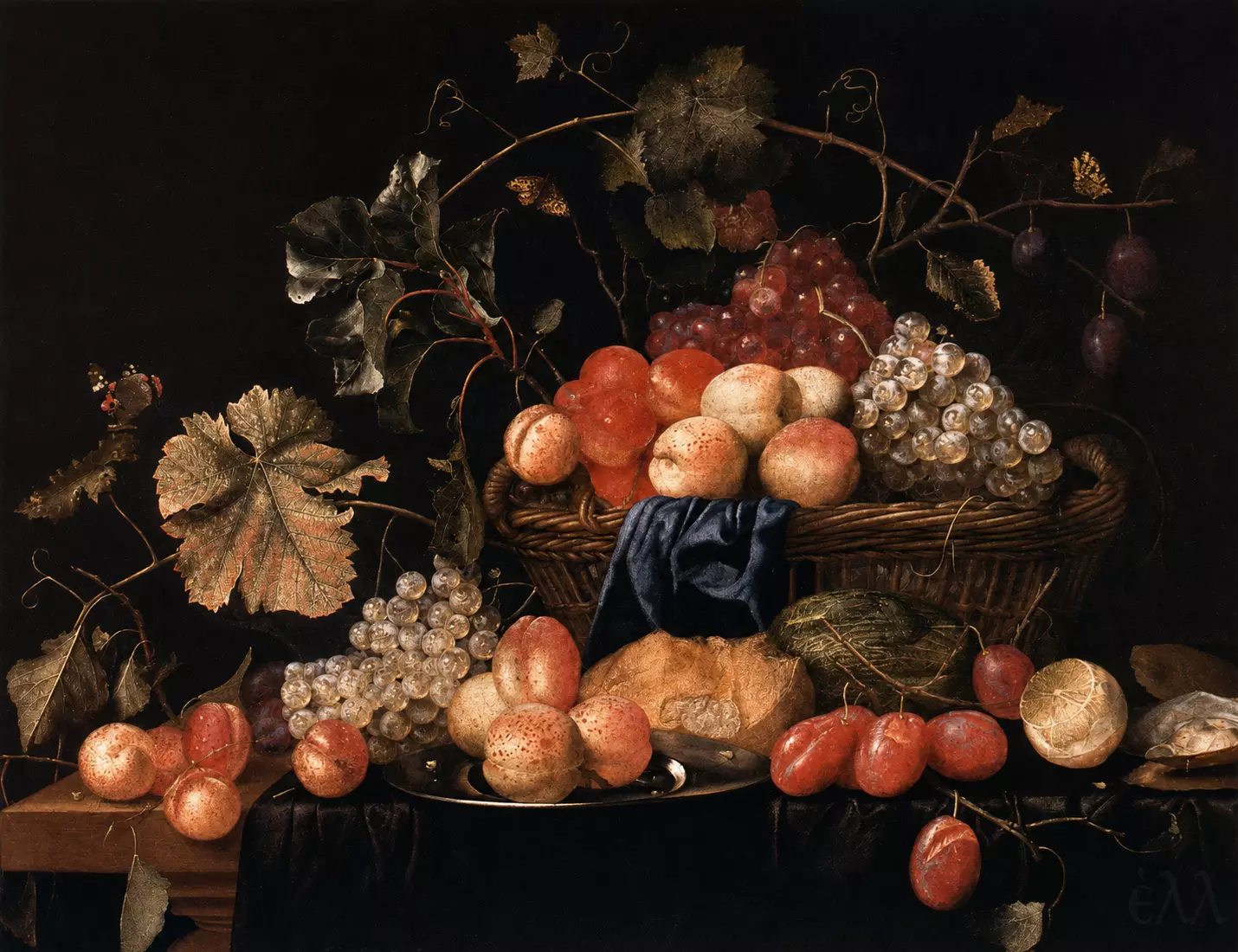
A broad wicker basket, heaped with fruit and crossed by a strip of dark cloth, governs the centre of Theodoor Aenvanck’s Fruit, painted in 1653. Aenvanck, an Antwerp painter born in 1633, gives this apparently simple gathering of cultivated produce an unusually elaborate pictorial structure: grapes spill forward, rounded fruits press against one another, vine stems rise into the darkness, leaves turn at different angles, catching or refusing the light. Painted in oil on panel and measuring 63 × 80 cm, the work belongs to the Koninklijk Museum voor Schone Kunsten in Antwerp.
Its abundance is immediately evident, its organisation less so. The basket occupies the upper centre but does not contain the composition. Fruit descends from it towards the table, while the vine extends upwards and sideways, carrying the eye into regions of the dark background that might otherwise have remained empty. On the left, a large vine leaf opens almost flat towards the spectator; below it, grapes and individual reddish fruits accumulate close to the edge. Across the opposite side smaller forms continue the horizontal movement, although with wider intervals between them.
Aenvanck thus treats still life as an arrangement of differences: smooth skin beside mottled skin, translucent grapes beside dense fruit, woven wicker beside soft textile, curling tendrils beside the blunt geometry of the tabletop. Abundance drives the picture, though it never escapes a firm structural discipline that keeps each element in its place.
Theodoor Aenvanck Fruit: Light, Texture and Abundance
Light enters the composition selectively, finding surfaces rather than illuminating the whole arrangement as a single mass. Pale grapes become small globes marked by concentrated highlights, the warmer fruit acquires speckled and uneven skins, and individual forms separate from neighbouring ones through slight changes of value. A reddish fruit near the lower left is modelled differently from the grapes beside it, while the pale fruits in the basket have a softer, more granular appearance. Such distinctions are essential to the painting. Without them the accumulation would collapse into colour alone.
Especially effective is the contrast between the illuminated fruit and the background, a field so dark that several vine leaves nearly merge with it. Others suddenly become legible when their edges or veins receive light. The branch arching over the basket is thin, sometimes barely visible, yet its tendrils describe loose curves against the darkness. Small winged insects settle within this upper network. Their scale is minute compared with the fruit below, and the precision required to register them sharpens the viewer’s awareness of just how carefully the whole surface has been observed.
The table itself establishes a different rhythm. Across its lower edge, fruit is dispersed rather than piled into a single mound. Grapes occupy the left foreground; rounded reddish and pale forms lead towards the centre; farther right, isolated fruits create pauses between denser groups. The dark cloth, which falls from the basket in loose folds, interrupts this sequence. Folded upon itself, almost blue-black in parts, it forms a deep vertical note between the warm fruit and the brown wicker. Its presence is visually important, denying the composition an uninterrupted procession of edible objects, since cloth, basket, leaves and stems each introduce a different kind of surface alongside the fruit.
Texture becomes, in fact, one of Aenvanck’s principal means of pictorial organisation: the wicker rendered through repeated interlacing lines, the grapes through highlights and translucency, the peaches or apricot-like fruits through softly mottled skins. By contrast, the vine leaves demand something else again. Particularly in the large leaf extending towards the left, their dry, irregular edges, ribs and folds are articulated with greater linear complexity. Some have begun to lose their freshness, the signs small and undramatic: discolouration, curled margins, surfaces that appear drier than the full fruit beneath them.
Such observations keep the still life from becoming a diagram of perfect produce. Ripeness has several stages here. Fruit is blemished, leaves are ageing, stems twist unpredictably. Aenvanck allows cultivated plenty to retain the accidents of organic matter, and the result is more convincing because every object has not been corrected into ideal form.
The painting also depends upon a carefully managed alternation of warm and cool passages. Reds, ochres, muted yellows and brown tones dominate the fruit and basket, while the grapes provide paler accents and the cloth introduces a colder interval. Against the nearly black background these colours acquire considerable luminosity without becoming uniformly brilliant. One region catches the eye, another recedes, as a highlight appears on a grape, disappears into a leaf, and returns on the rounded surface of a fruit, so that light moves across the panel in this discontinuous, shifting way.
Composition, Balance and Spatial Order
This control matters because the quantity of objects could easily have produced visual confusion. Aenvanck instead builds several overlapping zones. The table forms the lowest horizontal band; fruit resting upon it advances into the foreground; the basket establishes the central mass; the vine occupies an upper, more open zone. Between them are crossings and interruptions. A stem passes in front of darkness, leaves overlap fruit, the cloth falls over the wicker rim. Depth remains relatively shallow, yet the overlapping is persistent enough to prevent the arrangement from appearing flat.
Older scholarship recognised Aenvanck as an elusive figure. It was Eugenia Zarnowska who, in her 1929 survey, referred to the small number of decorative paintings then associated with him, characterising their tonality as blond and delicate. The description is suggestive when set beside Fruit. Delicacy does not mean weakness in this case. It resides in the restrained transitions between illuminated and shadowed surfaces, in the minute differences between grapes, in a tendril traced through darkness, in the speckling of a pale skin.
The painting belongs unmistakably to the culture of seventeenth-century Flemish still-life painting, in which the representation of natural and manufactured surfaces offered painters an exacting field for technical display. Aenvanck’s solution remains comparatively concentrated. There are no figures to establish narrative, no architectural setting, no broad landscape opening behind the table, only the objects themselves, occupying the visual field and building their own spatial order from surface, light and interval.
At the centre, the basket gives that order weight. Above it, the vine refuses stillness. Its branch travels across the upper part of the picture with an almost calligraphic irregularity, sending out tendrils, leaves, small offshoots. Below, heavier fruits settle under gravity, some supported by the basket, others resting directly on the table. The opposition is quietly sustained: weight below, extension above; compact forms in the centre, thinner lines at the margins.
What remains most persuasive is Aenvanck’s refusal to make every fruit equally conspicuous. Several are partly concealed, others merge with neighbouring forms, and some leaves are barely recoverable from the background. The eye therefore has to search. From the pale grapes to the dark foliage, from the wicker to the folded textile, from an illuminated fruit to a stem almost lost in shadow, Fruit reveals itself gradually—a still life abundant in objects, exact in observation, controlled in light.
(The translation was edited by K. Brown.)