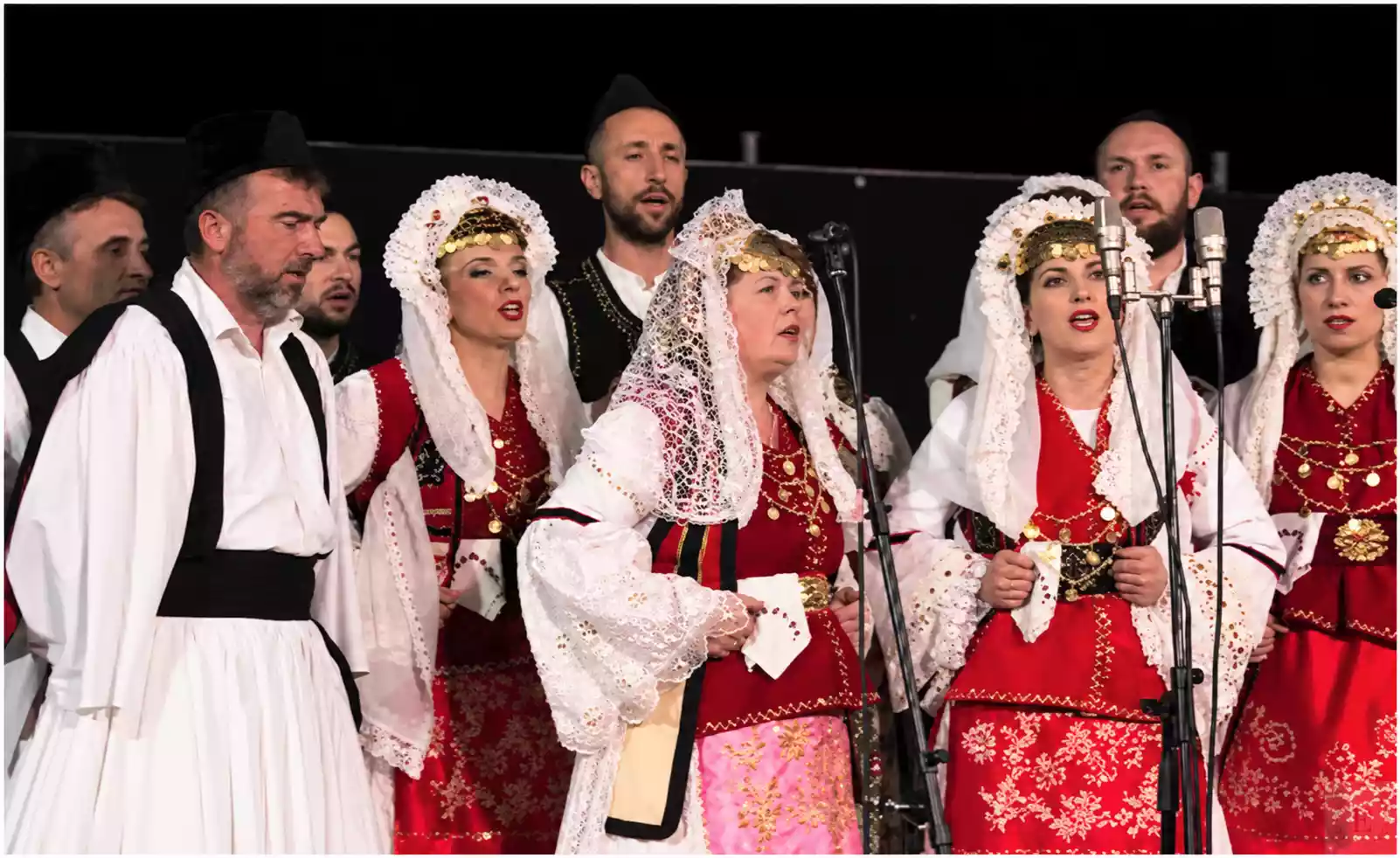
 A mixed vocal ensemble on stage, the women in embroidered costumes and white lace head coverings.
When the partis takes up the song, the other singers pick out from his opening phrase the pitch and the contour of the melody, well before the dense web of sound that defines Pogoni polyphony has begun to unfold. The first voice sets out the words; a second answers with a melodic movement of its own, over the foundation held by the isokrates, the drone singers. A group with a good number of singers may therefore produce only a handful of distinct vocal lines, since several people share the drone between them.
In the villages of Pogoni and in the neighbouring Greek-speaking communities of southern Albania the tradition takes on local variants, within a wider area of related polyphonies that pays little heed to state borders. The names of the roles come from the singers’ own vocabulary, and they often describe what each voice actually does within the ensemble.
What an anhemitonic pentatonic scale means
Pentatonicism describes a musical framework of five different pitches within the octave, while the adjective “anhemitonic” indicates that no semitones occur between adjacent degrees. A simple theoretical example is the series A, C, D, E, G and then A again an octave higher, with intervals of a minor third, a tone, a tone, a minor third and a tone. The final A merely repeats the starting pitch higher up; the distinct degrees remain five. The series serves as a teaching example and does not imply that every Pogoni song is built on A as its tonic.
The tonic is the pitch that acts as the melody’s point of reference. Around it the movements and cadences of the voices are organised, with ornaments and inflections of pitch that a bare list of notes can only approximate. To the listener, the way a singer approaches a note, or cuts it off, carries a weight of its own.
The number of degrees concerns the organisation of pitch, whereas metre concerns the organisation of time: pentatonicism and a five-beat metre are independent parameters.
The partis and the steadiness of the drone
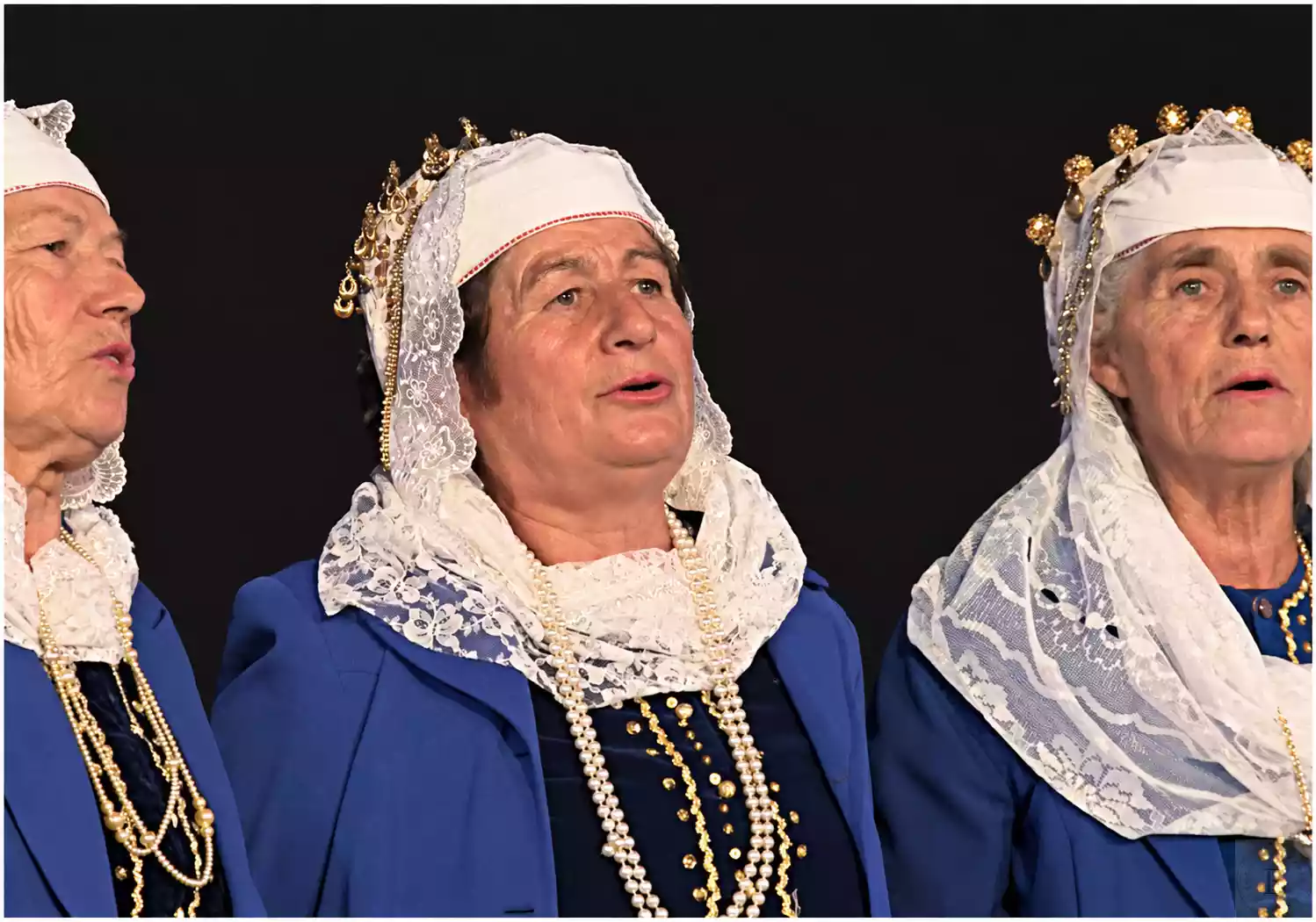 Women in mid-song, dressed in blue with white lace on their head coverings.
The opening falls to the partis, who shapes a phrase that often comes close to musical recitation and prepares the entry of the other voices. It is in his delivery that the poetic text is heard most clearly. The account of the polyphonic roles in Greece’s National Inventory of Intangible Cultural Heritage brings out his coordinating function, since the relationship between the main melody and the other voices depends on him.
The isokrates as a rule hold the tonic and sustain the drone wherever the partis breaks off the melody. In Thanassis Moraitis’s description they follow the leader’s syllables with a less distinct articulation, keeping the sound continuous between his phrases.
The gyrisma and the breaking of the voice
Around the line of the partis moves the gyristis, the “turner”, with characteristic cadences and ornaments. A key point of support for him is the subtonic, the degree immediately below the tonic in the system in question, where he often comes to rest by cutting his voice off abruptly. Against the partis on the tonic, this produces a sharp dissonance, such as A against the lower G in the example above. Depending on the mode, the distance between tonic and subtonic may be a whole tone or a minor third.
For this sudden break the terms kopsimo (“cutting”) and tsakisma (“breaking”) are attested. In these particular descriptions skasto is not recorded as a polyphonic role in its own right; if the word is used for the clipped sound, that descriptive use should be made explicit. The technique combines the placing of the cadence with the manner in which the sound is cut short.
The klostis sings the high, ornamented voice, with characteristic laryngeal trills and the use of head voice or falsetto, often vocalising on vowels rather than the words of the poem. His relationship to the gyristis is described differently in different sources: the National Inventory presents them as alternative forms of the second role, while Lambros Liavas, in his notes on “Alismono kai chairomai” in the Domna Samiou archive, mentions that a klostis may be added to the group. The make-up of an ensemble therefore needs to be considered in the light of the local version and the specific performance, within the broader tradition that the Ionian University also presents.
Some versions also feature the richtis, who makes a brief intervention at the end of the opening phrase, before the full ensemble comes in. His function varies by area and by type of song.
Slow time and the distinction from 5/8
The Pogonisios dance is associated with a slow, heavy step and is usually notated in quadruple time, 4/4. In the case of “Vasilikos tha gino”, Miranda Terzopoulou describes the tune as a slow syrtos sta tria in 4/4. Here “sta tria” (“in three”) refers to the form of the dance, while 4/4 gives the musical metre of the transcription.
The marking 5/8 indicates a metre of five quavers, usually grouped internally as 2+3 or 3+2, while tempo is specified separately. Epirote music also knows free rhythmic organisation, characteristic of many laments, in which the phrase follows breath and delivery with no regularly recurring metre. Analysis must therefore keep metre distinct from the temporal freedoms of performance.
How the clarinet draws close to the voice
In the instrumental moiroloi, or lament, the kinship with the human voice can be heard in the attack of each note and in the way it changes before dying away. The Domna Samiou archive states explicitly that Epirote clarinettists imitate women’s lamenting voices, and it classes this particular recording as being in free rhythm. The impression that the clarinet “weeps” thus rests on a concrete acoustic basis, familiar to anyone who knows the sung lament.
In her research on Parakalamos, Nicola Maher describes a sobbing effect produced when the pitch slides downwards together with a wide, slow oscillation of the sound, that is, vibrato. The sustained note sinks and trembles. In the same local setting the term moria is used for expressive ornaments involving pitch bends and microtonal shadings, which matter a great deal to the character of the playing.
The same study examines the relationship between vocal polyphony and the kompania, the instrumental band: the clarinet takes the main melody, while the violin may support the sound or develop a second line, depending on the performance. These correspondences concern specific musical functions, and they allow us to hear affinities between the vocal and the instrumental tradition.
Mourning and exile within the same repertoire
In Katsanevaki’s study, the vocal practices of the lament are examined as they are transformed and take on other social functions. Exclamations and modes of delivery associated with mourning pass into different musical contexts, which is why a lamenting sound can sit alongside love songs or festive occasions. Its meaning is shaped each time by the words and by the use of the song within the community.
In the polyphonic “Alismono kai chairomai” (“I forget and rejoice”), imminent exile is conveyed through the preparation of bread for the journey. The son asks his mother to knead paximadi, a twice-baked rusk, and she wishes the baking would take longer, so that the caravan might pass and her child remain at home. The departure still lies ahead of them, while the mother waits on the oven and the bread.


