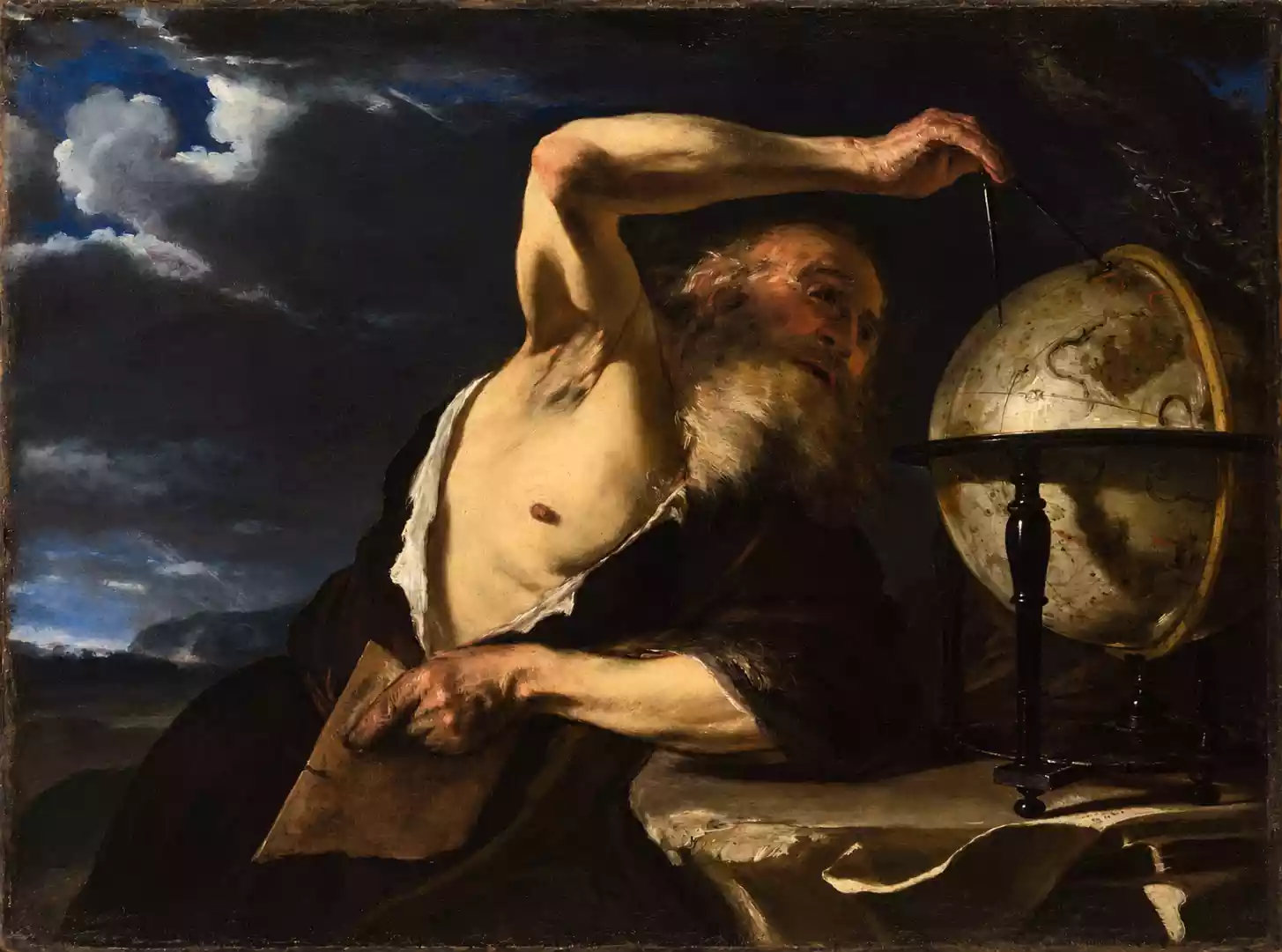
 Attributed to Giovanni Battista Langetti (1625–1676), The Philosopher Anaxagoras, c. 1660. Oil on canvas, 99.7 × 134 cm. Philadelphia Museum of Art, accession no. W1904-1-25, purchased with the W. P. Wilstach Fund, 1904. Digital reproduction: Philadelphia Museum of Art, via Wikimedia Commons. Public Domain.
His right arm raised above his head, in a movement that twists the shoulder and lets his torn shirt fall open to the waist, the old man in a seventeenth-century painting at the Philadelphia Museum of Art grips a pair of dividers by the hinge and lowers their points towards the surface of a celestial globe. The museum attributes the oil painting, which it dates to around 1660, to Giovanni Battista Langetti and identifies the sitter as Anaxagoras of Clazomenae (c. 500–428 BC), the Presocratic philosopher who was the first of his profession to live in Athens and, as far as we know, the first to explain eclipses by the interposition of one heavenly body in front of another. A generation earlier, in 1636, Jusepe de Ribera had painted him quite differently: bent over a massive book, in patched clothes. Imaginary portraits both, each reads from its own side a tradition that begins with the philosopher’s few surviving fragments and runs, by way of Plato and Aristotle, down to the biographers of late antiquity.
From Clazomenae to the Athens of Pericles
Born into a wealthy, aristocratic family of Clazomenae, a city on the western coast of Asia Minor, Anaxagoras is said to have made over his inheritance to his relatives in order to devote himself to philosophy. The anecdotes collected by Diogenes Laertius in his Lives of the Philosophers shaped early on the image of a thinker indifferent to everything that did not concern the heavens. When his relatives reproached him for neglecting his property, he asked why they did not look after it themselves; when someone asked whether he cared nothing for his native land, he pointed to the sky and said that he cared for it greatly; and when he was asked what he had been born for, he replied that he was born to study the sun, the moon and the heavens. Such stories from the biographical literature can rarely be checked against history, yet they remain valuable as evidence of how antiquity remembered him, and we shall meet them again in front of the two paintings.
He was twenty years old, the same biographer writes, when Xerxes crossed the Hellespont in 480 BC, a statement from which his birth is placed around 500 BC. Beyond this point almost every milestone of his life shifts according to the scholar consulted, as the entry by Patricia Curd and John Sisko in the Stanford Encyclopedia of Philosophy shows in detail. For his arrival in Athens, dates have been proposed ranging from 480 BC, improbable for a city then embroiled in war, to 456 BC, argued by Mansfeld and followed by other scholars, while a different reconstruction, Janko’s, places the philosopher at Lampsacus as a protégé of Themistocles in the years 466–460 BC, before he reached Athens and joined the circle of Pericles. In the city, where he remained for between twenty and thirty years as Pericles’ friend and protégé, his ideas circulated well beyond the small group of his interlocutors: Sophocles and Euripides knew them, perhaps Aeschylus too, and the comic playwright Aristophanes certainly did.
He wrote only one book, which, as Socrates says in Plato’s Apology, could be bought for a drachma at most. Its dating fluctuates in the same way, from the 470s to 440 BC, and the entry in the Stanford Encyclopedia regards as particularly persuasive Graham’s proposal of the years between 478 and 466 BC, which rests on two astronomical events we shall come to below. Twenty-two fragments survive, 118 lines of text in all, transmitted by later philosophers and commentators. In the standard collection of the Presocratics by Diels and Kranz, Anaxagoras is number 59. According to Diogenes, the treatise opened with the statement that all things were together until Mind (Nous) came and set them in order, and from this beginning the philosopher himself earned the nickname ‘Nous’.
The Charge of Impiety and Lampsacus
The sun, which traditional religion honoured as a god, was for Anaxagoras a red-hot stone, and this view, together with others deemed dangerous, brought him face to face with a charge of impiety. On the circumstances of the trial the ancient accounts diverge so widely that Diogenes lists the versions one after another without choosing between them. According to Sotion, the accuser was Cleon, and the philosopher, who had called the sun a red-hot mass of metal, was sentenced to a fine of five talents and to exile. According to Satyrus, the charge was brought by Thucydides, a political opponent of Pericles, who added to impiety the accusation of collusion with the Persians, so that Anaxagoras was condemned to death in his absence. Hermippus spoke of imprisonment and release after Pericles appealed to the people, Hieronymus of an acquittal owed more to the sympathy of the judges than to anything else.
Modern scholars have placed the trial in 450, 437, 434 or 430 BC. The last date, which the authors of the entry consider the most likely, connects the affair with a period in which the failed campaigns of 431 and 430 BC and the outbreak of the plague had shaken Pericles’ standing, exposing members of his circle along with him, among them Phidias and Aspasia. Plutarch links the prosecution to the decree of Diopeithes, directed against those who did not believe in the gods and who taught about celestial phenomena. In the same context belongs a remark that Satyrus attributes to the philosopher: on learning in prison of his own condemnation and, at the same time, of the death of his two sons, he said that he had known they were mortal from the moment he begot them. Spoken in the midst of the plague, which also robbed Pericles of his own sons, it sounds less cold than it would if transposed to another year.
Settled at Lampsacus, on the southern shore of the Hellespont, he died there in 428 BC. The people of Lampsacus buried him with great honours. When, Diogenes tells us, they asked him what he would like done in his memory, he requested that the boys of the city be given a holiday every year in the month of his death, a custom still observed in the biographer’s own day.
Everything in Everything: The Physics of Anaxagoras
His thought moved between two traditions. On one side stood the Milesians, Thales, Anaximander and Anaximenes, who had tried to explain the world through regularities inherent in the natural system itself, without recourse to personified gods; Anaxagoras belongs to this line, and the word ‘god’ does not occur in his surviving fragments. On the other side, Parmenides had argued that what is not cannot be, and that coming into being and perishing are therefore impossible. The man from Clazomenae accepts this prohibition but interprets it in his own way. The Greeks, he writes in one of the fragments (B17), do not think correctly about coming to be and passing away, for nothing comes to be or passes away, but is mixed together and separated out from things that already exist; it would be more correct to call coming to be mixing and passing away separation. Motion, however, which the Eleatic rejected, is something Anaxagoras needs, and here he parts company with him.
The principle most closely associated with his name is set out in another fragment (B11): in everything there is a share of everything. By this logic a bar of gold contains earth and water, flesh and hair, and portions of all the basic kinds of stuff, which, in order to coexist everywhere, must interpenetrate one another. Nutrition offered an almost textbook example. When a child eats bread and drinks milk and its body gains flesh, blood and bone, the change is not due to one substance being transformed into another, since these ingredients were already present in the food and simply accumulate. The question ‘how could hair come from what is not hair?’, preserved by an anonymous scholiast on Gregory of Nazianzus, sums up the reasoning, although the authenticity of the fragment has been disputed.
If everything is in everything, it remains to explain why gold looks like gold. The answer lies in fragment B12, according to which each thing is and was most manifestly that of which it contains the most. This does not mean, as is often assumed, that the predominant ingredient must exceed half of the mass; it is enough for it to outweigh each of the other ingredients taken individually. The possibility of complete separation, which would undo the universal mixture, is ruled out by his view of the infinite: of the small there is no smallest, but always something smaller, and of the large always something larger (B3). Less clear are the ‘seeds’ mentioned in fragment B4b, which have been interpreted sometimes as biological seeds and sometimes as a term for the basic substances themselves, from which, in some sense, everything else sprouts. The term ‘homoeomeries’, finally, with which later tradition summed up his system, probably belongs to Aristotle rather than to Anaxagoras himself.
Mind and the Cosmic Vortex
Amid all that is mixed, one thing alone remains unmixed. Mind, according to the longest surviving fragment (B12), is unlimited and self-ruling and has been mixed with nothing; for if it were mixed, the things with which it was mingled would prevent it from ruling over them, whereas now, being alone by itself, the finest and purest of all things, it has complete knowledge of everything and the greatest power. It was Mind that set the rotation going, a rotation that began in a small region, now revolves more widely and will revolve more widely still; and it was Mind that ordered all that was to be, all that was and now is not, all that is and all that will be, together with the revolution in which the stars, the sun, the moon, the air and the aether now move. As the vortex spreads, it redistributes matter and lets the individual objects of the world emerge, and in another fragment (B4a) the philosopher speaks of human beings who inhabit cities and till the land, with a sun and a moon ‘as with us’, advancing a thesis of multiple worlds of like form whose topography is nowhere made clear.
This principle, which promised more than it delivered, gave rise to the best-known disappointment in ancient philosophy. In Plato’s Phaedo, Socrates recounts how delighted he was to hear that Mind orders all things, expecting to learn from Anaxagoras’ book why it is best for things to be as they are, and how, on reading it, he found that the author made no use of Mind to explain the ordering of the world but invoked as causes air, aether, water and many other oddities. Aristotle repeated the criticism, yet he also wrote the sentence that defined Anaxagoras’ place in the history of thought: when he declared that mind is present in nature, as in animals, as the cause of the world and of all its order, he seemed like a sober man among those before him who had spoken at random (Metaphysics I.3, 984b15).
What exactly Mind was, modern scholarship has not agreed. For some interpreters it is a special, exceedingly fine kind of matter; for others, an attempt to describe something incorporeal before the language for such a thing existed; a third reading sees in it natural law itself. Most modern scholars, contrary to the verdict of Plato’s Socrates, understand it as a teleological cause, Sedley with emphasis on an anthropocentric direction in the cosmogony, Laks as an ongoing cognitive discrimination of the ingredients. A fragment of Philodemus from the Herculaneum papyri (PHerc. 1428), not included in Diels and Kranz and edited by Vassallo, attributes to Anaxagoras the idea that the motion due to Mind was, is and always will be, which is to say that the cosmogony had no first moment. The principle’s influence can be clearly traced in the cosmic intellect of Plato’s Timaeus, in Aristotle’s unmoved mover and in his theory of the human mind in On the Soul.
Eclipses, Meteorites and the Sun as a Fiery Stone
The explanation of eclipses by interposition, the screening of one body by another, appears to have rested on observation and on reports. On 17 February 478 BC an annular solar eclipse, visible from Athens, Clazomenae and Lampsacus, cast its shadow over most of the Peloponnese, and sailors crossing the Aegean could have carried the news. Two otherwise curiously specific claims attributed to him may derive from such reports: that the moon is as large as the Peloponnese, and that the sun is larger than the moon. For this reason the eclipse of 478 is taken as the earliest possible date for the composition of his book.
He was also the first to maintain that there are solid, heavy bodies in the sky, held aloft by the violent rotation of the vortex, and that some of them, overcoming its force, will one day fall to earth. A few years later, in 466 BC according to Pliny, while a comet was visible in the night sky, a stone the size of a wagon fell at Aegospotami, on the shore of the Hellespont opposite Lampsacus, and Anaxagoras acquired the reputation of having ‘predicted’ its fall. Diogenes writes that he had foretold that a stone would fall from the sun, and that Euripides, whom he regards as a pupil of Anaxagoras, calls the sun a golden clod in the Phaethon. The same year also brought, according to the analysis adopted in the Stanford entry, a refutation: his theory of comets, which he explained as a conjunction of planets, was contradicted by Halley’s Comet, visible across the whole Mediterranean from June to August of 466 BC, a fact that argues for the book having appeared before that year. In the same naturalistic manner he explained thunder and lightning, whirlwinds, hail and the flooding of the Nile, which he attributed to melting snow in the mountains of Ethiopia, while he pictured the earth as flat, shaped like a drum.
An episode recounted by Plutarch shows how the theory reached Pericles’ circle. On 3 August 431 BC, as the fleet was preparing to sail, an eclipse of the sun occurred and panic spread through the crews. Pericles held his cloak in front of the eyes of the terrified helmsman and asked him whether he thought this a dreadful omen; when the man said no, Pericles asked what difference there was with the eclipse, except that it had been caused by something larger than a cloak. As for the senses, Anaxagoras acknowledged that their weakness prevents us from discerning the truth (B21), but held that appearances offer a glimpse of what is unseen (B21a), and Aristotle would later use his explanation of eclipses as a model of scientific explanation in the Posterior Analytics.
Anaxagoras in Seventeenth-Century Painting
The rediscovery and publication of classical texts in the sixteenth and seventeenth centuries revived interest in the philosophers of antiquity, and in Naples, where the Spanish aristocracy of the viceroyalty made up Ribera’s most important clientele, the figure of the wise old man, poor and humble, became a pictorial subject in demand in its own right. The LACMA catalogue notes, regarding a philosopher from the same group of works, that the painter portrayed these thinkers as poor men, stressing their devotion to metaphysical rather than material pursuits, and that the asceticism which tradition ascribed to ancient philosophers, prophets and saints resonated with a Spanish Catholic public. Diogenes Laertius, finally, was a source not only of anecdotes but also of physiognomic clues, and identifications of uninscribed figures are still attempted on the basis of such descriptions.
Dividers and Celestial Globe in the Philadelphia Painting
The museum record titles the work The Philosopher Anaxagoras, dates it to around 1660 and assigns it, with the caution of ‘attributed to’, to Giovanni Battista Langetti (1625–1676). An oil on canvas measuring 99.7 × 134 cm, with accession number W1904-1-25, it entered the collection in 1904 as a purchase from the W. P. Wilstach Fund. In its brief note the museum places Anaxagoras in the fourth century BC, whereas the ancient testimonies and the philosophical literature converge on the years c. 500–428 BC, that is, the fifth century. As characteristics of the figure it cites his fame for astronomical and mathematical discoveries and his ascetic life, which the painter signals through the garment of animal skin. The identification, moreover, is not the only one that has been put forward, since the name of Archimedes also appears in records of the work’s digital reproduction.
Horizontal in format, the composition opens on the left onto a stormy sky with grey-white clouds and patches of deep blue above a low, dark horizon, while the figure, set on a diagonal, fills the centre. The light falls strongly on the bare torso and on the white shirt, which is torn and hangs open, and at the shoulder, near the globe, the fur of the garment can be made out. The face, framed by a long greyish beard with warm highlights, is seen foreshortened, the gaze directed towards the globe. The right arm bends above the head and holds the instrument by its top, while the left crosses in front of the body and rests on a folded sheet or book in the lower left. The globe, on a dark turned stand and encircled by rings, bears drawn constellation figures, among them a long serpentine line like the body of a snake, and small reddish marks. On the table to the right are a small inkwell with a white quill and an unrolled sheet with a line of letters that cannot be read in the available reproduction.
In contrast to Ribera’s reader, Langetti’s philosopher is painted out of doors, beneath an open sky, in the act of measuring. The choice may be read as a pictorial rendering of Diogenes’ anecdotes, of the man who points to the sky as his homeland and declares that he was born to study the sun, the moon and the heavens, although we cannot know whether the painter or his patron had precisely these passages in mind.
The Book and the Patched Clothes in Ribera’s Painting
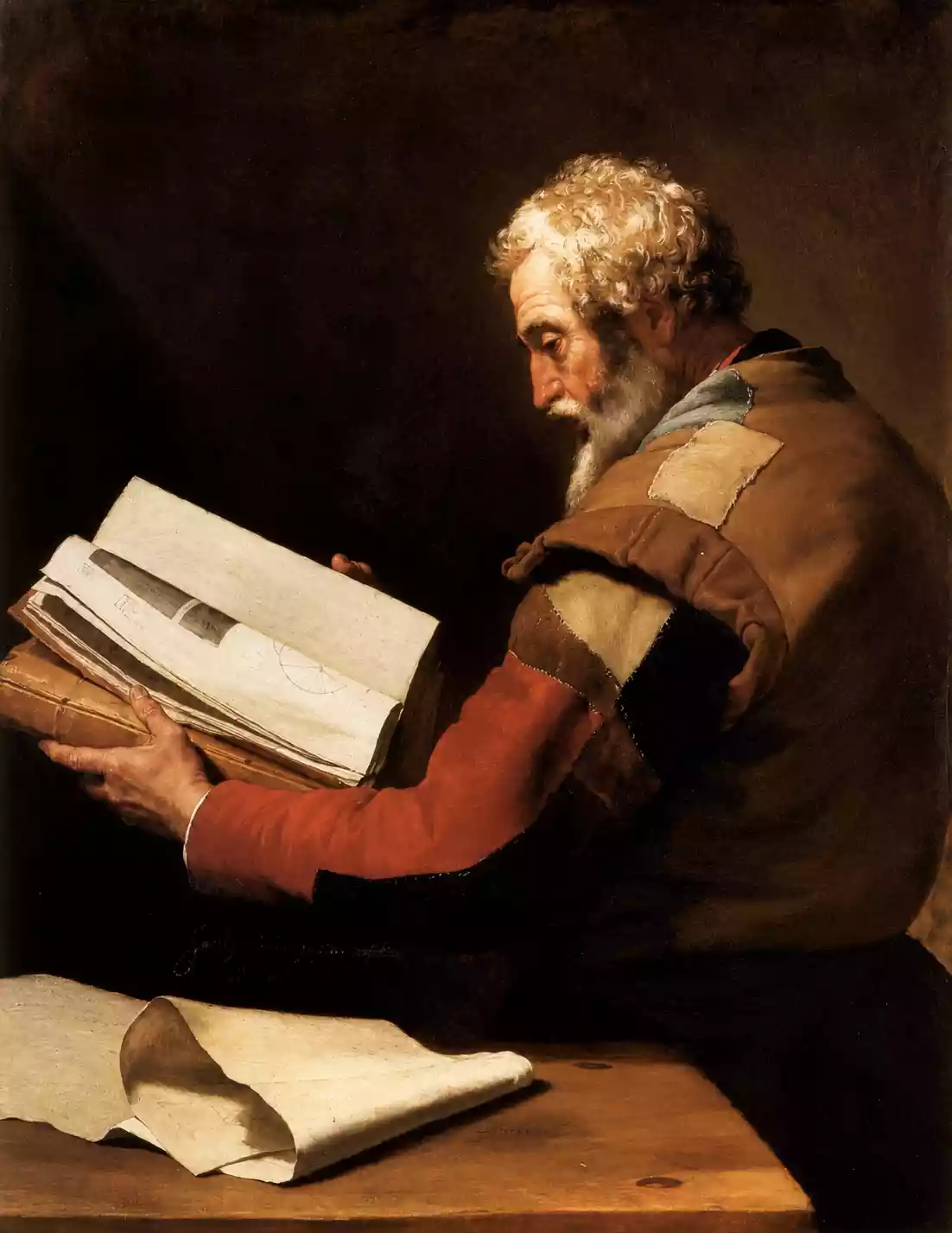 Jusepe de Ribera (1591–1652), Anaxagoras, 1636. Oil on canvas, 120 × 95 cm, private collection. Source of digital reproduction: caravaggio.com, via Wikimedia Commons. Public Domain.
In 1636 the books of the Banco dello Spirito Santo in Naples recorded a payment of one hundred ducats, an advance on a total of five hundred, from Lorenzo Cambi and Simone Verzone to ‘Gioseppe de Ribera’ for twelve paintings five palms high and four palms wide, in each of which the painter was to paint a philosopher with his own hand, for the use of ‘conte Carlo Felesbergh’, that is, Prince Karl Eusebius von Liechtenstein, with a delivery deadline of six months. The document, published in 1983 by Eduardo Nappi and discussed in 1986 by Craig Felton in the Burlington Magazine, is quoted in the catalogue of the Clowes Collection at the Indianapolis museum, in the entry on a philosopher by Ribera most probably identified as Euclid, signed and dated 1637. Of the twelve paintings only six were eventually delivered, and they remained in the collections of the Princes of Liechtenstein until 1954, when they were dispersed. The Indianapolis Euclid measures approximately 124.7 × 98.7 cm and the LACMA philosopher 124.3 × 99.1 cm.
The Anaxagoras, an oil on canvas of 1636 measuring 120 × 95 cm, is in a private collection. Turned to the left, in profile, the figure bows his head over a thick book that he holds with both hands, one supporting it from below. The curly white hair and white beard, the forehead and the cheek catch the light falling from the upper left, the same light that whitens the pages, on which linear geometric figures are traced, while the background remains dark and almost uniform. The coarse brown tunic is patched at the shoulder and on the arm with pieces of lighter cloth, and beneath it a grey-blue collar and a red sleeve show. At the edge of the table, in the foreground, folded sheets of paper also bear faint traces of lines. Above them, in the dark area beneath the hand that supports the book, an inscription in light-coloured paint cannot be read with certainty in the available reproduction.
The patches on the garment belong to the convention of the poor sage that Ribera cultivated throughout his series of philosophers. In the case of Anaxagoras, however, the convention acquires a particular resonance if one recalls the story of the wealthy young man of Clazomenae who left his property to his relatives. The geometric figures on the pages, on the other hand, link the figure to his reputation as a mathematician and astronomer, the same reputation that the Philadelphia museum invokes for Langetti’s painting. The work’s place in the prince’s commission is documented in the Clowes Collection catalogue, where the Anaxagoras is included among the six paintings delivered and is listed among the figures identified by inscriptions.
Sources and Bibliography
- Curd, P., & Sisko, J. (2026). Anaxagoras. Stanford Encyclopedia of Philosophy, Stanford University (first published 2007; substantive revision 9 August 2026).
- Diogenes Laertius (1925). Lives of Eminent Philosophers, Book II, ch. 3 (Anaxagoras). Trans. R. D. Hicks. Loeb Classical Library, Harvard University Press.
- Los Angeles County Museum of Art. Jusepe de Ribera, A Philosopher (1637), no. M.91.125.2, collection record.
- Philadelphia Museum of Art. The Philosopher Anaxagoras (c. 1660), collection record.


