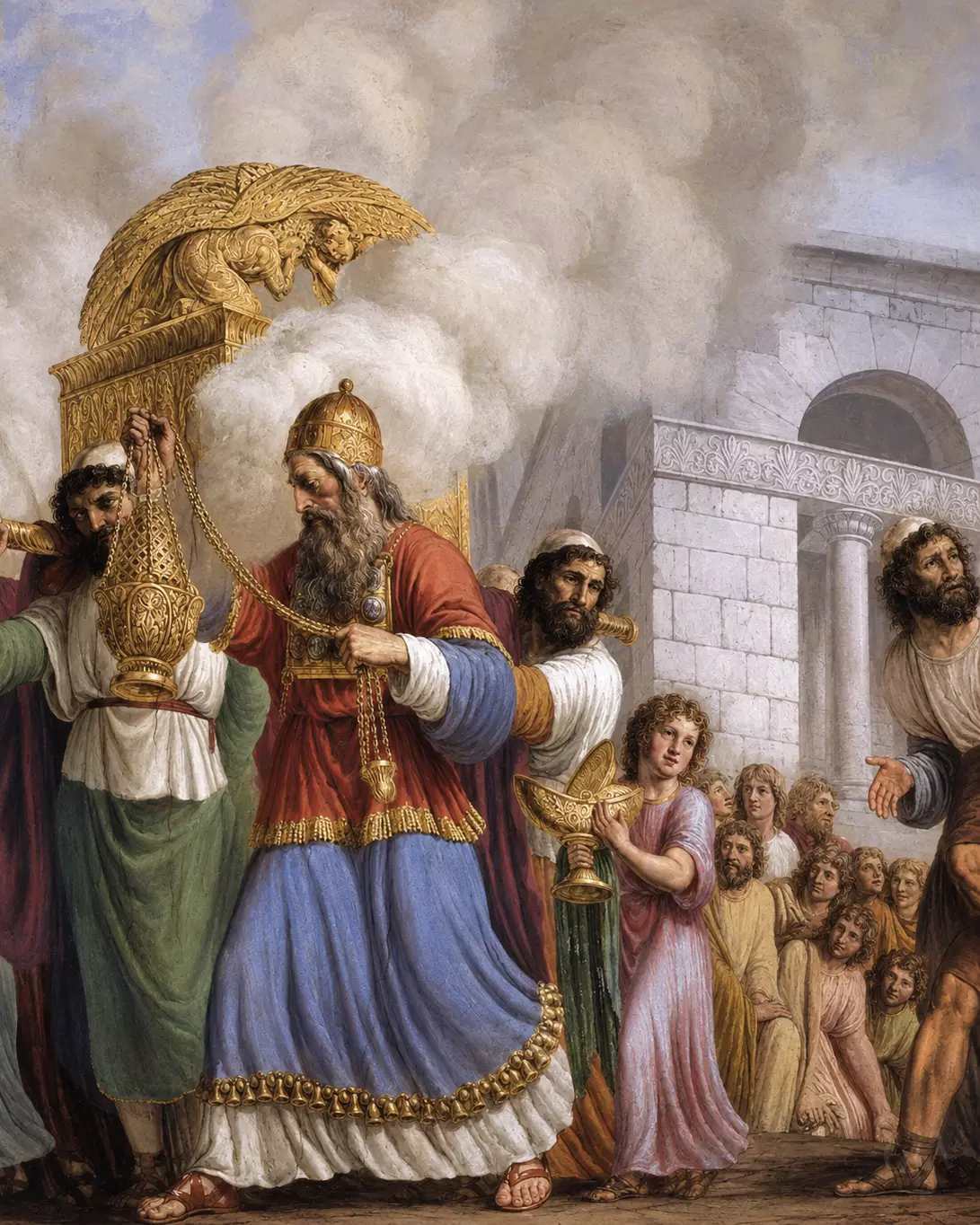
Luigi Ademollo’s Transportation of the Ark of the Covenant Containing the Tablets of the Law, painted in 1816 for the Galleria Palatina in Palazzo Pitti, belongs to the large decorative enterprise through which the Milanese-born artist transformed biblical history into monumental court painting. The subject is immediately legible, although the fresco does not approach the episode as a quiet archaeological reconstruction. A procession fills the pictorial field. The Ark, raised on carrying poles and crowned by the outspread wings of the cherubim, emerges through a mass of pale smoke; in front of it stands a richly vested priest, his garments worked with gold ornament, while musicians, attendants, bearers and spectators press into the surrounding space. Therefore the sacred object is present without being isolated. It moves.
The fresco is preserved in the Sala dell’Arca, one of the rooms on the piano nobile of Palazzo Pitti that Ademollo decorated during the years surrounding the restoration of Habsburg-Lorraine rule in Tuscany. Scholarship on the room dates the cycle more broadly to 1814–1816, while the work itself is commonly given the date 1816. Forming part of a major phase of Ademollo’s activity at the palace, the commission drew upon an ability to organise crowded narratives on an architectural scale that had already made him especially suited to the decoration of ceremonial interiors.
Transportation of the Ark of the Covenant and the Processional Image
The central figure controls the composition through scale and colour. His red upper garment, blue lower robe, white sleeves and gold-edged vestments create the densest chromatic concentration in the fresco; the breast ornament and elaborate headdress establish a high-priestly role, while the large golden vessel suspended from chains introduces another vertical accent against the broader horizontal movement of the procession. Behind him, the Ark occupies a higher register. Its gilded surface, heavy ornamental treatment and winged cherubim distinguish it from the human figures without requiring an artificial enlargement of the sacred object.
This is one of Ademollo’s most effective compositional decisions. The Ark is clearly visible, yet it is partly absorbed into ceremony: borne by men, surrounded by sound, followed by a crowd, preceded by priestly action. At the edge, a musician raises a long wind instrument to his mouth, and another youthful figure holds a large gilded object whose flaring form catches the light. Farther back, faces accumulate in a compact group, some turned towards the centre of the event, others angled upward or outward. The crowd is not arranged as a regular frieze of equivalent bodies. Heads rise and fall, shoulders overlap, and the cortège compresses sharply as it approaches the architectural opening.
The biblical Ark is described in Exodus (25:10–22) as a gold-covered chest containing the tablets of the covenant, fitted with poles for transport and surmounted by two golden cherubim whose wings spread above the cover. Ademollo does not reduce these prescriptions to a diagram. The painting gathers recognisable signs of sacred transport, poles, cherubim, priestly costume, musical instruments and clouds of vapour, and translates them into the language of an early nineteenth-century historical composition. Although they remain enclosed and consequently invisible, the title itself makes the presence of the tablets explicit. The viewer encounters their significance through the Ark’s material splendour and through the behaviour of those around it.
The atmosphere is unusually important. Pale clouds spread above and behind the Ark, softening the transition from the dense foreground figures to the open upper field. Their opacity interrupts the architecture and gives the golden cherubim a momentary, almost suspended appearance. Yet the surrounding construction is emphatically solid: squared masonry, an arched opening, columns, a decorated balustrade. Ademollo employs this architecture to create recession, but also to restrain the throng. Human movement presses forward against a setting that feels measured, pale and immobile.
Luigi Ademollo’s Neoclassical Language
Ademollo had established himself in Florence through large-scale decorative work, including his activity at the Teatro della Pergola. The Uffizi describes his artistic vocabulary as drawing upon ancient relief, Michelangelesque and Mannerist traditions, and Lombard Neoclassical culture; his formation also included study under Giocondo Albertolli at the Brera Academy. Particularly characteristic was Ademollo’s facility in constructing expansive narrative programmes from subjects taken from the Old and New Testaments, a capacity that found an obvious field of application in the grand-ducal interiors of Palazzo Pitti.
In the Transportation of the Ark, those habits appear without stiffness. The figures have a sculptural clarity, especially in the large priest and the bearers immediately around him, but the surface is kept active by folds, cords, chains, feathers, hair, smoke and repeated flashes of gold. The effect does not depend upon dry linearity. A study devoted specifically to Ademollo’s Pitti decorations notes the brilliant palette of blues, greens and oranges and singles out the priestly garment for its unusually elaborate treatment. That observation corresponds closely with the piece, where colour performs much of the work that a stricter dependence upon contour might otherwise have carried.
There is also a theatrical intelligence in the staging. The principal figures are large enough to confront the spectator directly, while the multitude behind them is reduced and packed into a narrower zone. The open arch and elevated balustrade extend the fictive environment beyond the retinue, suggesting an inhabited monumental setting instead of an indeterminate biblical landscape. Ademollo worked extensively on decorative cycles for palaces, churches and theatrical spaces, and the work exploits precisely this experience: bodies are arranged for legibility across distance, gestures are enlarged, costume becomes pattern, architectural mass almost scenery. Then the smoke passes across it, disturbing the order.
The Sala dell’Arca at Palazzo Pitti
The room itself adds another level to the image. Research on the Sala dell’Arca connects its decoration with the political circumstances following the end of Napoleonic domination and the return of Ferdinand III of Habsburg-Lorraine to Tuscany. The larger programme has consequently been read as a courtly allusion to restoration and return, with the procession of the Ark providing a biblical language through which recovered dynastic order could be represented without direct contemporary portraiture. A modern account of the room likewise interprets its great processional decoration as an allusion to the return of the Lorraine rulers after the Restoration.
Such a reading also helps explain the unusual weight given to collective movement. No single hero monopolises the scene visible in the fresco. Priest, bearers, musicians, children, older men and the tightly gathered public are bound to the same ceremonial action. Even the Ark, although visually privileged by gold and elevation, advances because it is carried. The political analogy consequently operates through procession, continuity and public display as much as through the holy object itself.
At close range the painting is full of particulars: gold ornament that appears almost embossed, the linked chain of the vessel, beards treated in separate curls, white cloth folding beneath coloured robes, faces half hidden behind other faces. From farther away these details enter a broader historical spectacle. The pale architecture recedes, the gold advances, smoke breaks the upper contour of the Ark, and the crowd still seems to be arriving from beyond the painted field.
(The translation was edited by F. Kalimeris.)