
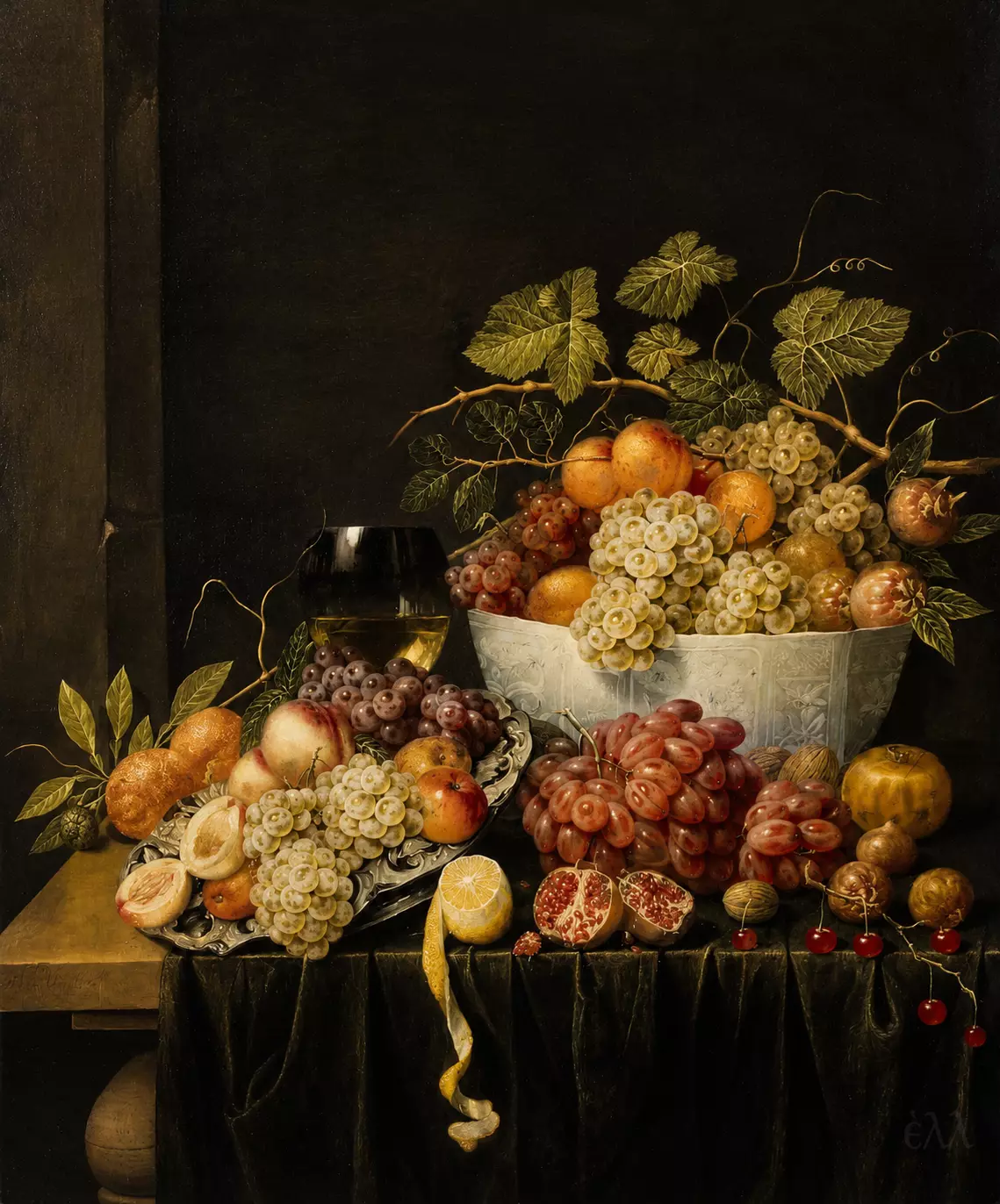
Painted during the 1640s, Adriaen van Utrecht’s Still-Life with Grapes belongs to the mature flourishing of Flemish still-life painting in Antwerp, a genre in which abundance became both pictorial subject and technical challenge. The oil on canvas, measuring 119 × 99 cm and now in the State Hermitage Museum in St Petersburg, concentrates an extraordinary quantity of fruit within a relatively compact vertical format. Grapes dominate, certainly, while around them accumulate citrus fruits, pomegranates, cherries and other fruit, some intact, others opened or peeled. A vine extends above the arrangement, its leaves catching the light before disappearing again into the dark field behind them. The Hermitage has recently presented the painting within its broader account of seventeenth-century Flemish still life, alongside works by Frans Snyders, Jan Fyt and other Antwerp masters.
Nothing in the painting is casually disposed. Across the horizontal edge of the table, the broad pale vessel near the centre, and the darker container receding behind it, a firm compositional armature guides the rising movement that carries the eye from the foreground toward the vine leaves above. Against almost impenetrable darkness, colour acquires unusual density. Pale grapes seem powdered with bloom; red ones become translucent at their edges; the opened pomegranate exposes a granular interior of brilliant seeds—the overall execution remaining lavish and controlled.
Still-Life with Grapes: abundance, light and pictorial structure
Van Utrecht was born in Antwerp in 1599, entered the workshop of Herman de Ryt in 1614, travelled through France, Italy and Germany, and returned to Antwerp, becoming a master in the Guild of Saint Luke in 1625. His career developed within one of Europe’s most important centres of Baroque painting. Frans Snyders provided a decisive model for his still lifes, especially in their abundant presentation of fruit, vegetables, game and costly objects, although Van Utrecht generally imposed a more stable framework of horizontal and vertical relationships upon his compositions. The Museo del Prado also notes the warmer, increasingly brown tonal effects of his later work alongside the gradual disappearance of figures from his compositions.
Those characteristics are particularly useful when approaching Still-Life with Grapes. No human presence interrupts the arrangement. The fruit possesses the entire pictorial field, while the painter carefully avoids converting the composition into a simple inventory of natural produce. At the upper centre, heavy clusters of pale grapes spill over the rim of the vessel and descend toward the table. Behind them, red and darker grapes press into the shadow; above, fruits and vine branches create a less compact zone through which isolated areas of darkness remain visible. The composition contracts and expands, filling and releasing pictorial space.
Across the foreground the rhythm changes. An ornate platter at the left supports pale grapes and several pieces of fruit, including opened citrus whose flesh and thick rind introduce rougher surfaces beside the smooth grape skins. Near the centre, a partially peeled citrus fruit stands almost independently, its long strip of rind falling over the front edge of the table in an irregular spiral. Visually sharp, that descending peel breaks the otherwise dominant horizontality of the tabletop and links the illuminated upper arrangement with the dark cloth below.
To the right, the composition becomes heavier again. Large clusters of reddish grapes rest directly on the cloth, followed by split pomegranates whose seeds are exposed toward the viewer. Small cherries, scattered nuts and rounded fruits create a sequence of isolated accents along the edge. Some objects touch; others remain separated by tiny intervals of darkness, through which gaps Van Utrecht prevents abundance from becoming pictorial congestion.
Surface and the discipline of light
Light provides the principal means by which the objects are differentiated. It enters from the left and moves unevenly across the still life, striking some surfaces directly while allowing others to remain only partly legible. The pale grapes are modelled through minute changes of cream, yellow-green and grey; their translucent skins respond differently from the dense surfaces of the citrus fruits. Pomegranate seeds receive another treatment entirely, with tiny highlights placed against deep crimson; cherries, points of reflected light. Even the vine leaves, dry-looking and sharply veined, possess a material character distinct from the fruit below.
Such differentiation is central to the virtuosity of Flemish still-life painting. Van Utrecht was recognised as one of the important practitioners of the genre, alongside Snyders and Jan Fyt, during a period when painters expanded earlier kitchen and market imagery into increasingly autonomous displays of fruit, game and other natural products. The scale and richness of his paintings could also carry social associations: the Prado describes his elaborate still lifes as works connected with the wealth and cosmopolitan culture of their owners.
Yet richness in Still-Life with Grapes relies on varied elements beyond the mere count of items. Its effect comes from contrasts of material, colour and degree of illumination. The cool, almost silvery vessel at the centre separates itself from the dark background, while the blackish container behind it is defined mainly by reflected highlights along its curved surface. Golden leaves above answer the warm citrus below; pale grapes against shadow answer the brighter areas of exposed fruit flesh. Throughout, Van Utrecht moves between sharply described detail and passages that recede into tonal obscurity.
The dark background deserves particular attention. Empty of architectural description, it removes the objects from an anecdotal domestic setting and intensifies their physical presence. Depth is nevertheless maintained through overlapping: fruit before vessel, vessel before branches, branches passing behind clusters of grapes and then outward toward the edges. The pictorial space remains shallow while preserving dimensional depth, against which the illuminated produce seems almost to project beyond the canvas.
Seventeenth-century Flemish still life could accommodate a wide range of associations, from pleasure in abundance to reflections upon time and mortality; the Hermitage itself referenced the balance between joie de vivre and memento mori when presenting the broader tradition in its 2024 exhibition devoted to Flemish still life. A fixed symbolic interpretation of every fruit in Van Utrecht’s painting remains unnecessary. The opened pomegranate, cut citrus, curling peel and ripe grapes already establish a quieter tension through their visible states: whole and divided, firm and yielding, fresh yet perishable.
What remains most persuasive is the painter’s command of looking. Grape skins, pith, rind, seeds, leaves, polished surfaces, cloth: each demands another response from the brush. From this accumulation emerges the character of Still-Life with Grapes, opulent without disorder, sensuous without losing structure, its abundance held together by darkness, measured light and a compositional discipline characteristic of Adriaen van Utrecht’s mature still-life painting.
(The translation was edited by Jason Papandreou.)