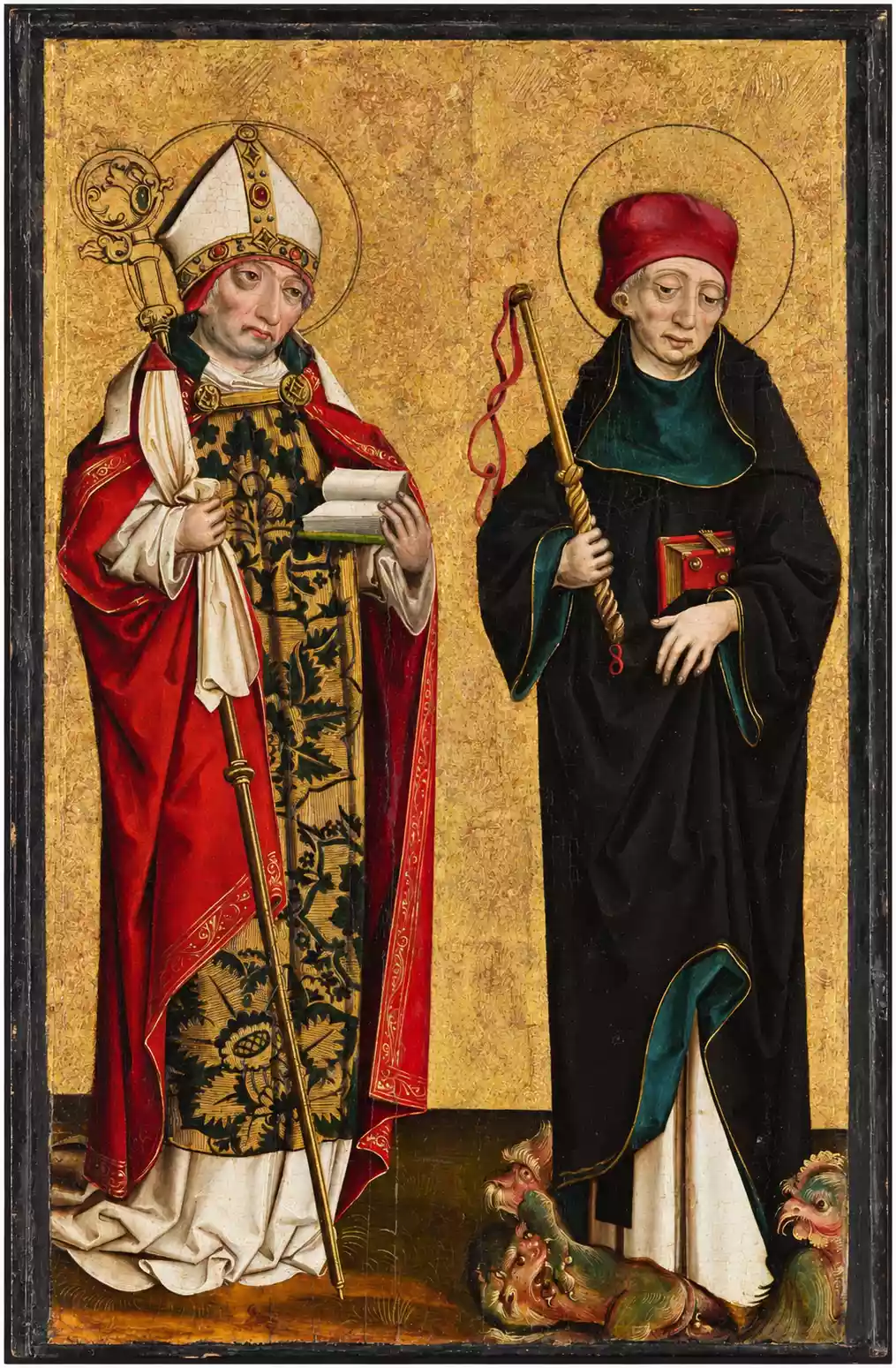
 Saint Adalbert of Prague and Saint Procopius of Sázava. Master of Eggenburg, c. 1490–1500, oil on spruce with gold ground. The Metropolitan Museum of Art, New York, acc. no. 44.147.1. Public Domain.
Saint Adalbert of Prague, known in Czech tradition as Vojtěch and in Polish as Wojciech, was bishop of a city whose Christian institutions were still taking shape, yet his activity reached well beyond Bohemia, into a European world in which missionary work was bound up with the dealings of princes. Born around 956 and killed on 23 April 997 while on a mission to the Prussians, he came after his death to hold a distinctive place in the history of central Europe. His ties to several different places also explain why the sources know him by more than one name, all of which refer to the same man.
From Bohemia to the See of Prague
The future bishop was born into the Slavník family, whose seat lay at Libice in Bohemia, the son of Slavník and Střezislava. Such birth gave him access to education; it also placed him squarely within the rivalries of the region’s powerful clans, from which an ecclesiastical career could hardly remain untouched. The hagiographical accounts link his dedication to the Church with a grave illness in childhood and a vow made by his parents – a motif that belongs to the way biographers liked to present the early calling of a saint.
His schooling at Magdeburg brought him into contact with Latin ecclesiastical learning and with Archbishop Adalbert, whose name he took. Back in Bohemia he joined the clergy and, after the death of Thietmar, the first bishop of Prague, was chosen as his successor, his episcopal consecration being placed in 983. He was thus the second bishop of Prague, at a time when the see belonged to the ecclesiastical province of Mainz.
The tradition of his life gives considerable weight to the figure of a stern pastor who spent his resources on the poor and opposed the traffic in Christian captives. We should note, however, that these descriptions have come down to us mainly through texts written to proclaim his sanctity. In them the bishop’s clashes with those around him take on an exemplary function as well, illustrating how hard the burden of pastoral responsibility could be.
Withdrawals from the See and the Monastic Life
Adalbert’s two stays in Italy are among the most debated points of his biography. In Rome he settled in the monastery of Saints Boniface and Alexius on the Aventine Hill, where monastic life offered a setting quite different from that of diocesan government – which did not mean that his bond with the see of Prague had been finally dissolved.
According to the chronological reassessment by the historian David Kalhous, the first Roman stay ran from the second half of 989 to the middle of 992, the second from the autumn of 995 to June 996. Kalhous goes further and suggests that the first departure is better understood as a pilgrimage than as simple flight from an impending conflict, whereas for the second he recognises the threat of danger more clearly. His study shows how differently a life can read once the intervals of time and the intentions of its narrators have been tested.
The return to Prague and the renewed departure therefore need to be read against the conditions of the period, when the enforcement of church discipline cut across established social practices and could meet resistance from powerful interests. To lay all these difficulties solely at the door of the bishop’s temperament, or of the conduct of an entire people, would be to narrow a story for which our evidence is fragmentary.
Reading the Earliest Lives
What we know of Adalbert’s life comes chiefly from two early Latin hagiographical works: the Vita prior, traditionally attributed to John Canaparius, and the Life written by Bruno of Querfurt. Their closeness in time to the events gives them particular value, while the fact that they were composed as saints’ Lives obliges us to examine the historical material alongside the way the narrative is put together.
For the Vita prior in particular, scholars have proposed differing views on its author and the milieu in which it originated, and more than one recension of the text survives. The debate bears on the image of the man himself, since the choice of an episode, the elaboration of a conflict or the stress laid on his monastic vocation could all serve a particular model of holiness.
The same caution applies to the stories about his connection with Hungary and the baptism of the future King Stephen, which have been absorbed very widely into his ecclesiastical biography. This tradition may be mentioned as tradition, leaving open the question of its exact date and circumstances, rather than being used to fill the gaps in his career with a certainty the evidence does not allow.
The Mission to the Prussians and the Martyrdom
With the support of the Polish ruler Bolesław I, Adalbert set out in 997 for the southern Baltic to preach to the Prussians. These were the old Baltic peoples related to the Lithuanians, whose identity must be kept distinct from the later German Prussia if the account is to stay within the geography and political circumstances of the tenth century.
The mission met with hostility and ended in his death on 23 April 997. The narratives describe an armed attack and a beheading, though the exact place and some details of his last days remain under discussion. His companions survived and carried the news, so that the memory of the mission was preserved and a search for his remains could begin.
Here historical distance matters a great deal. Later descriptions of Prussian religion often come from Christian writers with differing experiences and aims, and transferring them wholesale to Adalbert’s time risks producing a uniform picture of societies whose internal differences are known to us only in part.
Gniezno and the Shaping of His Cult
Bolesław secured the return of the body and its burial at Gniezno, where the tomb soon became a centre of pilgrimage. The well-known story that the ransom was paid in gold equal to the weight of the body belongs to the tradition surrounding the translation of the relics, and conveys in vivid terms the worth that was placed upon them.
His canonisation by Pope Silvester II is dated to 999, and in 1000 the Emperor Otto III came as a pilgrim to his tomb. The visit was bound up with the founding of the Archbishopric of Gniezno and with the strengthening of the Polish realm’s standing in the Church, in a setting where the cult of a martyr could also shape the public recognition of a place. Monika Salmon-Siama examines this relationship in her study of the birth of his cult in medieval Poland.
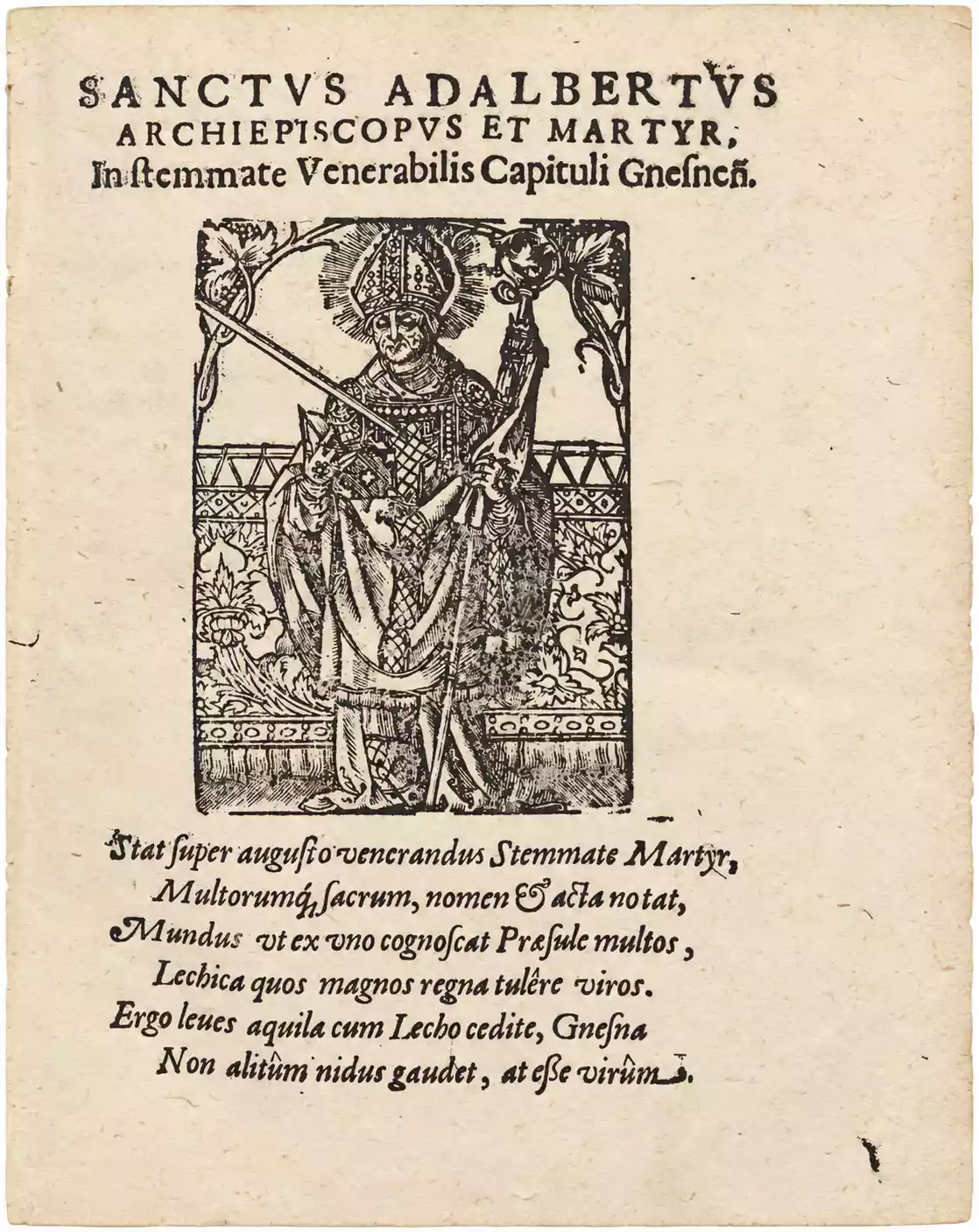 Saint Adalbert on a leaf of Stefan Damalewicz’s “Series Archiepiscoporum Gnesnensium…”, Warsaw, 1649. Ossoliński National Institute, Wrocław, XVII-3809. Public Domain.
In the Catholic Church his feast falls on 23 April and carries special weight in the countries of central Europe. The same date appears in Orthodox calendars as well, and in communities that follow the Julian calendar the ecclesiastical 23 April currently corresponds to 6 May in the civil calendar. His place in both traditions is linked to his standing among the saints who lived before the schism of 1054.
His Image in Painting and in a Reliquary
In the panel by the Master of Eggenburg, painted around 1490–1500, Adalbert appears on the left, wearing a mitre and holding a crozier and an open book, while Saint Procopius of Sázava stands beside him. The gold ground and the vestments set the figures within the pictorial language of late medieval European art, several centuries after the lifetimes of the men portrayed. The work is held by the Metropolitan Museum of Art in New York.
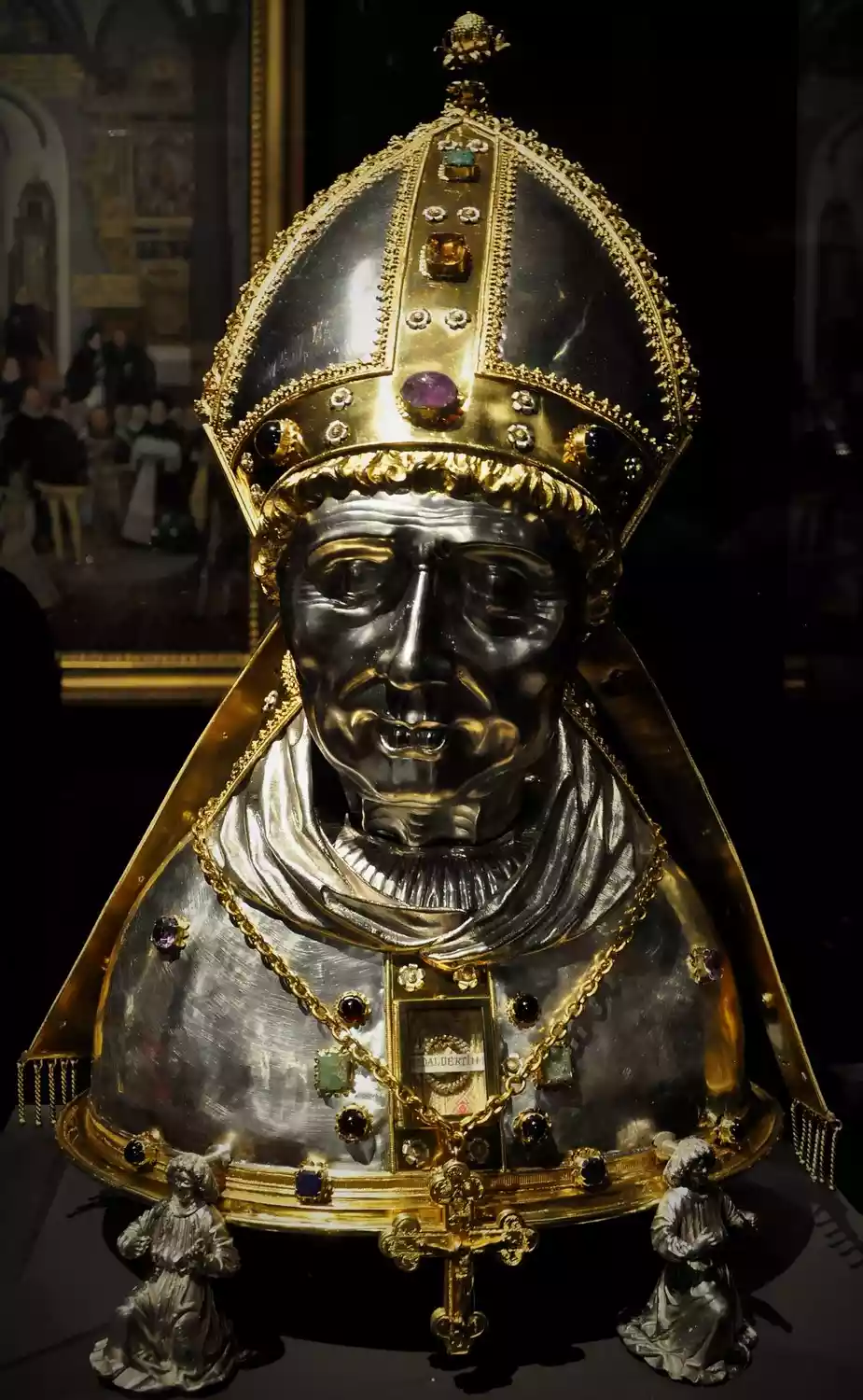 Reliquary bust of Saint Adalbert, c. 1500, a gift of Vladislaus II. Treasury of St Vitus Cathedral, Prague. Photograph: Packare, 12 February 2015, CC0.
A different use of his image can be seen in the reliquary in the treasury of St Vitus in Prague, where he is rendered as a bust in partly gilded silver, with a mitre studded with stones. The gift of Vladislaus II is recorded in the treasury inventory of 1503, and related documents connect the making of the busts of the local patron saints with work carried out in 1498–1500. By then the bishop’s likeness had become part of the cathedral’s liturgical life, for on the great feasts the reliquaries were placed on the high altar.
Sources and Bibliography
- Bayerische Akademie der Wissenschaften. Vita s. Adalberti episcopi Pragensis. Geschichtsquellen des deutschen Mittelalters, no. 3051.
- Bayerische Akademie der Wissenschaften. Vitae s. Adalberti episcopi Pragensis recensio I. Geschichtsquellen des deutschen Mittelalters, no. 718.
- Davies, N. (1997). Adalbert or Wojciech: Gdansk and Danzig. A Multinational Millennium 997–1997. School of Slavonic and East European Studies, University of London.
- Kalhous, D. (2012). ‘Svědectví z první ruky? Nad „pramennou hodnotou” nejstarších vojtěšských legend’. Historia Slavorum Occidentis, 1(2), 37–58. See also the university abstract.
- Metropolitan Museum of Art. Saint Adalbert and Saint Procopius. Master of Eggenburg, c. 1490–1500, no. 44.147.1.
- Pavelec, P. (ed.) (2014). Hrady a zámky objevované a opěvované. Národní památkový ústav, p. 67.
- Salmon-Siama, M. (2011). ‘La couronne et la sépulture, ou la naissance du culte de saint Adalbert de Prague en Pologne médiévale’. Iris, 32, 153–168.
- Schmale, F.-J. (1953). ‘Adalbert (heilig)’. Neue Deutsche Biographie, 1, 45–46.


