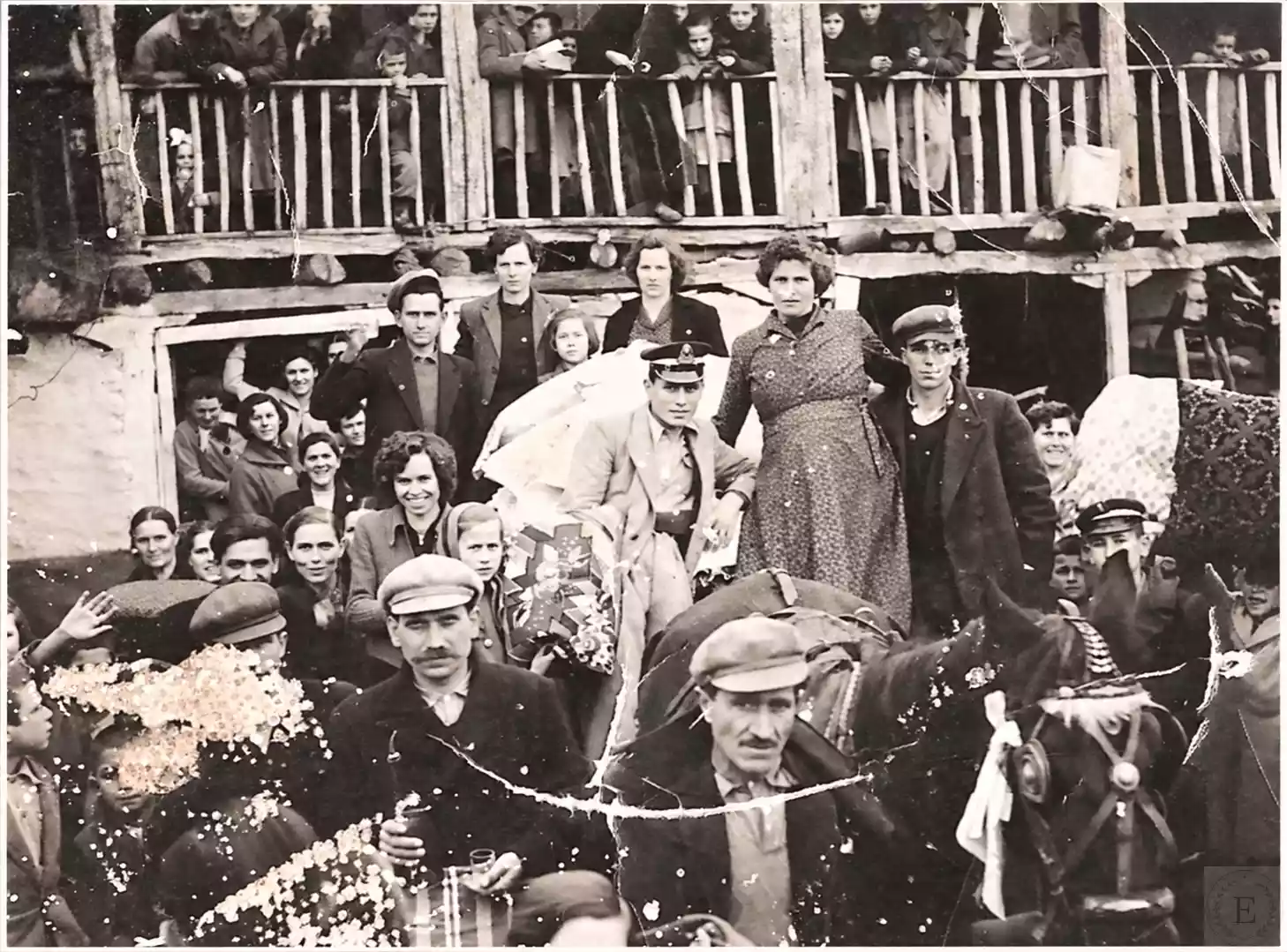
 Riders on horseback among a gathered crowd, in front of a building with a wooden balcony. The location and date have not been identified.
In Naoussa, it is the music of the Genitsaroi and Boules that sets the course of the troupe, the bouloúki, through the town. The zournas and the daouli summon each dancer from his home, and different tunes then accompany the procession as it moves on and pauses in the various neighbourhoods. This customary order is set out in the entry in the National Inventory of Intangible Cultural Heritage, which records how the music is tied to the movements of the performers. The custom was added in 2020 to the national inventory of the Intangible Cultural Heritage of Greece.
The zygia and the division of sound
A zygia is the small group of instruments that play together in the traditional manner. The zournas, a loud double-reed pipe, paired with the daouli, a large double-headed drum, is a typical combination, though one also finds two zournades played with a single daouli. In that case the primadoros carries the melody while the pasadoros, or basadoros, usually holds the iso, a sustained note that underpins what the listener hears. The second player may also join in on certain melodic phrases, as the organological account on ceti.gr explains.
Specific examples of Naoussa practice survive in the 2000 publication of the Lyceum Club of Greek Women featuring the Psathas family. In the 1969 recordings Vangelis Psathas plays the zournas and his brother Dimitris the daouli. The 1999 material has two zournades, played by Vangelis and his son Dimitris, with Antonis Psathas on the daouli. The Lyceum Club of Greek Women release thus allows the listener to follow the different line-ups of the ensemble as well.
The cane ‘tsampouna’ of the zournas
At the top of the instrument sits the double reed, the small cane component also known as the tsampouna. It is bound onto a thin metal tube, the kaneli, which in turn fits into the kleftis at the upper end of the wooden body. Its construction is described in the Zournas record of the Hellenic Folklore Research Centre of the Academy of Athens.
When the player blows, the two blades of the reed vibrate. The melody is shaped by fingering and breath control, and experienced zournatzides use circular breathing to keep the sound flowing: during a quick intake through the nose, the air held in the mouth continues to feed the instrument. The description of the zournas, based on the work of Fivos Anoyanakis, also explains how fingering and breath serve the melodic ornaments. The relevant excerpt is hosted on ceti.gr.
The daouli and the musical step
The daouli player works the two skins with two different sticks. The heavier beater, the kopanos, produces the deeper strokes, while the slender switch, the verga, gives the higher and lighter ones. The skins must be tensioned with care, since the difference in sound between the two sides of the drum depends on it, as described on ipet.gr.
The dancers’ steps rest on these contrasting strokes. The drummer follows the melodic phrase and responds to the movement of the dance, especially when the formation of the group changes.
The patinada accompanies the processional movement from one square to the next. The Hellenic Dance Pandect describes an arrangement in two lines, with the dancers turning to face each other at certain points in the music. These changes are linked to the meeting of the swords, the so-called pales. The record on dance-pandect.gr shows how closely the music follows the gestures of the procession.
Tunes of the street and the neighbourhoods
The correspondence between melody and place is explained by the folklorist Takis Baitsis in his oral testimony for the Istorima archive. On the way to the Lamnia crossroads, he mentions Rigas’s Thourios. From Kammena towards Pouliana comes the Pouliana patinada, while in the area of the Metropolis the Ypatros patinada begins, to which the troupe crosses the Batania bridge.
From the Kioski towards Agios Georgios, according to the same account, the ‘Kampana’ is played. Later, nearing the Alonia, come the tune ‘Kateva Lenkou’ and the Alonia patinada. Time and again the narrator distinguishes the practices he remembers from earlier times from those current at the time of the interview, and this distinction should accompany any reading of the testimony in the Istorima Archive.
In the Lyceum Club of Greek Women’s recorded documentation, the patinades are kept apart from the dances performed at the stops. ‘Papadia’ and ‘Makrinitsa’, for instance, are listed as dances, whereas ‘Pouliana’ and ‘Kampana’ appear as patinades. The Lyceum Club of Greek Women catalogue preserves their names together with the corresponding recordings.
The musical architecture of the custom thus becomes perceptible through its transitions. As the troupe moves on, those who know the tradition recognise in the tune the neighbourhood and the stage of the route. For the dancer, the change is heard while he is already in motion, holding his place beside the others and waiting for the cue to the next gesture.
Dressing and the ‘prosopos’
The Genitsaros’s preparation begins at home, with the help of relatives who see to the costume and fasten on the silver ornaments. When the troupe arrives and the Zalistos is heard, the dancer greets it from the window or balcony with raised arms and shakes of the torso. He then comes down, takes leave of his family and joins the group. The entry in the Intangible Cultural Heritage of Greece inventory also describes this greeting with small leaps that set the metal ornaments ringing.
The prosopos with tarampoulo, as documented in the collection of the Lyceum Club of Greek Women of Naoussa, combines the mask with an elaborate head-wrap. In the recorded object, the mask is built on a base of thick cotton cloth with plaster and carries layers of wax on the inside. Calling it a ‘wax mask’, then, refers to only one of the materials from which it is made.
On the white surface, black eyebrows and a moustache are painted in, with red on the cheeks and lips. A round gold mark sits on the forehead. Tiny openings serve the eyes, nose and mouth, and beneath the tarampoulo there is a woollen cap onto which the mask is fastened. These details concern the specific museum object recorded on searchculture.gr.
At the Town Hall the leader briefly lifts his mask to reveal his identity and ask for the customary permission to perform. Late in the afternoon, at the Alonia, the performers uncover their faces, and former Genitsaroi may now join the dance without the costume. The procession then continues towards Kammena, where the last dance of the day takes place, according to the description in the Intangible Cultural Heritage of Greece inventory.
Sources and Bibliography
- Academy of Athens, Hellenic Folklore Research Centre. ‘Ζουρνάς’. Collection record on SearchCulture.gr.
- Ανωγειανάκης, Φ. (1991). Ελληνικά λαϊκά μουσικά όργανα. 2nd edn. Athens: Melissa. Online excerpts: ‘Ο ζουρνάς’ and ‘Το νταούλι’.
- Lyceum Club of Greek Women, Naoussa. ‘Πρόσωπος με ταράμπουλο παραδοσιακής φορεσιάς Γενίτσαρου (Μπούλας) Νάουσας’. Collection catalogue on SearchCulture.gr.
- Λύκειον των Ελληνίδων (2000). Νάουσα Ημαθίας, Μπούλες, Χοροί και Πατινάδες από το έθιμο της Αποκριάς με ζουρνατζήδες την οικογένεια του Βαγγέλη Ψαθά. Two CDs with printed booklet. Texts by Fivos Anoyanakis, Takis Baitsis and Lefteris Drandakis.
- Μπάιτσης, Τ. ‘Η προσήλωση του λαογράφου Τάκη Μπάιτση στην προβολή και στην προστασία του εθίμου Γενίτσαροι και Μπούλες’. Oral interview conducted by Antonia Markoviti. Istorima Archive, EL-17048.
- Όμιλος Γενίτσαροι και Μπούλες (2019). ‘Γενίτσαροι και Μπούλες της Νάουσας’. Element file, National Inventory of the Intangible Cultural Heritage of Greece, inscribed 2020.
- Hellenic Dance Pandect. ‘Πατινάδα στη Νάουσα’. Encyclopaedia of Greek Dance, entry E-A8D7E.


