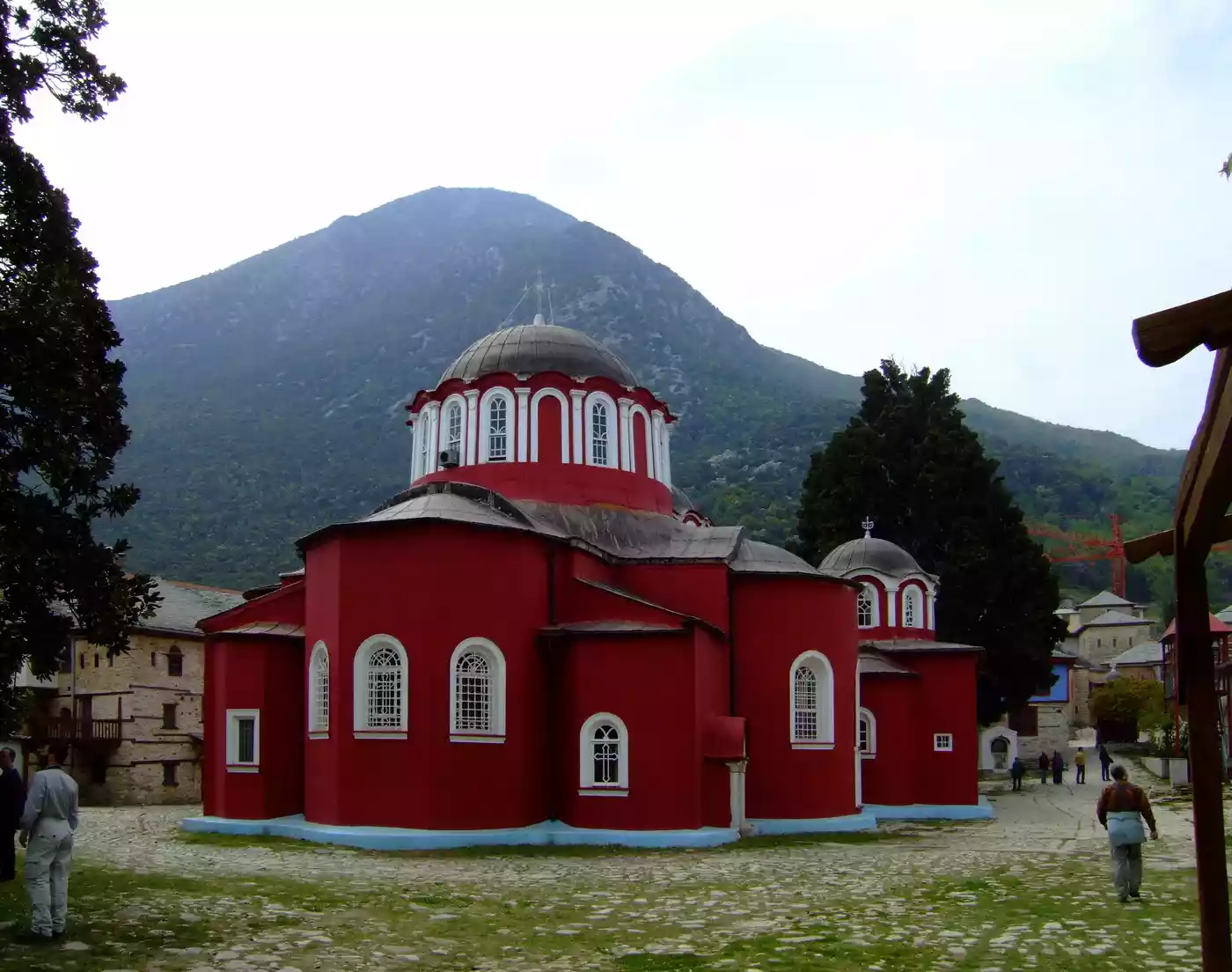
 The katholikon of the Great Lavra Monastery, Mount Athos, 28 April 2006. The monastery library holds Codex Ω 89, which preserves the note recording the martyrdom of Saint Habakkuk in Thessaloniki (1628). Photograph: Dimboukas (public domain).
In hagiographical terms Saint Habakkuk the New Martyr is a hosiomartyr, a venerable martyr: a monk, that is, who suffered a martyr’s death. His is one of those cases in which everything the usual hagiographical tradition hands down about a person fits into a single sentence. That sentence was written by an unknown hand on folio 155 of a manuscript belonging to the Great Lavra Monastery on Mount Athos, Codex Ω 89, and according to it a monk named Habakkuk was martyred in Thessaloniki on 6 August 1628. The standard hagiographical reference works transmit no hypomnema of his martyrdom, meaning the narrative account that normally accompanies the commemoration of a new martyr and tells of his origins, arrest, interrogation and end. His name is likewise missing both from the Συναξαριστής των Νεομαρτύρων (Synaxarion of the New Martyrs) and from the earliest known printed synaxaria. Habakkuk thus becomes, I would say, an almost textbook example of how the memory of a saint can survive in a note jotted into a book.
The note in Codex Ω 89
In the post-Byzantine manuscript tradition an enthymesis is the brief note that a reader, an owner or one of the monks of the house would add on the blank leaves or in the margins of a codex. In it he set down whatever he judged worth remembering: a death, an earthquake, an epidemic, a year of dearth or, as here, a martyrdom. Recent descriptions associate the note on Habakkuk with a seventeenth-century codex, and it reads: «Κατὰ τὸ ζρλς’ ἐν μηνὶ Αὐγούστῳ εἰς τὰς ς’ ἐμαρτύρησεν ὁ ὅσιος καὶ νέος μάρτυς Ἀββακοὺμ ἐν τῇ μεγαλουπόλει Θεσσαλονίκῃ, εἰς δόξαν καὶ καύχημα τῶν ὀρθοδόξων χριστιανῶν» (‘In the year 7136, in the month of August, on the 6th, the venerable and new martyr Habakkuk was martyred in the great city of Thessaloniki, to the glory and pride of the Orthodox Christians’). As was customary, the date is reckoned from the creation of the world, the year 7136 being written in alphabetic numerals (͵ζ = 7,000, ρ = 100, λ = 30, ς = 6). Since the Byzantine year began on 1 September, August 7136 corresponds to August 1628 AD. The modern reader has to take the date according to the Julian calendar, the Gregorian not having been adopted in the Orthodox East; the scribe’s 6 August is therefore 16 August of the same year in the Gregorian reckoning.
Who wrote the note, and how long after the event, we do not know. The precision of the date and the complete absence of anything miraculous are not enough, on their own, to place the entry close to the events. The scribe may have learnt of the martyrdom at first hand or from an earlier source he considered reliable. This assessment is an interpretation, not evidence.
What the testimony says, and what it leaves unsaid
What, then, can safely be drawn from so spare a statement? First the name, which is that of the Old Testament prophet. Then the designation «ὅσιος καὶ νέος μάρτυς» (‘venerable and new martyr’), which in the ecclesiastical language of the period points to a monk who had been martyred. From it comes the generally accepted assumption that Habakkuk was a monk, most probably an Athonite. An assumption it remains, though, since the note names no monastery. That it survived in a Lavra codex makes an Athonite connection plausible; it does not prove it. Manuscripts travelled, news passed from monastery to monastery, and the Athonite houses kept metochia in Thessaloniki and Chalkidiki – dependencies, in other words, with estates and lodgings for monks. Through them news from the city could reach the Holy Mountain without the martyr himself having been an Athonite.
What the note does not say is rather more: his origins, his age, the charge brought against him, the manner of his death, the place of his burial. The closing formula «εἰς δόξαν καὶ καύχημα τῶν ὀρθοδόξων χριστιανῶν» belongs to the stock vocabulary of ecclesiastical writing in this period. It is to be read not as information about the circumstances but as a sign of how the scribe understood the event and for whom he recorded it. It should also be noted that the day of the martyrdom coincides with the Transfiguration of the Saviour, one of the great Feasts of the Lord. The source makes no comment on the coincidence, and any symbolic reading of it is the responsibility of the modern interpreter, not of the witness of the time.
Thessaloniki in 1628 and the new martyrs
When our scribe called it a ‘great city’, Thessaloniki had been under Ottoman rule for almost two centuries, since 1430, and Sultan Murad IV (1623–1640) sat on the throne in Constantinople. It was a populous city of many tongues. Christians lived there alongside Muslims and the large Sephardic Jewish community that had settled in the city after the expulsion of the Jews from the Iberian Peninsula at the end of the fifteenth century. As in every major Ottoman urban centre, daily life was governed by a system of religious communities, each with its own legal status. The Orthodox Church calls new martyrs those Christians put to death for their faith in more recent centuries, chiefly during the Ottoman period, to distinguish them from the martyrs of the early Church. Their Martyrdoms were often written by monks, many of them Athonites, and describe cases set in widely differing circumstances. It is precisely this variety that forbids us, without a specific narrative witness, to fit Habakkuk into any of the familiar patterns.
In an open academic course at the Aristotle University of Thessaloniki on the saints of the city, Symeon Paschalidis places Habakkuk first among the seventeenth-century new martyrs of Thessaloniki, a series that continues into the nineteenth century. He also gives two pieces of information not found in the other sources. The first is that Habakkuk was an ascetic ‘at the Lavra of Karyes’, that is, at the administrative centre of Mount Athos; the name should not be confused with the Great Lavra Monastery, which lies elsewhere on the Athonite peninsula. The second is that, whereas until recently only his name and the manner of his martyrdom were known, a translation of his Martyrdom from Ukrainian survives. Were this last report to be confirmed by a published edition, it would mean that an account of the martyrdom circulated in the Slavic Orthodox world, even though the teaching material does not allow us to say when it was composed or disseminated. That would substantially alter the picture we have had until now. The teaching material, however, gives no reference to an edition of the Martyrdom, so the report has to be treated as a research lead still awaiting documentation. The same holds for the mention of a known manner of martyrdom, which the note itself does not specify.
From the margin of a manuscript to the hagiologion
The note found its way into the hagiologion through Sophronios Eustratiades, former Metropolitan of Leontopolis. Together with Spyridon, a monk and physician of the Lavra, Eustratiades published in 1925, in the Harvard Theological Studies series, the catalogue of the Lavra’s Greek manuscripts. A footnote in the catalogue explains that the chronological and other notes in the codices marked with an asterisk had already been published separately by Eustratiades in the periodical «Γρηγόριος ὁ Παλαμᾶς» (Gregory Palamas), under the title «Ἁγιορειτικῶν Κωδίκων Σημειώματα» (Notes from Athonite Codices), and for that reason were not reprinted there. The detail is a reminder that testimonies like Habakkuk’s often reached print through editions of such notes, separate from the descriptions of the manuscripts. It was Eustratiades himself who first recorded the hosiomartyr’s name in a hagiographical reference work, his «Αγιολόγιον της Ορθοδόξου Εκκλησίας» (Hagiologion of the Orthodox Church).
From there the name passed into later reference works. The Russian Orthodox Encyclopaedia devotes a short entry to Habakkuk in its first volume. It records that he suffered in Thessaloniki and that he is mentioned in the Lavra codex and in the Mikron Euchologion, with his commemoration on 6 August. Besides Eustratiades’s Hagiologion, it refers to the Θρησκευτική και Ηθική Εγκυκλοπαίδεια (Religious and Ethical Encyclopaedia) and to Perantonis’s Λεξικόν (Lexicon). Hagiographical tradition adds that fragments of his relics are kept in a monastery dedicated to the Nativity of the Theotokos in Acarnania. No published documentation has been traced that identifies the monastery or explains how the relics came to be there. The report, it should be said, also presupposes that at least part of the martyr’s relics survived – a matter on which the note is silent.
The commemoration of Saint Habakkuk on 6 August
The Orthodox Church commemorates Saint Habakkuk the New Martyr on 6 August, the day of his martyrdom. His name appears in the list of new martyrs published by the Apostoliki Diakonia of the Church of Greece. The coincidence with the Transfiguration, which dominates the day liturgically, may explain why his memory has remained so limited, known to students of hagiography and within the Athonite tradition rather than in wider popular devotion. The Great Lavra was founded in 963 by the Venerable Athanasius the Athonite. According to the ICOMOS evaluation on the basis of which Mount Athos was inscribed on the UNESCO World Heritage List in 1988, its foundation marks the intensification of organised monasticism on the peninsula. To its library, according to the 1925 catalogue, belongs the codex that preserved the principal written testimony to this otherwise scarcely known monk: a few words on folio 155.
Sources and Bibliography
- ICOMOS (1988). World Heritage List No 454: Mount Athos, Advisory Body Evaluation. Paris: UNESCO World Heritage Centre.
- Spyridon of the Laura & Eustratiades, S. (1925). Catalogue of the Greek Manuscripts in the Library of the Laura on Mount Athos, with Notices from Other Libraries (Harvard Theological Studies 12). Cambridge, MA: Harvard University Press.
- О. Е. П. (2000). Аввакум. In Православная энциклопедия, vol. 1, p. 83. Moscow: Церковно-научный центр «Православная энциклопедия».
- Paschalidis, S. (2014). Οι Άγιοι της Θεσσαλονίκης [The Saints of Thessaloniki]. Unit 8: Οι Νεομάρτυρες της Θεσσαλονίκης [The New Martyrs of Thessaloniki] (17th–19th c.). Thessaloniki: Aristotle University of Thessaloniki, Open Academic Courses.


