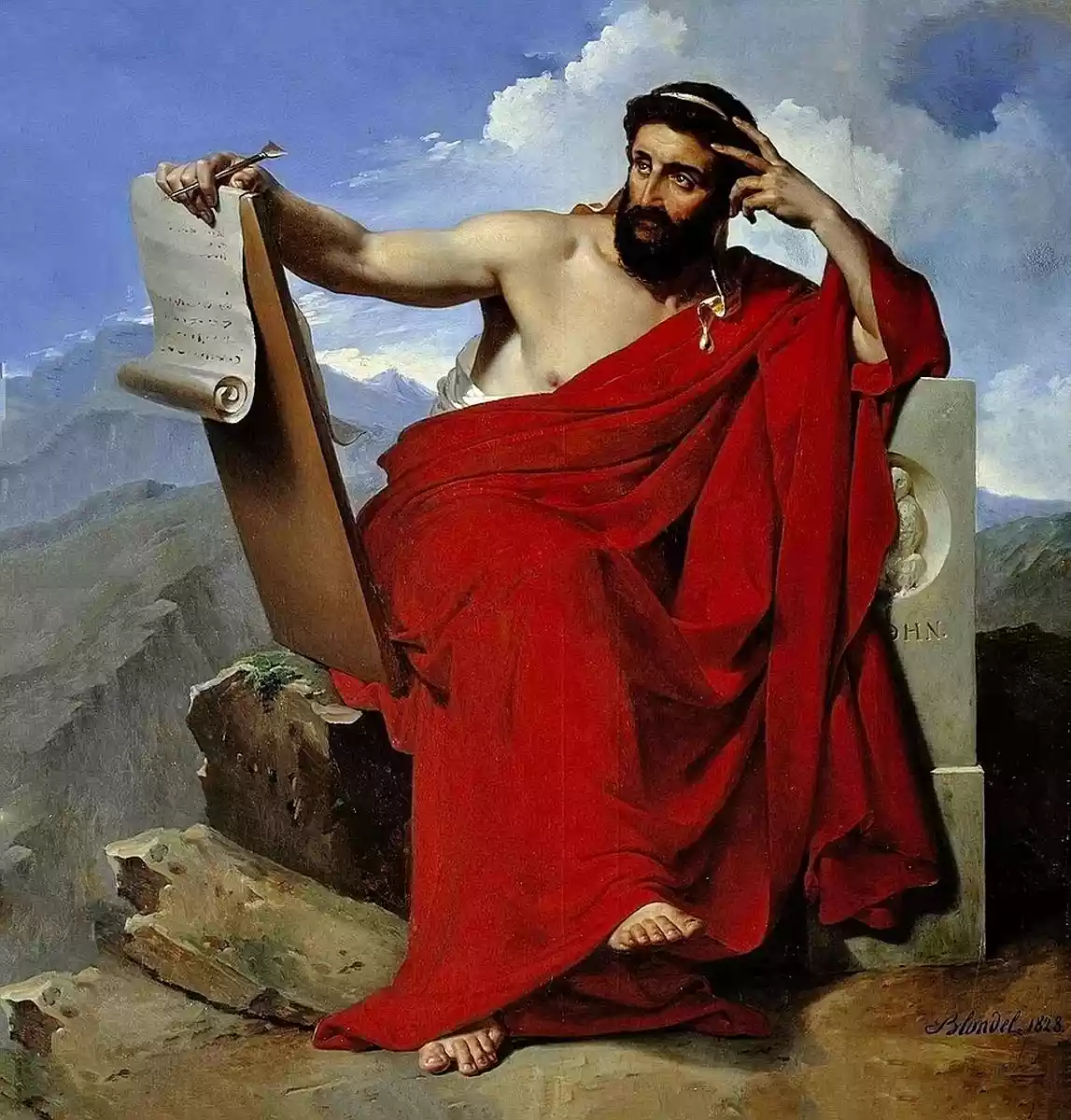
 Merry-Joseph Blondel, Portrait of Solon, lawgiver and poet of Athens. Signed and dated 1828, although the Louvre catalogue entry dates the work to 1827. Oil on canvas, 171 × 160 cm, according to the Louvre. Musée du Louvre collection, on deposit at the Musée de Picardie, Amiens. A later, idealised depiction. Public domain.
Solon of Athens is a figure of archaic Greece for whom we have, beyond what later writers told of him, his own voice as well: fragments, that is, of his elegiac and iambic verse, which survive because they were quoted, in support of their own narratives, by the Aristotelian Constitution of the Athenians in the fourth century BC and by Plutarch, the biographer from Chaeronea, some seven centuries after the events. The lawgiver’s biography therefore rests on three layers of testimony of unequal reliability: his own poems, in which the statesman justifies himself and defends what he did; the constitutional history of Athens, which read his laws through the eyes of classical democracy; and, finally, the anecdotal tradition, with its journeys, its audiences with kings and its sayings, which counted him among the Seven Sages and earned him, centuries later, a place in the painting of modern Europe. To separate these layers cleanly is not always possible. What one can do is make clear, at every step of the story, which of them one is standing on.
Ancestry and youth: a nobleman in trade
About his father the ancients were very nearly unanimous: he was Execestides, a man, as Plutarch notes in his Life of Solon, of middling means and moderate political standing, but from a house that traced its descent to Codrus, by tradition the last king of Athens; a lone dissenting testimony, which the biographer records without endorsing it, named the father as one Euphorion. His mother, according to Heraclides of Pontus, was a cousin of the mother of Peisistratus, a kinship on which later narrative loaded the whole weight of the political rivalry between the two men. The year of his birth is not recorded, and the dates in circulation, around 640 or 630 BC, are back-calculations from his archonship and from traditions about his age, not direct statements of the sources.
What tradition brings to the fore from his youth is the turn to trade. His father, according to Hermippus as cited by Plutarch, had eroded the family fortune through benefactions and favours, and the son, brought up in a house accustomed to helping others rather than being helped, was ashamed to accept support, although there would have been no lack of people ready to offer it. Some ancient writers, however, preferred to think that the young man travelled for the sake of knowledge and experience rather than gain, a reading that suits, perhaps a little too well, the sage of the later stories; and from there the biographer moves on to the line Solon is said to have repeated in old age, that he grew old forever learning many things, ‘γηράσκειν αἰεὶ πολλὰ διδασκόμενος’, as Plutarch gives it in indirect speech. An aristocrat in commerce was in any case no anomaly in the world of the late seventh century BC, where seaborne trade, as Plutarch himself observes, brought friendships with kings, practical experience and honour.
The Salamis elegy
The first act of his public life is bound up with Salamis, the island over which Athenians and Megarians fought a long war that went badly for Athens. In the story preserved by Plutarch and Diogenes Laertius, the Athenians, weary of defeat, had forbidden on pain of death any proposal to renew the struggle, and Solon, feigning madness, appeared in the agora with a felt cap on his head and recited an elegy on the lost island (according to Diogenes he wore a garland and had the herald recite it), which so roused the citizens that the war was resumed and Salamis passed to Athens. The scene bears every mark of the moralising anecdote, and the feigned madness looks like an explanation devised after the event to bridge the gap between the law and its breach. The elegy, however, did exist, for lines of it survive in which the poet wishes he were a citizen of some obscure island rather than an Athenian, pointed at with scorn as one of those who gave Salamis up. Poetry as a political act, then: a method Solon would not abandon even when he came to explain his laws to his fellow citizens.
The crisis in Attica and the archon of 594/3 BC
To understand why the warring factions of Athens agreed, early in the sixth century BC, to entrust one man with the reshaping of the state, one has to remember what had gone before: Cylon’s failed attempt to seize power as tyrant, its bloody suppression by the Alcmaeonid Megacles, the legislation of Draco, which left the root of the trouble untouched, and above all the dead end of mounting debt. Most smallholders, as D. I. Kyrtatas sums up in Η Ελληνική Αρχαιότητα (‘Greek Antiquity’), borrowed on the security of their own persons, and whoever could not repay ended up as his creditor’s slave or was sold outside Attica, while the best land and nearly all political power lay in the hands of a few families. Part of the scholarship links this state of affairs to the hektemoroi, cultivators who, on the most widely held interpretation, handed over a sixth of their harvest to someone more powerful; who exactly they were, though, and what tie bound them to the land are still debated.
Solon held the annual office of eponymous archon in 594/3 BC, with a mandate to legislate. The date, which the ancient chronographers transmitted consistently, came under question once the papyrus of the Constitution of the Athenians was published in 1891, because two passages of the work seemed to imply a different sequence. N. G. L. Hammond, in a study of 1940, argued that the text puts the archonship and the seisachtheia in 594/3 and a second mandate, under which the main body of the laws was enacted, in 592/1, while other scholars have proposed a later date for the reforms altogether. Either way, 594/3 remains the conventional point of reference.
The seisachtheia and the horoi on the land
The first measure, and in the eyes of his contemporaries the weightiest, was the seisachtheia, the ‘shaking-off of burdens’, as the word itself says: debts were cancelled, lending on the security of personal freedom was forbidden from then on, those enslaved for debt were freed, and those sold abroad were brought home. Solon himself, in a poem preserved for us by the Constitution of the Athenians, calls as witness to his work the black earth of Attica, from which, he says, he tore up the horoi fixed everywhere, so that she who had once been a slave was now free. What exactly were these horoi? The commonest view took them to be stone markers advertising an encumbrance on the holding, a mortgage or a duty to surrender part of the crop, whereas Kyrtatas favours the interpretation of wooden tablets on which the cultivators’ obligations to the landowners were recorded, tablets whose removal freed both the land and those who worked it. On one point at least the sources agree: the lawgiver refused the redistribution of land demanded by the more radical of his supporters, and so left the structure of ownership intact.
Classes, courts and the right of every citizen
Beyond the debts, Solon reorganised the relation between wealth and power by dividing the citizens into four tele, that is, property classes, according to annual agricultural yield: pentakosiomedimnoi, hippeis, zeugitai and thetes. The nine archons were drawn from the two highest classes and the other offices were distributed among the first three according to income, while the thetes, the poorest citizens, took part in the Assembly and the law courts; birth thus ceased to be the sole key to political participation, without of course losing its social weight, which is why modern historians have called the system timocratic. Also ascribed to Solon are a Council of Four Hundred, a hundred members from each of the four tribes, which prepared the Assembly’s business, and the Heliaia, the citizens’ court. Draco’s laws were repealed, except those on homicide, and the new ones were written up on revolving wooden axones, so that anyone who wished could consult them.
Of deeper consequence in the long run were two procedural innovations: the right of any citizen to go to law not only for a wrong done to himself but also on behalf of a third party or in the public interest, and the possibility of appeal to the popular court. The Constitution of the Athenians, written when Athenian democracy had already completed its institutional course, singles these out, together with the ban on loans secured on the person, as the measures that most favoured the people; and that verdict, even if it projects fourth-century priorities back onto the past, explains why the Athenians of the classical age recognised Solon as the founder of their constitution.
The lawgiver who refused tyranny
The reforms satisfied neither side entirely, since the rich lost claims and dependent labour while the poor did not receive the land they had hoped for. Solon answered, as ever, in verse, portraying himself standing between the two factions with a strong shield held up and letting neither prevail unjustly, having given the people as much power as was enough for them, no less and no more. Friends urged him to keep power as tyrant, by no means an unusual course in the Greek cities of the time, and his refusal drew mockery, which he recorded himself in verse: he makes his critics say that Solon had no sense, for when his net was full of fish he would not haul it in, whereas they would have let themselves be flayed and their line be blotted out, if only they might rule Athens for a single day. Plutarch quotes these lines as evidence of how the many and the humble saw him.
Ten years abroad: Egypt, Cyprus and Sardis
After the legislation Solon left Athens. Herodotus, writing roughly a century and a half later, explains that he travelled ostensibly to see the world but in truth so as not to be forced to repeal any of his laws, since the Athenians had bound themselves by oath to keep them for ten years; the Constitution of the Athenians and Plutarch speak instead of a hundred years, a discrepancy which shows how fluid the tradition remained even on institutional matters. The itinerary takes in Egypt, where Plato would set his conversations with the priests of Sais and the starting point of the Atlantis story; Cyprus, where, according to Plutarch, he persuaded King Philocyprus to move his city to a better site, which was thereafter named Soli; and Sardis, the capital of Lydia.
The meeting with Croesus is the episode that made Solon famous across Europe and, at the same time, the one least able to survive chronological scrutiny. In Herodotus’ account the king, having shown the Athenian his treasures, asked him whom he considered the happiest of all the men he had known, expecting to hear his own name. Solon named first Tellus, an Athenian who lived in a prosperous city, saw children and grandchildren grow up and fell fighting near Eleusis, honoured by his fellow citizens; then Cleobis and Biton, the Argive brothers who themselves drew their mother’s cart to the sanctuary of Hera and died in their sleep after the festival; and he concluded that no one may be called happy until it is seen how his life will end. The historian closes the circle himself a little later, when Croesus, defeated by Cyrus and set upon the pyre, remembers the Athenian’s words and calls out his name three times.
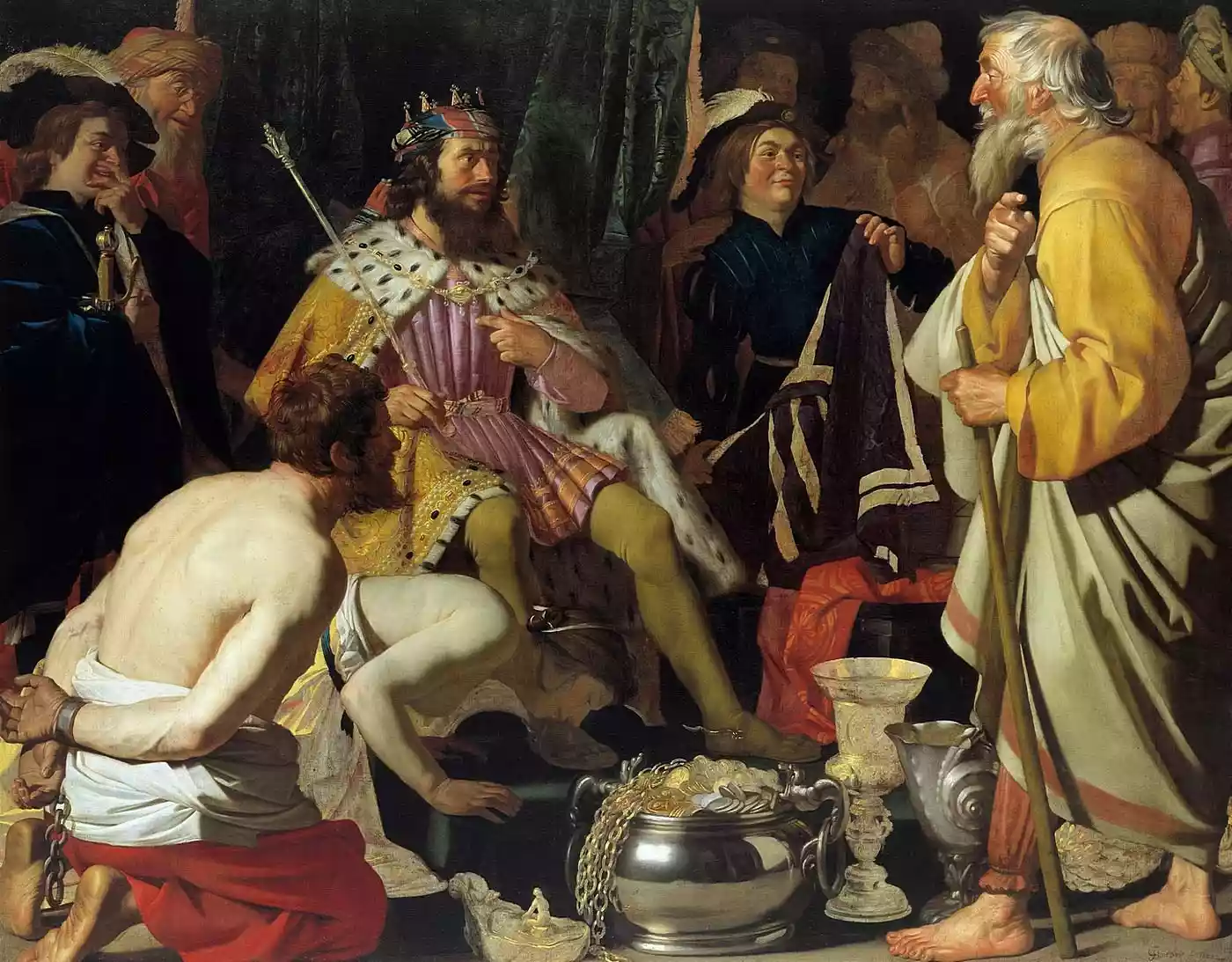 Gerard van Honthorst, Solon and Croesus, 1624. Oil on canvas, 168.5 × 214 cm. Hamburger Kunsthalle, Hamburg, inv. no. HK-772. Public domain.
The moral purpose of the story within Herodotus’ work is plain enough, but the chronology will hardly bear it, for the accession of Croesus, like that of the pharaoh Amasis, whom Herodotus connects with the same journey, is placed by the usual reckonings around 560 and 570 BC respectively, that is, after the end of the ten-year absence, if that absence followed directly on the legislation. Plutarch was already aware of the problem, and says in so many words that he does not mean to reject so famous a story, so fitting to Solon’s character and wisdom, for the sake of chronological canons which, as he remarks, a host of people are still correcting without ever having brought them into agreement with one another.
Return, Peisistratus and death
When Solon returned, Athens had not grown calm. Regional and family factions were at odds once more, and out of their conflict emerged Peisistratus, his kinsman on his mother’s side, who, appealing to his military successes against the Megarians, obtained a personal bodyguard and seized power in the archonship of Comeas, in 561/0 BC. Tradition has the old lawgiver warning the Athenians in vain and, when nothing could any longer be changed, laying his arms down before the door of his house, as if to declare that he had served his country as far as his strength allowed. Peisistratus, for his part, left the Solonian laws essentially in place, taking care only that the offices were held by men on good terms with him.
In his last years, according to Plutarch, Solon had begun a long poem on Atlantis, drawing on what he had heard from the learned men of Sais, but gave it up, not for want of leisure but from dread of so vast an undertaking at such an age. It should be noted that no fragment of any such work survives, and the report is tied to Plato’s narrative. How long he lived after Peisistratus took power was disputed in antiquity: Heraclides of Pontus wrote that he lived on for a long time, Phanias of Eresus that it was less than two years, placing his death in the archonship of Hegestratus, Comeas’ successor, that is, around 560/59 BC.
Solon in modern European painting
No authentic likeness of Solon survives, and his figure passed into later art chiefly through the scene with Croesus, a subject much liked by seventeenth-century painters in the Low Countries, where the contrast between wealth and prudence also took on a moralising tone. In Gerard van Honthorst’s picture of 1624, now in the Hamburger Kunsthalle, the king, weighed down with furs, gold-embroidered cloth and a crown, sits among courtiers smiling ironically and vessels full of coins, while a bound captive kneels in the foreground; opposite him the barefoot old man speaks, holding his staff close to his chin. Nikolaus Knüpfer, around 1650–1652, transposes the same confrontation to a smaller scale, with the sage at the foot of the steps leading up to the royal table, alone and severe, facing a Croesus who points out his riches with his sceptre.
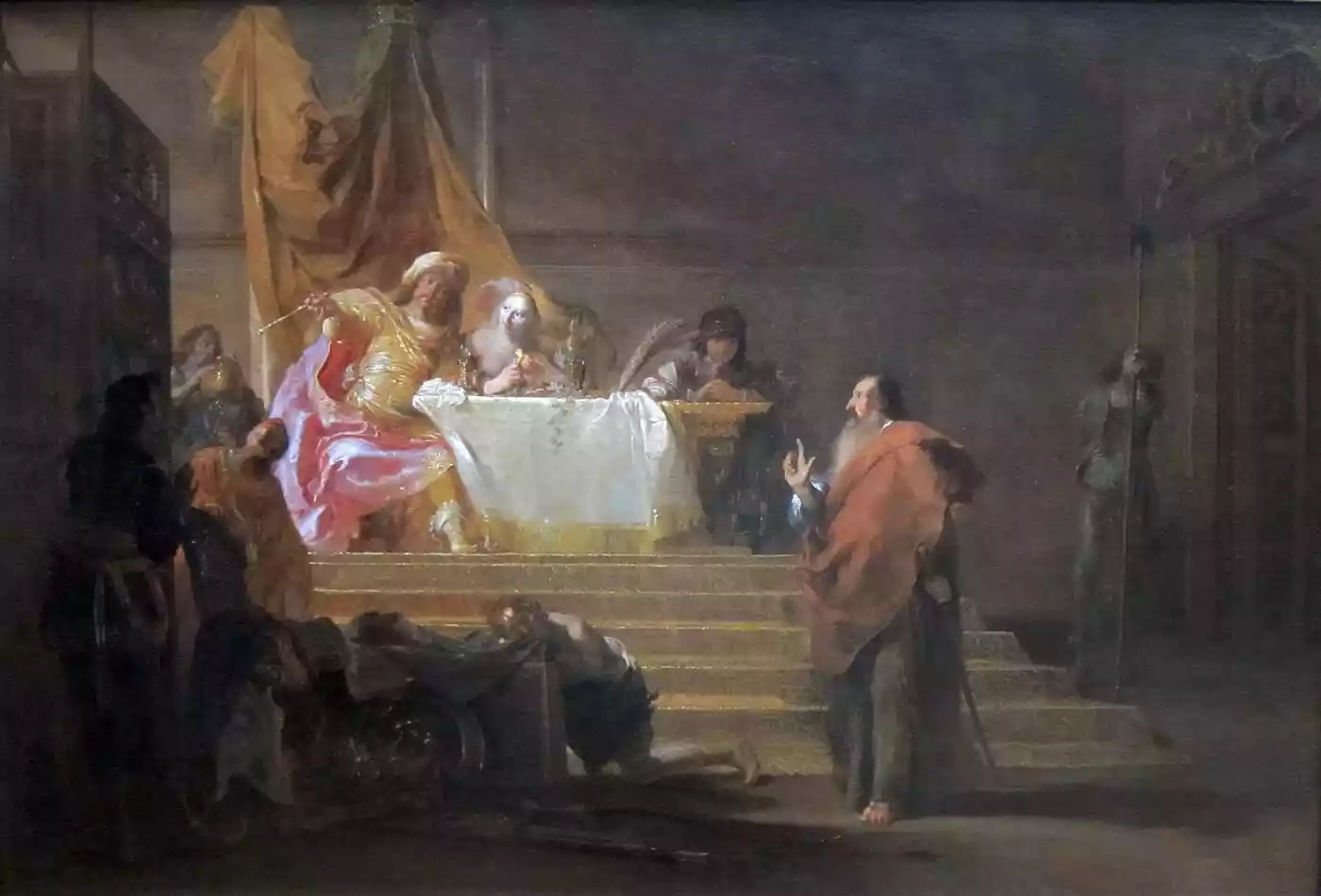 Nikolaus Knüpfer, Solon before Croesus, c. 1650–1652. Oil on panel, 61 × 89.9 cm. J. Paul Getty Museum, Los Angeles, accession no. 84.PB.640. Public domain.
Merry-Joseph Blondel has something else in mind in the painting signed and dated 1828, which leaves out any narrative episode and presents the lawgiver and poet as an idealised type, seated in a mountain landscape and wrapped in a red himation, an unrolled scroll in one hand and the other resting against his temple in an attitude of reflection, while traces of a Greek inscription can be made out on the stone support of his seat.
Sources and Bibliography
- Aristotle. Constitution of the Athenians (Athenaion Politeia).
- Diogenes Laertius. Lives of Eminent Philosophers, Book I.
- Herodotus. Histories, Book I.
- Kyrtatas, D. I., & Rangos, S. I. (2012). Η Ελληνική Αρχαιότητα: Πόλεμος – Πολιτική – Πολιτισμός [Greek Antiquity: War, Politics, Culture]. Centre for the Greek Language, Stavros Niarchos Foundation & Institute for Modern Greek Studies.
- Plutarch. Σόλων [Solon]. Modern Greek translation by A. I. Giagkopoulos and Z. E. Malathouni. Mnemosyne, Digital Library of Ancient Greek Literature, Centre for the Greek Language.
- Plutarch (1914). Plutarch’s Lives, Vol. I: Theseus and Romulus, Lycurgus and Numa, Solon and Publicola (B. Perrin, Trans.). Harvard University Press.


