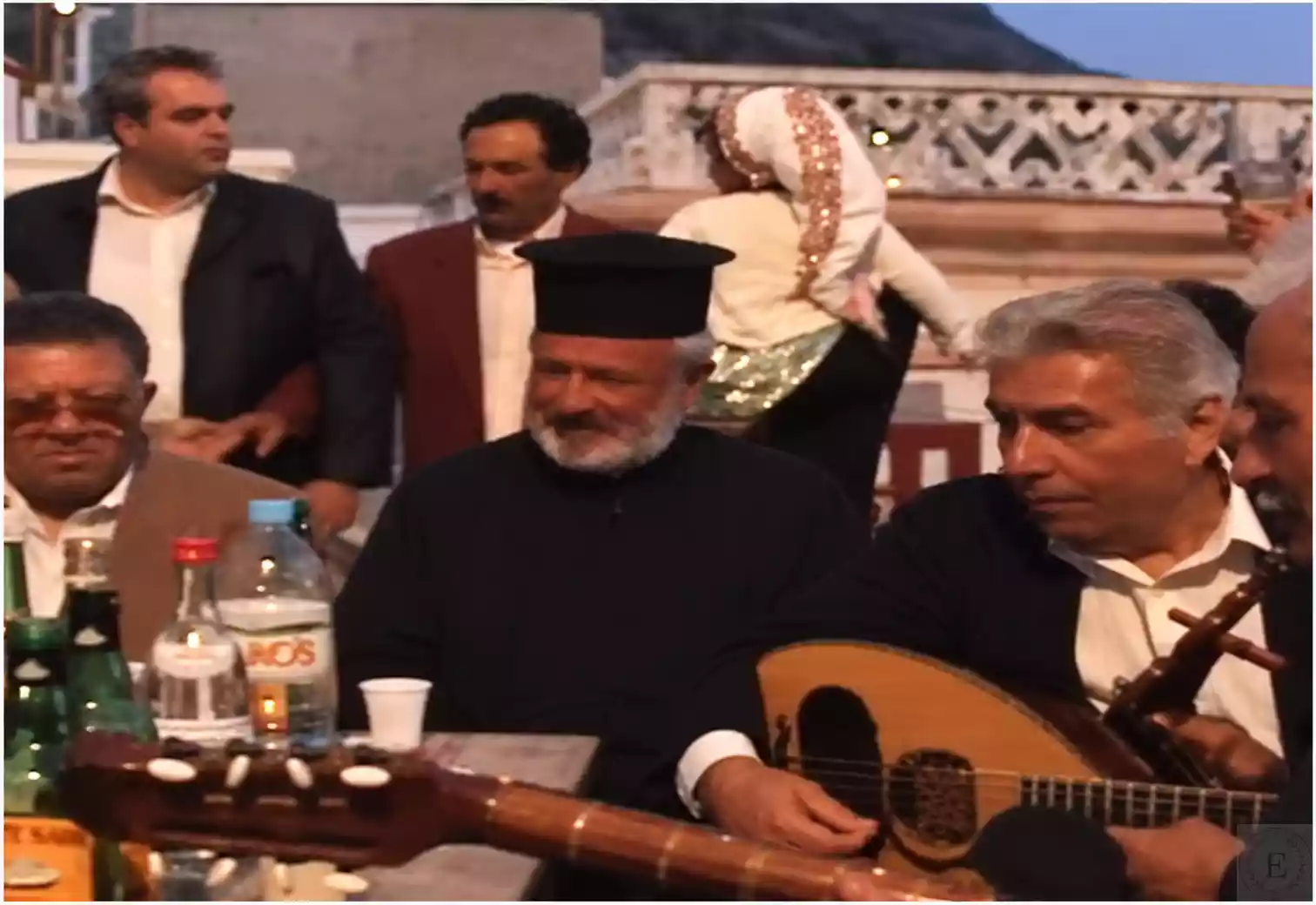
 A seated glenti in Olympos, with a laouto player and diners gathered round the table.
In Olympos, on Karpathos, the right to open the singing depends on the standing a person is granted by the company, and on the responsibility of guiding an exchange that may go on for hours. Around the table the revellers follow every word, wait for the right moment to reply and compose mantinades addressed to particular people. The order of the songs, and the passage to the dance, keep to a sequence that everyone present knows, even when nobody needs to be reminded of it.
From the shared table to the first mantinada
The seated glenti takes shape in many settings, from a gathering at the kafeneio to the village feast, and how long it lasts depends on the occasion and on the company. In Foteini Margariti’s account of the feast at Vroukounda, the communal meal is followed by troparia chanted by the priests and cantors. The priest then raises a toast, by name, to the protomeraklis, who leads the table song «Άρχοντες τρων και πίνουσι» (‘The lords eat and drink’) and, after it, the first mantinada. It is a specific ritual opening, bound up with the feast and with the people who take part in it.
The table songs and the syrmatika have texts received through oral tradition. The mantinada of the glenti, by contrast, is made for the occasion, as the conversation unfolds. An experienced reveller knows both kinds, and knows too how the company moves from one to the other.
Who is recognised as ‘first’
Precedence presupposes recognition by others. In the Karpathian tradition, meraklíki – the reveller’s flair and devotion to the art of the glenti – is judged by the community, and more particularly by the circles of revellers, who weigh a person’s poetic ability together with his character. Especially telling is his capacity to hold the company together and to draw the others in. The protomeraklis thus takes responsibility for the course of the glenti, his skill put to the test each time among his fellow villagers.
The obligations of whoever takes the floor are just as precise. The National Inventory records that if two people begin at the same moment, precedence goes to the elder or to the acknowledged better meraklis, to an office-holder, or to the person in whose honour the glenti is held. Attention to the theme and to the singer is also required, with no conversations on the side. The next reply has to fit what has just been heard.
The fifteen-syllable line as sung dialogue
Two rhyming fifteen-syllable lines make up the mantinada, each with its characteristic caesura dividing a hemistich of eight syllables from one of seven. Mélanie Nittis’s ethnomusicological study describes how the improviser sings his couplet in segments, using repetitions and exclamations to fit the words to the melody. The other men repeat the hemistichs in chorus, all except the last, which gives the singer time to shape what follows. The answer that comes next belongs to the same thematic thread.
Many tunes, or skopoi, carry this dialogue, with local variants and preferences. The musicians know which tune helps a particular reveller and adjust their accompaniment so as to support his efforts at versifying. Part of an instrumentalist’s knowledge, then, is this familiarity with the people around the table.
A new mantinada is heard by people who often remember older ones. Nittis stresses the importance of this memory, since repeating a couplet that has already been sung runs counter to the rule of improvised composition. The poiitaris, the folk poet, composes before listeners who know rather well what has been said at earlier gatherings.
The lyra and its hawk bells
The sung word is carried by the Karpathian lyra, while the small bells on its bow, the gerakokoudouna or ‘hawk bells’, add a rhythmic sound to every stroke. The laouto supplies rhythmic and harmonic accompaniment, and the tsambouna holds a place of its own in the Olympos ensemble. Nittis’s study distinguishes these functions, examining how the instruments support the voices and encourage those present to join in.
The lyra matters in its making as well. In her doctoral thesis on Karpathian organology, Eirini Beina examines the instrument within the cultural setting of the island and approaches it as a bearer of local identity. Its makers, often players themselves, set particular store by keeping its older form, which they associate with the continuity of their musical tradition. Their choices therefore also concern the way in which the community recognises its own sound.
The sousta and the passage to the dance
The sousta belongs to the wider Karpathian repertoire, yet the dancing at an Olympos glenti follows a sequence of its own. Nittis’s ethnographic account traces the progression from the slow Kato choros to the Gonatistos and then to the faster Pano choros. She also records a sousta in the programme presented by musicians from Olympos in France. Its place in the repertoire is therefore documented, without its name being taken to stand for the whole local sequence of dances.
The dance, too, has its distinct responsibilities: the kavos leads, while the other positions help the chain of dancers to unfold smoothly. Women, whose part in the public improvised dialogue has traditionally been confined to certain family occasions, play an active role in the dancing.
Nittis’s research also brings out their contribution to memorising mantinades, and even to writing them down in notebooks. Kept there are words once sung about particular fellow villagers, along with the memory of the occasions on which they were heard.
Sources and Bibliography
- Margariti, Foteini (2021). Το Ολυμπίτικο γλέντι ως στοιχείο άυλης πολιτιστικής κληρονομιάς. Μελέτη περίπτωσης το πανηγύρι του Αγίου Ιωάννη στην Βρουκούντα της Ολύμπου Καρπάθου [The Olympos glenti as an element of intangible cultural heritage: a case study of the feast of Saint John at Vroukounda, Olympos, Karpathos]. MA dissertation, University of the Peloponnese.
- Beina, Eirini (2011). Η καρπάθικη λύρα: μια εθνογραφική προσέγγιση στην πολιτισμική οργανολογία: μουσικά όργανα και πολιτισμική ταυτότητα της Καρπάθου [The Karpathian lyra: an ethnographic approach to cultural organology: musical instruments and the cultural identity of Karpathos]. PhD thesis, Ionian University.
- Hellenic Ministry of Culture (2019). Καρπάθικο Γλέντι [The Karpathian glenti]. National Inventory of Intangible Cultural Heritage of Greece.
- Hellenic Ministry of Culture (2020). Ολυμπίτικο Γλέντι [The Olympos glenti]. National Inventory of Intangible Cultural Heritage of Greece.
- Nittis, Mélanie (2022). ‘Une oralité fonctionnelle à l’ère du numérique : le cas d’Olympos (Karpathos, Grèce)’. Martor, 27, pp. 113–131.
- Nittis, Mélanie (2025). ‘La mise en spectacle d’un rituel : le cas du glenti d’Olympos’. L’ethnographie, 10.


