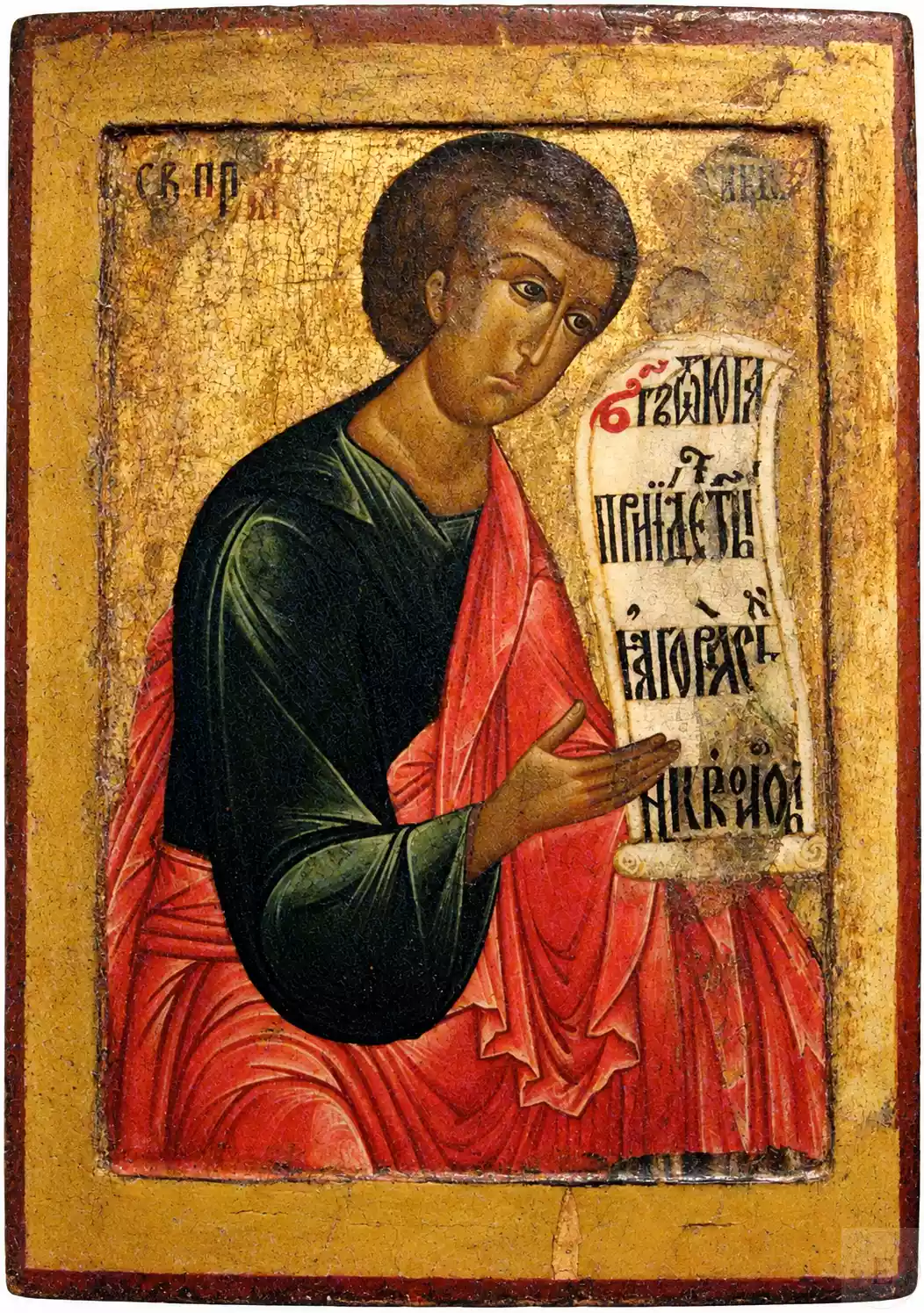
 The Prophet Habakkuk. Seventeenth-century icon, tentatively attributed to Terenty Fomin of Vologda (documented 1646–1670), from the Church of Saint Epiphanius of Cyprus at the Kirillo-Belozersky Monastery, Russia.
Eighth among the twelve so-called Minor Prophets of the Old Testament, in the Hebrew canon and in the Septuagint alike, Habakkuk belongs to those figures of biblical literature of whom we know far more from their words than from their lives. The book that bears his name, a mere three chapters, gives no father’s name, no place of origin and no date, only the prophet’s name and title; what the synaxaria tell us today about his tribe, his father and his death derives from later traditions, Jewish and Christian, written down centuries afterwards and often at odds with one another. The Orthodox Church keeps his memory on 2 December. To separate what the book itself says from what has accreted around it is, I think, the only safe way of approaching him.
One name, two tribes and scarcely any biography
The name poses the first problem. In the Hebrew text the prophet is called Ḥăḇaqqûq; the Septuagint rendered this as Ἀμβακούμ (Ambakoum), while Greek ecclesiastical tradition settled on the form Avvakoum. The interpretation ‘warm embrace’, repeated by the modern synaxaria, rests on a Hebrew root meaning ‘to embrace’ and is an old one, already adopted by Jerome; more recent scholars, however, have proposed a different origin in the Akkadian name of a plant, which shows how uncertain the etymology is of a name found nowhere else in the Hebrew Bible.
More interesting, and more revealing of the way in which the biographies of the prophets came into being, is the disagreement of the ancient sources over his origins. The so-called Lives of the Prophets, a collection of brief biographical notices usually dated, with considerable caution, to the beginning of the Christian era and preserved in Christian recensions, some of them ascribed to Saint Epiphanius of Cyprus, make him a member of the tribe of Simeon from the field of Bethzouchar, and this is the version that passed into the Orthodox synaxarion. The ancient Greek translation of the story of Bel and the Dragon, however – that is, of the addition to the Book of Daniel – presents him in its heading as the son of one Jesus of the tribe of Levi. Some scholars have linked this version with the psalm-like character of the book’s third chapter, which suggests liturgical use in the Temple, but the connection remains a hypothesis. The patronymic Saphat, finally, recorded in some modern synaxaria, does not occur in the biblical text.
The same is true of his date. The synaxaria place his activity between 672 and 650 BC, except that the book speaks of the Chaldeans, the Neo-Babylonians, as a rising and menacing power, whereas the Neo-Babylonian empire took shape only from 626 BC, and its dominion over Syria-Palestine was established chiefly after the victory at Carchemish in 605 BC. Most scholars therefore place the book, or at least its core, in the late seventh or early sixth century BC, often in the reign of Jehoiakim, king of Judah (609–598 BC), while others prefer dates after the first capture of Jerusalem by the Babylonians in 597 BC.
A dialogue with God in the age of the Chaldeans
Anyone who comes to the book with the synaxaria’s picture of a prophet rebuking the people for their idolatry will be taken aback, for Habakkuk addresses himself chiefly to God and not to the people. The book opens with a complaint, with the question of ‘how long’ the prophet must cry out without being heard while injustice and violence prevail around him, and God replies that He is raising up the Chaldeans, a bitter and impetuous nation, as the instrument of His judgement. Yet the answer gives rise to a new and deeper question: how can the Holy One, whose eyes are too pure to behold evil, tolerate the wicked man who swallows up one more righteous than himself? The prophet then takes his stand upon his watchtower to await the reply, and the reply comes as a vision to be written plainly on tablets, with the injunction to wait for its fulfilment, though it tarry.
There follow five ‘woes’, five taunting denunciations of the oppressor who grows rich on the goods of others, builds cities with blood and worships dumb idols – idols mentioned here, strangely enough for the synaxarion’s scheme, as the sin of the conqueror and not of Judah. The third chapter, headed ‘A Prayer of Habakkuk’, is a psalm with musical directions such as the Hebrew selah, which the Septuagint rendered diapsalma; it describes the coming of God as a theophany amid earthquake and storm and closes with a confession of trust: though the fig tree should not blossom and the vines bear no fruit, the prophet will rejoice in the God of his salvation. That the book raises openly the problem of divine justice in the face of the triumph of the wicked is what sets it apart, and this explains why modern interpreters often read it as an early theodicy.
‘The righteous shall live by faith’: one verse, many readings
Few verses of the Old Testament have enjoyed so rich an afterlife as the fourth verse of the second chapter, and few show so clearly how translation becomes interpretation. The Hebrew text says that the righteous will live by his faithfulness, that is, by his steadfastness under trial, whereas the Septuagint translated ‘ὁ δὲ δίκαιος ἐκ πίστεώς μου ζήσεται’, ‘but the righteous shall live by my faith’, a wording that has been understood either as a reference to God’s faithfulness or as faith in Him. The Apostle Paul quotes the verse in Romans and Galatians without any possessive pronoun and makes it the foundation of his teaching on justification by faith; the Epistle to the Hebrews, according to its critical text, quotes it with the ‘my’ attached to the righteous one rather than to faith; and centuries later the same verse would find itself at the heart of the theological debates of the Reformation. Three, then, or even four different inflections within the same few words, none of them cancelling out the others.
Yet another reading, entirely different, survives in the Habakkuk Pesher, one of the first seven Dead Sea Scrolls discovered at Qumran in 1947. The scroll, about a metre and a half long, with thirteen columns of Hebrew text, dates from the second half of the first century BC and comments verse by verse on the first two chapters of the book, applying them to the history of the community that produced it: the prophet’s Chaldeans become the Kittim, that is, the Romans, and behind the figures of the text one discerns the Teacher of Righteousness, the Wicked Priest and the Man of the Lie, figures whose identity has not been established. The fact that the commentator stops at the end of the second chapter has led some to suppose that the prayer of the third chapter originally circulated separately; but other, almost contemporary manuscripts of the Twelve Prophets from the Judaean Desert do contain the third chapter, so the silence of the pesher may simply reflect the interests of its author.
From Daniel’s den to the prophet’s tombs
The best-known story about Habakkuk is found not in his book but in the addition to Daniel already mentioned, where an angel seizes him by the hair of his head as he is taking food to the reapers in Judaea and carries him to Babylon to feed Daniel in the lions’ den. The Lives of the Prophets weave the episode into a full biography: when Nebuchadnezzar invaded the land, Habakkuk fled to Ostrakine on the borders of Egypt and lived as a sojourner in the land of Ishmael; he later returned and cooked for the reapers, was carried to Babylon to give Daniel food and came back without telling what had happened; he gave the Jews signs concerning the future of the Temple, and died two years before the return of the captives, to be buried in his own field. The synaxarion’s phrase that he died in peace and was buried in the land of his fathers echoes this tradition, not the biblical text.
It was this tomb that Zebennus, Bishop of Eleutheropolis, claimed to have found at the end of the fourth century. The historian Sozomen, writing in Constantinople between 439 and 450, that is, some half a century later, relates that the relics of Habakkuk and of the prophet Micah were revealed to the bishop in a dream in the reign of Theodosius the Great and were located in two villages in the territory of Eleutheropolis, those of Habakkuk at Kela, the ancient Keilah. The record of the discovery of the relics in the Cult of Saints database of the University of Oxford notes that the pilgrim Egeria, who passed through the area in 384, says nothing of it, so that the events should be placed in the late 380s or early 390s, and that a more recent suggestion connects them with Zebennus’ rivalry with John, Bishop of Jerusalem. I should note here that Sozomen presents the discoveries as signs of the flourishing of Christianity under Theodosius, which says a great deal about the function of the story and almost nothing about the historicity of the identification.
Christian Palestine, moreover, was not alone in laying claim to the prophet. About a kilometre south of the town of Tuyserkan in western Iran, an octagonal brick tower with a conical roof is venerated as the tomb of Habakkuk by Jews and Muslims alike, with a marble tombstone, seven-branched lamps, a Star of David and inscriptions, in Hebrew and Persian, taken from the prophet’s book. The relevant entry in the Encyclopaedia Iranica observes, with due scholarly reserve, that no evidence explains how the prophet could have come to be in Iran, that the claim that he was among the exiles in Babylon has no historical basis, and that a Jewish traveller of the 1820s had already heard the local stories without being convinced. Two tombs, then, in two different countries, each with its own community of pilgrims, and between them a book that says not a word about the death of its author.
The Ode of Habakkuk in worship and in the icon
If the prophet’s biography belongs to the realm of tradition, his presence in Orthodox worship is daily and tangible. The prayer of the third chapter, in its Septuagint form, is the fourth of the nine biblical odes of Matins, beginning with the words ‘Κύριε, εἰσακήκοα τὴν ἀκοήν σου καὶ ἐφοβήθην’ (‘O Lord, I have heard the report of Thee and was afraid’), and upon it was built the fourth ode of the canons of Byzantine hymnography, so that its images return, transfigured, in hundreds of hymns. Here the difference between the Greek and the Hebrew text proved decisive: where the Hebrew asks God to make His work known ‘in the midst of the years’, the Septuagint read ‘ἐν μέσῳ δύο ζῴων γνωσθήσῃ’ (‘in the midst of two living creatures Thou shalt be known’), a verse the Fathers connected with the manger at Bethlehem; and the ‘ὄρος κατάσκιον δασύ’, the shaded, densely wooded mountain from which the Holy One comes, became for the hymnographers a prefiguration of the Theotokos, exactly as one of the apolytikia of the prophet’s feast puts it. The horses of God troubling the many waters of the sea were interpreted, in the kontakion of the same feast, as the Apostles who drown error, while the watchtower of the second chapter, where the prophet stands to await God’s answer, gave Saint John of Damascus the opening of the fourth ode of the Paschal canon, ‘Ἐπὶ τῆς θείας φυλακῆς ὁ θεηγόρος Ἀββακούμ’ (‘Upon the divine watch let Habakkuk, who spoke of God’), in which the prophet is called to stand with the faithful and to point to the light-bearing angel who proclaims the Resurrection. These are, it should be noted, Christological readings of the Greek text, belonging to the history of the book’s reception rather than to its original meaning – which in no way diminishes their theological and poetic worth for the tradition that shaped them.
Exactly the same reception is found in iconography. The seventeenth-century Russian icon from the Church of Saint Epiphanius at the Kirillo-Belozersky Monastery, tentatively attributed to the painter Terenty Fomin of Vologda, shows Habakkuk at half length, youthful and beardless, in a dark green tunic and red himation against a gold ground, pointing with his right hand to an open scroll. The Church Slavonic inscription on the scroll renders the verse about God who will come from the south and the Holy One from the shaded mountain, where the Septuagint’s ‘Thaiman’, a place name that in Hebrew also means ‘south’, has been translated in its common sense; so that the painter, choosing this verse from among so many others, placed in the prophet’s hand precisely the phrase by which Orthodox worship names him a herald of the Theotokos.
Sources and Bibliography
- James, M. R. (1920). The Lost Apocrypha of the Old Testament: Their Titles and Fragments. London: SPCK.
- Rahlfs, A. & Hanhart, R. (eds) (2006). Septuaginta. Editio altera. Stuttgart: Deutsche Bibelgesellschaft.
- Soroudi, S. (2002). Ḥabaqūq, Tomb of. Encyclopaedia Iranica, vol. XI, fasc. 4, p. 425.


