
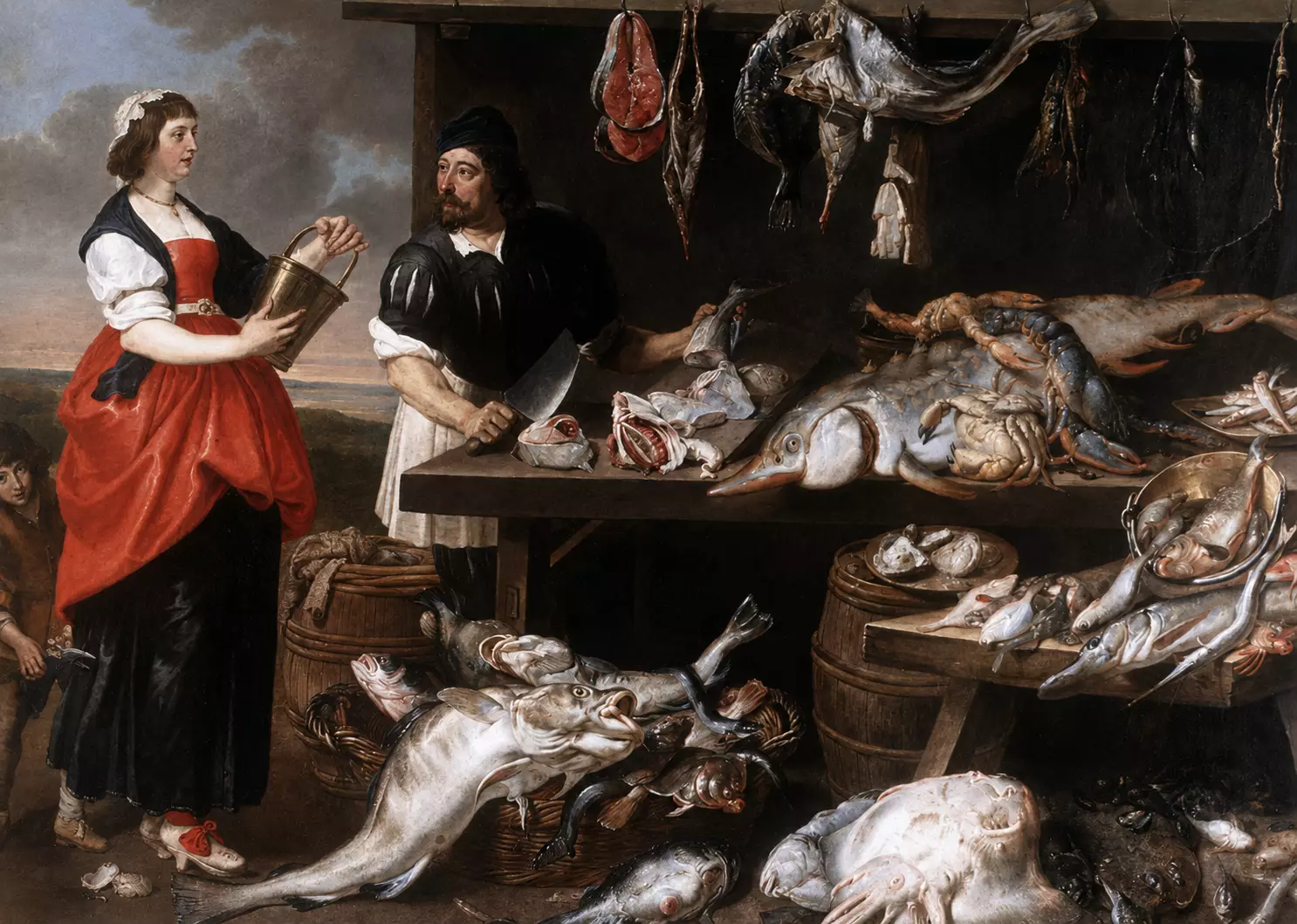
Adriaen van Utrecht’s Fishmonger’s Stall, painted around 1640, turns an ordinary commercial setting into an immense display of marine abundance. Executed in oil on canvas and measuring approximately 216 by 301 centimetres, the work belongs to the collection of the Museum of Fine Arts in Ghent. Its scale is immediately significant: this is not a small cabinet still life intended for close, private inspection, but a broad theatrical arrangement in which fish, crustaceans, shells, vessels and human figures occupy nearly the entire field of vision. The museum describes the painting as a deliberately heightened presentation of the sea’s richness rather than a strictly documentary record of a working fish stall. That distinction matters, because van Utrecht constructs the scene through selection, enlargement and accumulation. A large fish lies across the lower foreground with its mouth open; crabs and lobsters press forward on the central table; oysters and other shellfish gather in dishes; rays, fish and pieces of sea produce hang from above. Beyond this profusion, the narrow opening towards water and sky gives the scene a distant horizon, cool and almost incidental beside the dense materiality of the stall.
Fishmonger’s Stall and the Abundance of the Sea
The composition is built around a long horizontal counter, but the eye does not remain on that line for long. Van Utrecht interrupts it with the standing figures, the suspended specimens, the large diagonal bodies of the catch and the rounded forms of barrels below. The result has a curious mixture of order and pressure. Objects have been displayed for sale, yet they seem to exceed the furniture meant to contain them. The catch spills towards the lower edge, a basket is partly hidden beneath larger specimens, and the right side becomes increasingly crowded until the arrangement is almost sculptural in density.
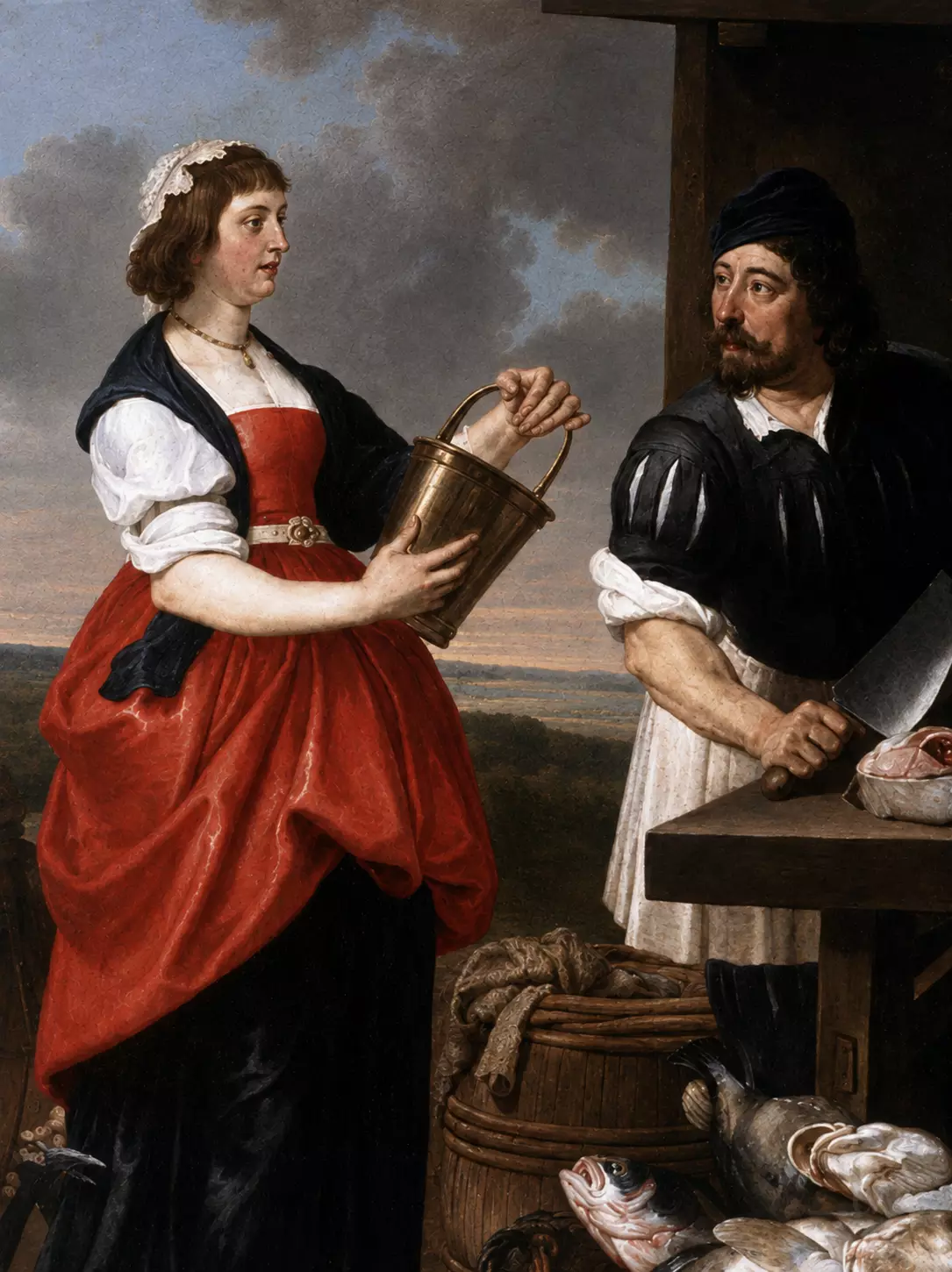
Colour establishes a second hierarchy. At the left stands a young woman dressed in a vivid red garment with full white sleeves and a dark covering across her shoulders. She carries a metal vessel whose brown-gold surface catches the light. Beside her, the fishmonger appears in black and white, his clothing much quieter, holding a broad knife while turning his head towards her. Their exchange forms the human centre of the painting, but not its largest centre. That privilege belongs to the goods. The pale belly of the enormous specimen in the foreground, the silvery sheen on the counter, the rough shells, the glossy crustaceans and the dull wood of the barrels all receive a degree of pictorial attention that makes texture itself one of the principal subjects.
An Antwerp-born Flemish painter, Van Utrecht built his reputation especially on still lifes, pantry scenes, fish markets and displays of fruit, vegetables and game. The Getty characterises him as a master of still life, while the Ghent museum records his Antwerp birth in 1599 and death there in 1652. His practice belongs to a culture in which the still life could expand far beyond a modest grouping of objects and assume the scale, complexity and narrative charge of history or genre painting.
These marine subjects are therefore not neutral commodities. Their number, variety and positioning turn the market into a demonstration of plenitude. Some are aligned with the tabletop; others project towards the viewer; still others hang overhead, introducing a vertical sequence of tails, fins, flesh and shadow. The scene can be read in relation to the traditional association of fish with the element Water, an interpretation explicitly recognised in the museum’s account of the work. Yet van Utrecht avoids converting the idea into a tidy allegorical diagram. Water itself occupies only a small background zone. Its products have moved forward and taken possession of the foreground.
Texture, Scale and Visual Appetite
Painted surfaces carry much of the argument. The skin of one specimen is opaque and heavy, another slick and reflective; the lobster has a rigid armour that catches small accents of light, while the opened oysters are softer, irregular and moist. A ray or skate at the right spreads across the display with a flattened breadth unlike the cylindrical forms around it. These differences prevent the mass of food from becoming monotonous. Repetition is constantly checked by species, size, direction and texture.
The lower foreground is particularly assertive. Van Utrecht lets the largest catch descend into the viewer’s space, its body crossing the boundary established by basket and barrel. Close to it lie smaller creatures whose mouths, eyes and curving bodies create a restless sequence of shapes. The objects do not sit politely for contemplation. They crowd, overlap, conceal one another, reappear. Even the barrels matter: their hoops and circular rims give geometric stability to the organic confusion above.
Light moves unevenly across this accumulation. The woman’s red clothing and white sleeves are brightly legible, the fishmonger’s torso recedes into darker tones, and the central produce seems to catch illumination in flashes rather than under a uniform wash. The background behind the hanging fish is darker still. Such contrasts help detach individual forms without destroying the sense of profusion. One sees a large catch first, then a lobster, then the pale interior of a shell, and only gradually the smaller objects lodged between them.
The Figures in Fishmonger’s Stall: A Closer View
Seen more closely, the exchange between customer and seller has a measured, almost suspended quality. The woman steadies the metal container with both hands while turning towards the fishmonger. He looks back at her, knife lowered, his forearm resting near the edge of the counter. Their gestures are practical enough for a market transaction, yet their attention to one another is conspicuous. The scene uses that pause.
At the far left of the full composition, partly concealed behind the woman, a boy is present. His small face and body are easy to miss amid the sweep of the red dress and the cluttered foreground. The Ghent gallery identifies him as a thief cutting the strings of the woman’s purse while the two adults remain distracted by their exchange. The same institution also connects the work’s erotic undertones with a moral warning against sensual distraction. In this reading, abundance is double-edged: the eye that delights in excess can also fail to notice what is happening at the edge of vision.
That narrative element does not reduce Fishmonger’s Stall to an illustrated moral lesson. It works because it is visually secondary. The thief is not placed at the centre, nor is his action announced through exaggerated gesture. He almost disappears. The principal figures are occupied with each other; the viewer, meanwhile, is likely to be occupied with the same things that dominate them, the red clothing, the shining pail, the enormous catch, the knife, the shells and crustaceans. Recognition comes late.
The painting once hung over the chimneybreast in the kitchen of St Peter’s Abbey in Ghent, an original setting recorded by the museum and one that gives the monumental scale a practical historical resonance. In a kitchen, the imagery of food, seafood, preparation and plenty would have had an immediate relation to the room’s function, even as the scale and moral undertone exceeded mere decoration. Today, in the Museum of Fine Arts, Ghent, the work remains a formidable example of seventeenth-century Flemish still-life painting enlarged into a populated market scene: part inventory, part spectacle, part genre narrative, with the sea compressed into a table that can barely contain it.
(The translation was edited by N. Jones.)