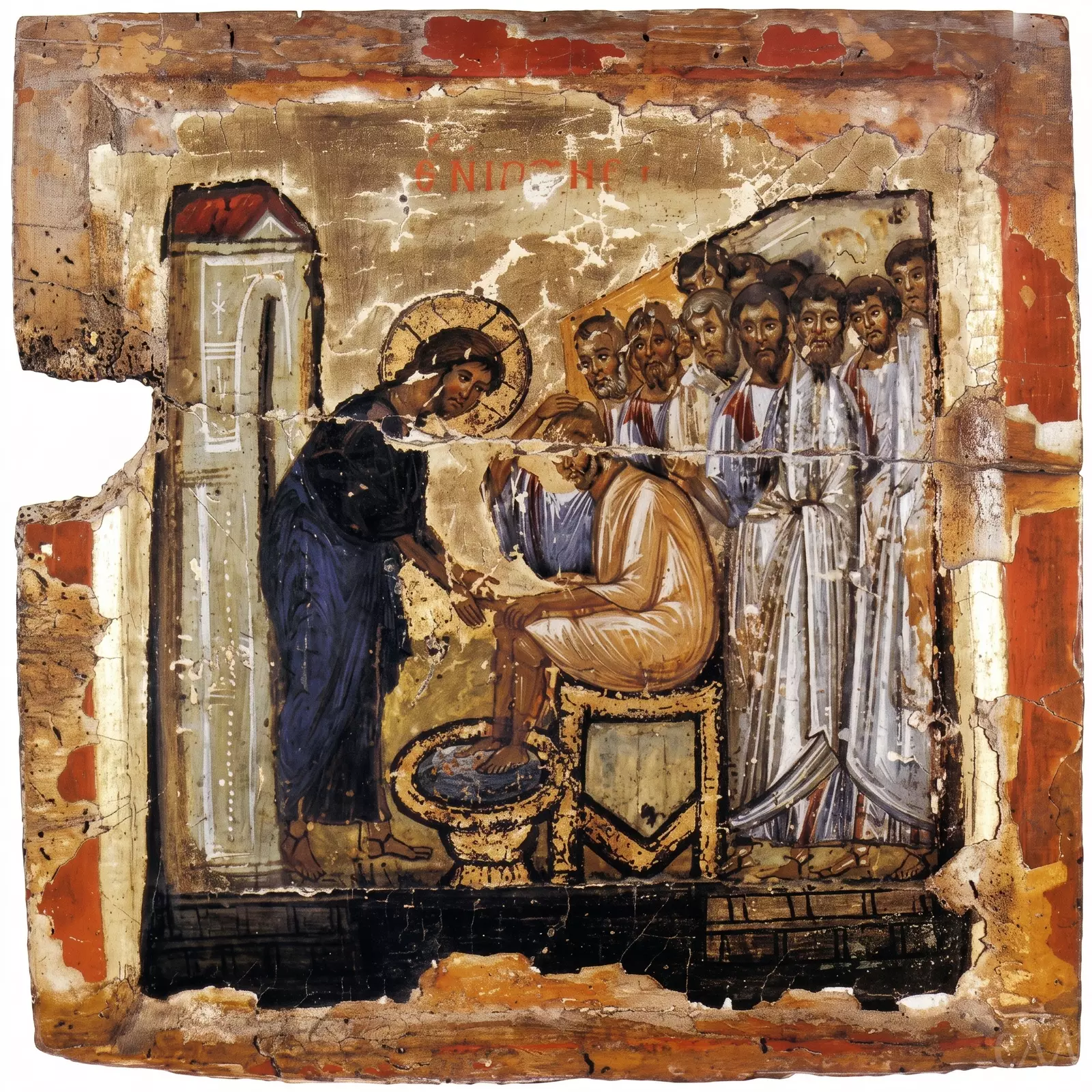
The Washing of the Feet preserved at the Monastery of Saint Catherine on Sinai is a small Byzantine panel of unusual narrative concentration. Dated to the first half of the tenth century and measuring only 25.6 × 25.9 cm, it compresses the Johannine episode (John 13:4–10) into a nearly square field: Christ bends at the left towards Peter, Peter sits with his bare feet placed in the basin, and the remaining apostles form a close, almost continuous body behind him. The scene is immediately legible, yet its visual economy is severe. A low wall marks the elevated interior in which the action takes place; a narrow architectural structure at the far left and the sloping forms behind the apostles give only enough setting to establish an upper chamber. Gold occupies much of the surviving background, its luminous expanse broken today by extensive losses.
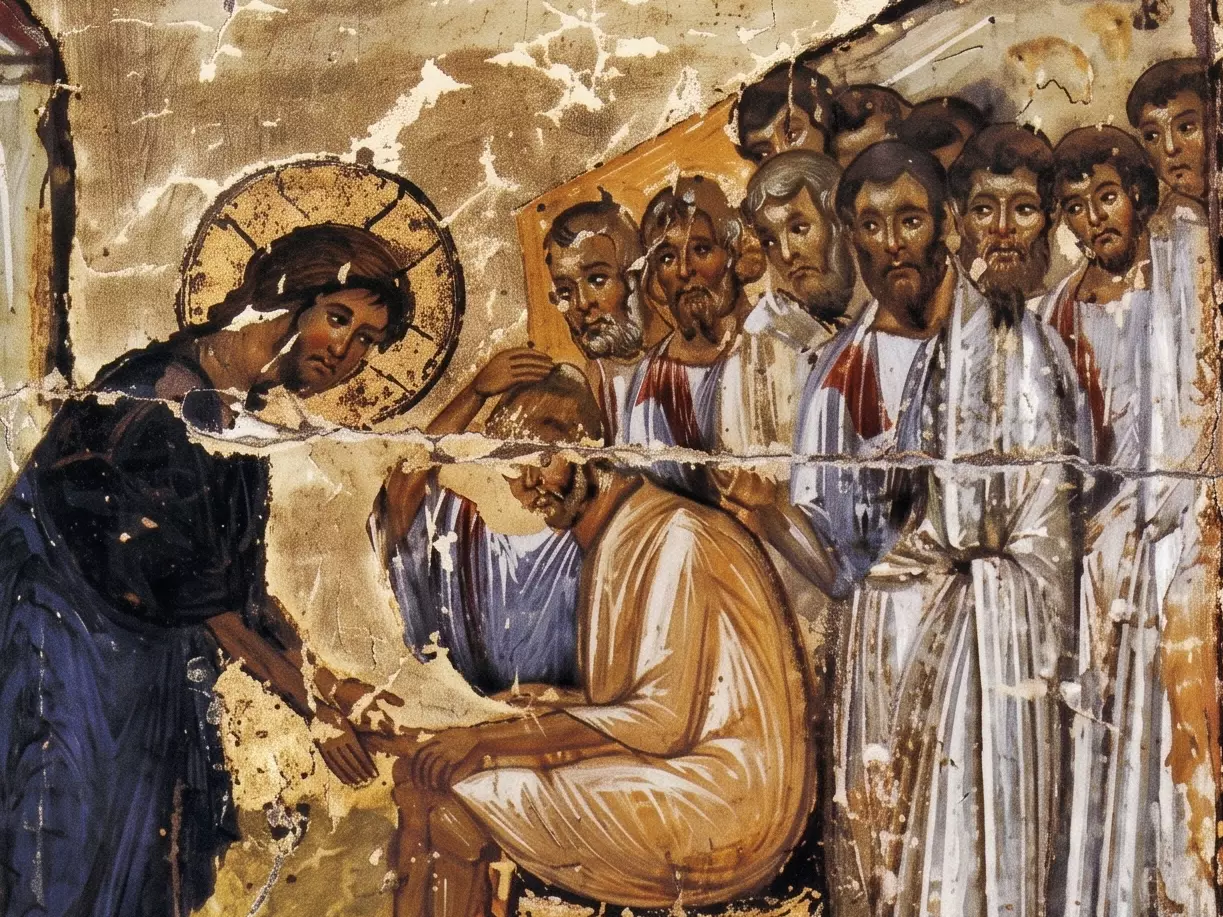
More striking is the opposition between movement and restraint. Christ alone inclines his whole body into the action, his dark garments gathering into broad, heavy folds as he reaches towards Peter’s feet. Peter answers with a gesture that belongs as much to speech as to movement: his right hand rises towards his head, referring to John 13:9, when he asks Christ to wash not his feet only, but also his hands and head. The disciples behind him do very little. Their attention, faces, shoulders, tightly packed bodies carry the drama.
Washing of the Feet Sinai Icon: Gesture, Space, and Early Templon Painting
The composition depends on an unequal distribution of weight. At the left, Christ occupies a relatively narrow zone, separated from the apostles by the movement of his bent torso and by the dark blue of his clothing; opposite him, Peter and the other disciples gather into a denser, much lighter mass. The contrast is chromatic, but it is also structural. Christ advances. The apostles receive, observe, wait. Between the two groups lies the small basin, low in the pictorial field and close to the foreground, an object whose circular rim acts almost like a hinge between the diagonal descent of Christ’s body and the seated figure of Peter.
Peter is the centre of the narrative without becoming the geometrical centre of the panel. His seated posture lowers him beneath the line of the standing apostles, while the warm ochre of his garment sets him apart from their predominantly pale robes. Through posture rather than elaborate setting, the painter makes the exchange between Christ and Peter intelligible. Christ’s head inclines; Peter turns towards him; the raised hand moves back towards Peter’s own head. In this compact arrangement, the Gospel dialogue (John 13:6–10) becomes visible as a chain of bodily responses. The hands matter greatly. So do the eyes, especially in the apostles whose faces crowd together above Peter, each gaze directed towards the encounter or slightly aside from it.
Behind Peter, the disciples are not individualised through sharply differentiated costume or action. Their physiognomies belong to a shared visual vocabulary: elongated or oval faces, dark hair and beards, narrow eyes, pronounced noses, small mouths. Yet the repetition never becomes mechanical. One head is lowered, another turns obliquely, another appears almost frontal; a few are pushed back until only the face and part of the neck remain visible. Overlapping produces depth without opening a convincing continuous interior. Spatially compressed, the group is nevertheless not flat. Its density is one of the panel’s most effective devices.
This point becomes especially clear when the tenth-century composition is set beside later Byzantine versions of the same episode. From the eleventh century onwards, artists increasingly gave the apostles secondary actions: some sit, some bend down, some loosen or remove their sandals while waiting. The Sinai panel is earlier and more concentrated. All the disciples behind Peter remain standing. The result is a scene with fewer anecdotal incidents and a stronger collective presence. Their bodies form a vertical screen against which Peter’s seated figure and Christ’s stooping movement become more emphatic.
Restricted though they are, the architectural indications establish the setting. A low wall marks the chamber, while a slender gabled structure at the left and inclined planes behind the apostles extend the setting without establishing consistent depth. They provide locality; the figures remain the real measure of the space.
Across the surviving paint surface, the modelling retains a degree of softness important for the traditional dating of the icon. Faces are not constructed only by hard contour. Brown, ochre, cream, and lighter accents pass across cheeks, foreheads, and necks, while the garments are articulated by long linear highlights that also suggest volume. Christ’s dark mantle, especially, has a bodily weight beneath its folds. Peter’s robe turns around the bent knee in broad, curving passages. Such features belong comfortably within the classicising tendencies associated with tenth-century Byzantine painting, although the term “Macedonian Renaissance” is best used with care: it describes a recurring scholarly interpretation of the period’s engagement with antique visual language, rather than a single uniform style.
The panel’s condition changes the way this modelling is perceived. Large lacunae interrupt the gold ground and central action; abrasion and losses break the continuity of garments and architecture. Still, the compositional logic remains clear. From Christ’s inclined head the eye moves through Peter and upwards into the row of faces. Damage has removed paint without dissolving the narrative syntax.
The nearly square dimensions and the horizontal direction of the wood grain have long encouraged the proposal that the panel was originally one component of a templon beam or epistyle carrying a cycle of major Christological feasts. In art-historical terminology, such an object belongs to the category of the panel icon, while its proposed architectural setting would place it within the painted programme of the sanctuary screen. This proposed function matters because it shifts the work away from the idea of an isolated portable image. Seen as part of a sequence, the Washing of the Feet would have participated in a horizontal narrative unfolding above the templon, each scene compact enough to be read separately and yet dependent upon neighbouring episodes.
Kurt Weitzmann, discussing the painted beams at Sinai, singled out the tenth-century Washing of the Feet as a panel believed to have belonged to an iconostasis beam and observed that, if the hypothesis is correct, it would constitute the earliest surviving fragment of such a painted beam. Significant here is the conditional phrasing: the original ensemble has not survived, and the reconstruction rests upon the physical format of the panel and comparison with later examples. His argument can be consulted in Weitzmann’s study, while his wider treatment of Byzantine icons is available in The Icon.
If the panel did form part of an early feast cycle, its compactness becomes easier to understand. Christ, Peter, the basin, the witnesses, a few architectural signs: the painter reduces the event to what is necessary for recognition and tension. Christ’s dark clothing separates him sharply from the pale garments of the disciples within the crowded field.
The theological meaning is carried through this economy of action. John’s account presents the washing as an inversion of expected rank and as an example to be imitated (John 13:12–15); the panel renders that inversion physically, bringing Christ downward and placing the disciple above him. Peter’s raised hand, however, prevents the scene from becoming a simple image of service. It records resistance, misunderstanding, acceptance in formation (John 13:6–10). Into a silent image that brief gesture introduces speech.
For a work scarcely larger than a modern book, the panel sustains a surprisingly complex relation between narrative, liturgical memory, and pictorial form. Its importance lies partly in its early date, partly in the possibility that it preserves evidence for the development of the painted templon beam, and partly in the unusual clarity with which an entire Gospel exchange is built from a few intersecting movements. Christ bends; Peter turns; the apostles close behind him. The rest is held in the gold field.
(The translation was edited by K. Pappas.)