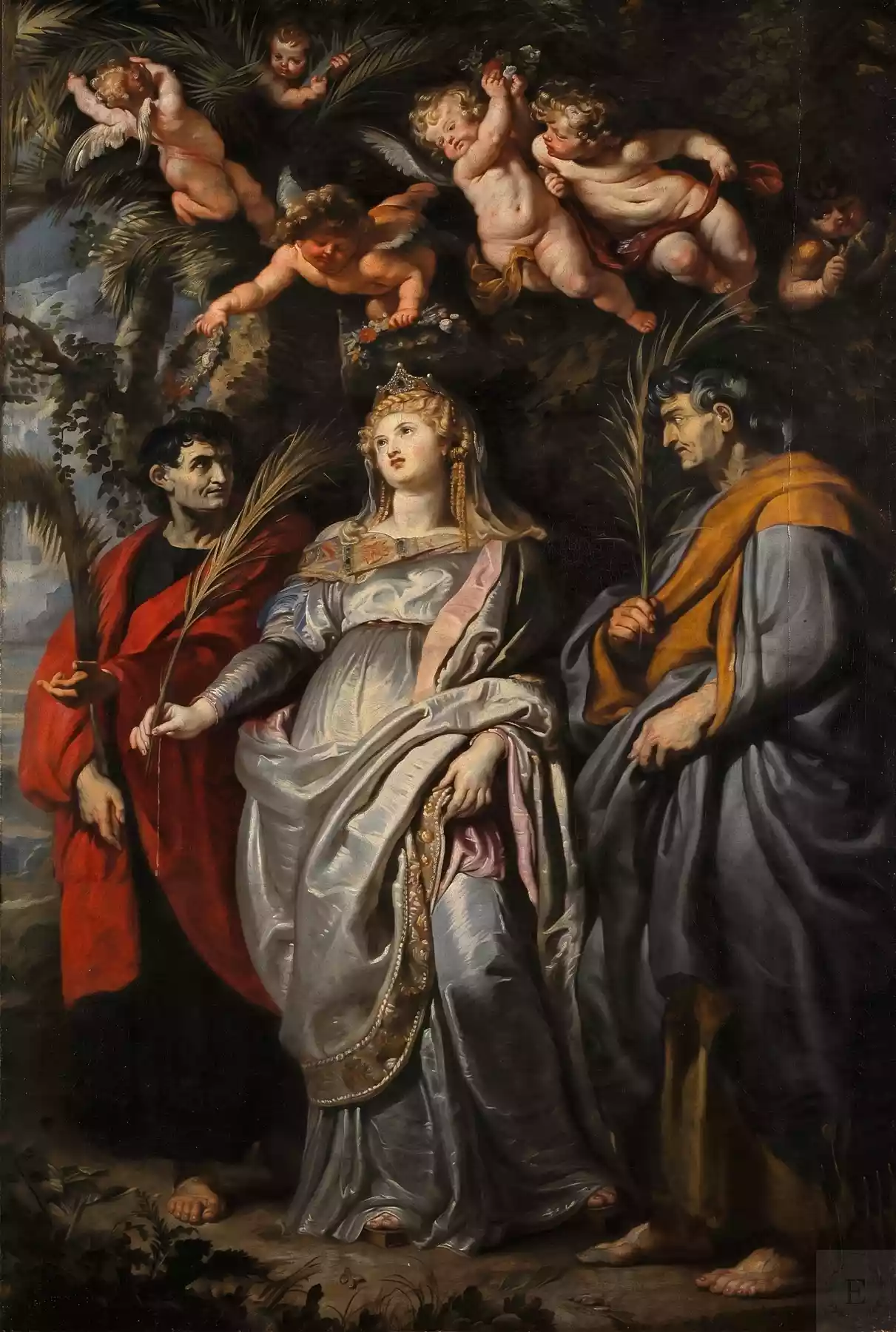
 Peter Paul Rubens (1577–1640), Saint Domitilla with Saints Nereus and Achilleus, 1608. Oil on slate, 425 × 280 cm. Santa Maria in Vallicella (Chiesa Nuova), Rome.
Saints Nereus and Achilleus are bound up with one of the most important Christian cemeteries of Rome, the Catacombs of Domitilla on the Via Ardeatina. By the fourth century the veneration of their tombs had already found public expression, whereas what is known of their earlier lives remains meagre. Later hagiographical narrative casts them as servants of a woman of the imperial house, Flavia Domitilla, sharing her exile and her devotion to the Christian faith; the oldest surviving testimony, however, places them in the ranks of the Roman army.
That discrepancy raises the central historical question. How did their shared story take shape, when everything we know comes from texts of different periods, written to meet different needs of the Church community?
The inscription of Pope Damasus
Under Pope Damasus I, between 366 and 384, a Latin epigram was composed in honour of the two martyrs and set up at their burial place. It describes their conversion in the language of military service. According to the text, the two men had carried out harsh duties, obeying out of fear the commands of a tyrant, until their acceptance of the Christian faith led them to desert the camp and throw down their weapons together with the insignia of their service.
Damasus lays particular weight on this change of allegiance, in which their former obedience to earthly power gives way to the confession of Christ. The epigram thus allows us to discern an ancient core of the tradition — soldiers who change their faith and cease to serve — though it offers neither the name of the emperor nor any date for their death.
Fragments of the marble inscription came to light during nineteenth-century excavations, while the complete poem had also survived in manuscript collections, so that the physical find can be studied alongside its written transmission.
When they lived and where they were venerated
The dating of their martyrdom to around 98, repeated in a number of modern biographies, depends on the narrative that links the two saints with Domitilla and with the reigns of Domitian and Trajan. Since the earliest inscription does not name the persecutor, this date should be treated as belonging to one particular strand of tradition, and it carries a different degree of certainty from the existence and veneration of the martyrs themselves.
The archaeological account published by the Pontifical Commission for Sacred Archaeology regards their association with the persecution of Diocletian, around 304, as more probable, and assigns the great basilica of the cemetery to the time of Pope Siricius, at the end of the fourth century. With columns dividing the interior into three aisles and an apse closing the nave, the building reveals how far the cult of the martyrs had come to dominate the cemetery.
The excavations conducted by Giovanni Battista de Rossi in the 1870s also brought to light a relief depicting the execution of Achilleus on a small column, with an inscription that makes his identification possible. The pairing of name and image is of particular importance, for it ties a specific person to the monumental setting of the site, independently of the details later added to his Life.
The Acts and the link with Domitilla
At a later stage, probably in the fifth or sixth century, the lengthy Martyrdom of Nereus and Achilleus took shape. Known in both Latin and Greek, it weaves their story into a wider web of figures from early Roman Christianity. The Acts of the martyrs present the two as eunuch chamberlains of Domitilla, baptised by the Apostle Peter, who urge her to dedicate herself to virginity and to abandon her planned marriage to Aurelian.
There follow her exile to Pontia, the modern Ponza, and the conflict with the rejected suitor, while the narrative becomes entangled with other martyr stories and with traditions surrounding Peter. Domitilla’s consecration as a virgin occupies a central place here, since it sets in motion the pressures and decisions that drive the martyrdom forward.
The distance in time from the events and the elaborate literary construction call for caution whenever the Acts are used as a biographical source. They remain, nonetheless, valuable evidence for the way later Christian communities understood consecrated virginity and connected the various sites of memory in Rome.
The problem of Flavia Domitilla’s identity
For Domitilla there is also evidence outside the Acts. In his Church History, Eusebius of Caesarea records that a Flavia Domitilla, niece of the consul Flavius Clemens, was exiled to Pontia because of her testimony to Christ. Set down in the early fourth century and referring to the time of Domitian, the passage in question makes no mention of Nereus and Achilleus.
This distinction needs to be maintained, particularly where abridged Lives conflate kinsfolk of the Flavian dynasty and turn Flavius Clemens into the saint’s betrothed. In the Acts themselves, as summarised in the NASSCAL scholarly catalogue, the suitor is called Aurelian; substituting Clemens for him therefore adds a further layer of confusion between the sources.
Liturgical commemoration
In the Roman Catholic Church, Saints Nereus and Achilleus are commemorated on 12 May, as an optional memorial in the General Roman Calendar. The antiquity of their cult is confirmed by the twenty-eighth Homily on the Gospels of Saint Gregory the Great, delivered in the martyrs’ church on their feast day, although the preacher adds no specific biographical detail.
In the Slavonic Prologue tradition, the reception of the same commemoration followed a curious course: medieval texts, citing Gregory’s homily, handed down the names in altered form as Jeremiah and Archilius. Under these names the commemoration was entered on 6 April — a detail that should be cited together with its specific source in the Prologue, rather than presented as the uniform calendar practice of the Orthodox Church as a whole.
From Roman tradition to painting
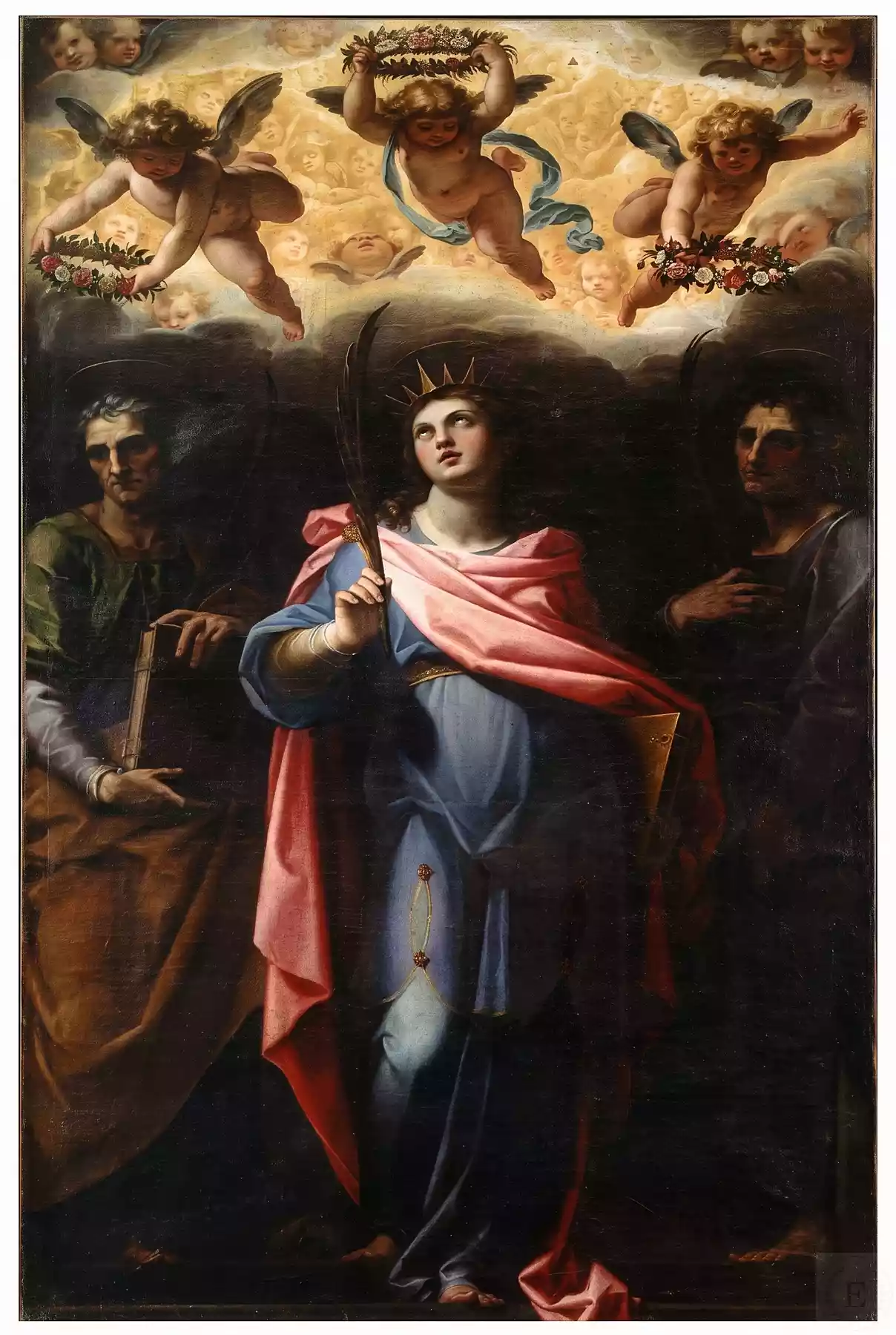 Cristoforo Roncalli, known as Pomarancio (1552–1626), Saint Domitilla with Saints Nereus and Achilleus, c. 1598–1599. Oil on canvas, 277 × 166 cm. Santi Nereo e Achilleo, Rome. Commissioned by Cardinal Cesare Baronio for the left-hand altar.
Cristoforo Roncalli, known as Pomarancio, gives prominence to Domitilla’s presence alongside the two martyrs in the altarpiece he painted around 1598–1599 for the church of Santi Nereo e Achilleo in Rome. The saint stands at the centre, crowned and holding a palm branch, between two male figures, while above them angels bear wreaths, drawing the eye away from earthly ordeal towards the heavenly recognition of martyrdom.
In Rubens’s painting of 1608, the same group acquires a different energy, its figures bound together by gesture and by the rich folds of their garments beneath a host of angels. The work for Santa Maria in Vallicella belongs to the later visual afterlife of the tradition, from which the painter drew a group of saints already formed, without that grouping offering independent historical proof of any shared activity.
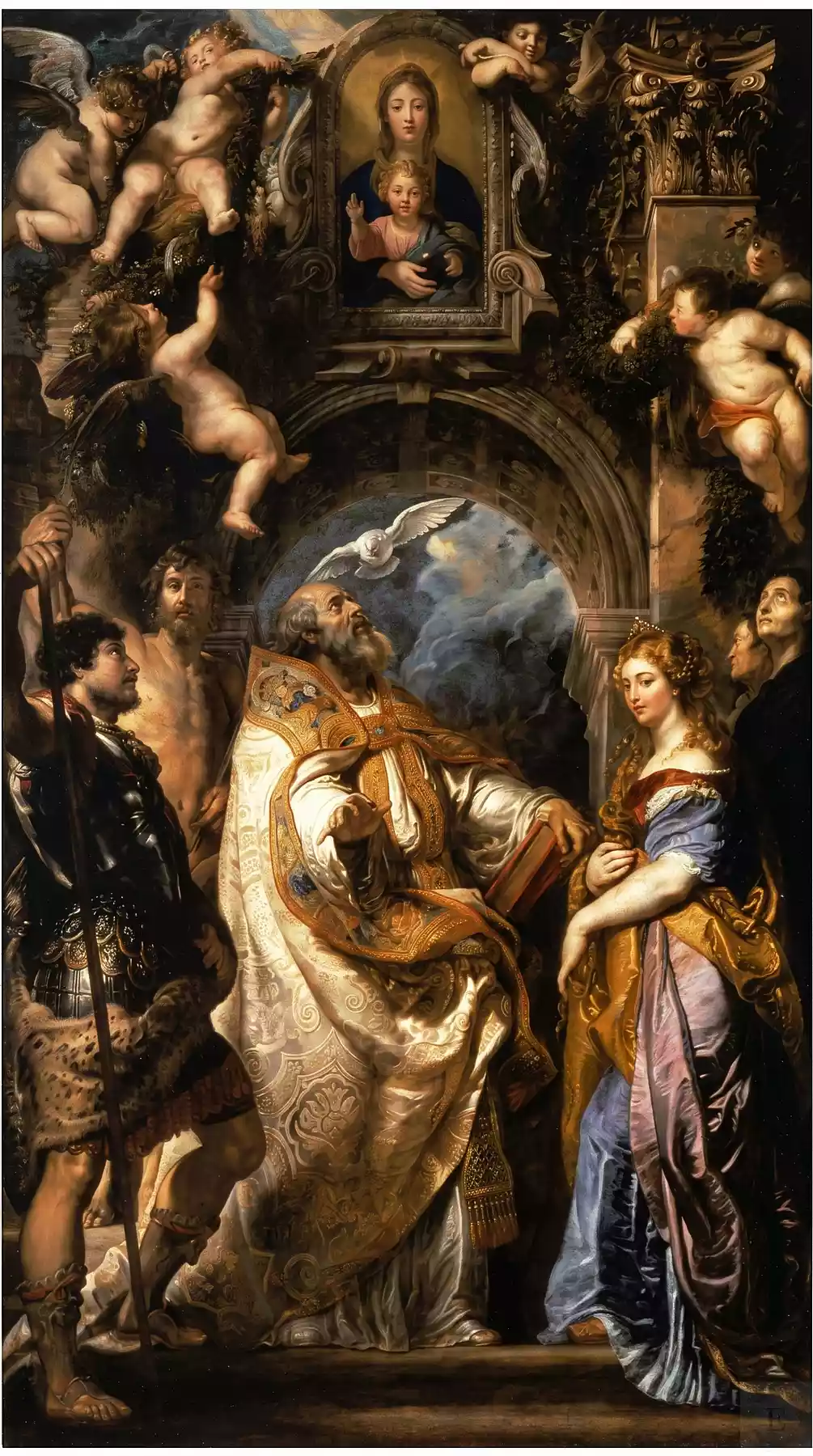 Peter Paul Rubens (1577–1640), Pope Saint Gregory with Saints Venerating the Miraculous Image of the Virgin and Child, 1606–1607. Oil on canvas, 477 × 288 cm. Musée de Grenoble, Grenoble, inv. MG 97. The composition includes Saint Domitilla and Saints Nereus and Achilleus.
In the same artist’s earlier composition of 1606–1607, now in the Musée de Grenoble, Domitilla and the two martyrs take their place within a larger assembly gathered around Saint Gregory, beneath the image of the Virgin and Child. The choice of figures reflects the relics held by the Roman church for which the painting was intended, while the glances and movement of the bodies lead the viewer’s eye towards the upper zone, where the image is framed by angels and foliage.
Sources and Bibliography
- Burke, T. (2024). ‘Acts of Nereus and Achilleus’. e-Clavis: Christian Apocrypha, NASSCAL.
- Eusebius of Caesarea. Church History, III.18. Translated by Arthur Cushman McGiffert, edited by Philip Schaff, Nicene and Post-Nicene Fathers, Second Series, vol. 1 (1890). Christian Classics Ethereal Library.
- Istituto Centrale per il Catalogo e la Documentazione. ‘I Santi Nereo, Achilleo e Domitilla’. Catalogo generale dei Beni Culturali, no. 1201030011.
- Musée de Grenoble. ‘Saint Grégoire pape, entouré de saints et de saintes, vénérant l’image miraculeuse de la Vierge à l’Enfant, dite de Santa Maria in Vallicella’. Museum entry for the painting by Rubens, 1606–1607.
- Pontifical Commission for Sacred Archaeology. ‘Catacombs of Domitilla’. Section of the presentation of the Roman catacombs.
- University of Oxford (2018). ‘E07153: Latin poem by Pope Damasus, for an inscription commemorating Nereus and Achilleus’. The Cult of Saints in Late Antiquity, record E07153.
- Zaitsev, D. V. (2022). ‘Нерей и Ахилий’. Православная энциклопедия, vol. 49, pp. 32–34.


