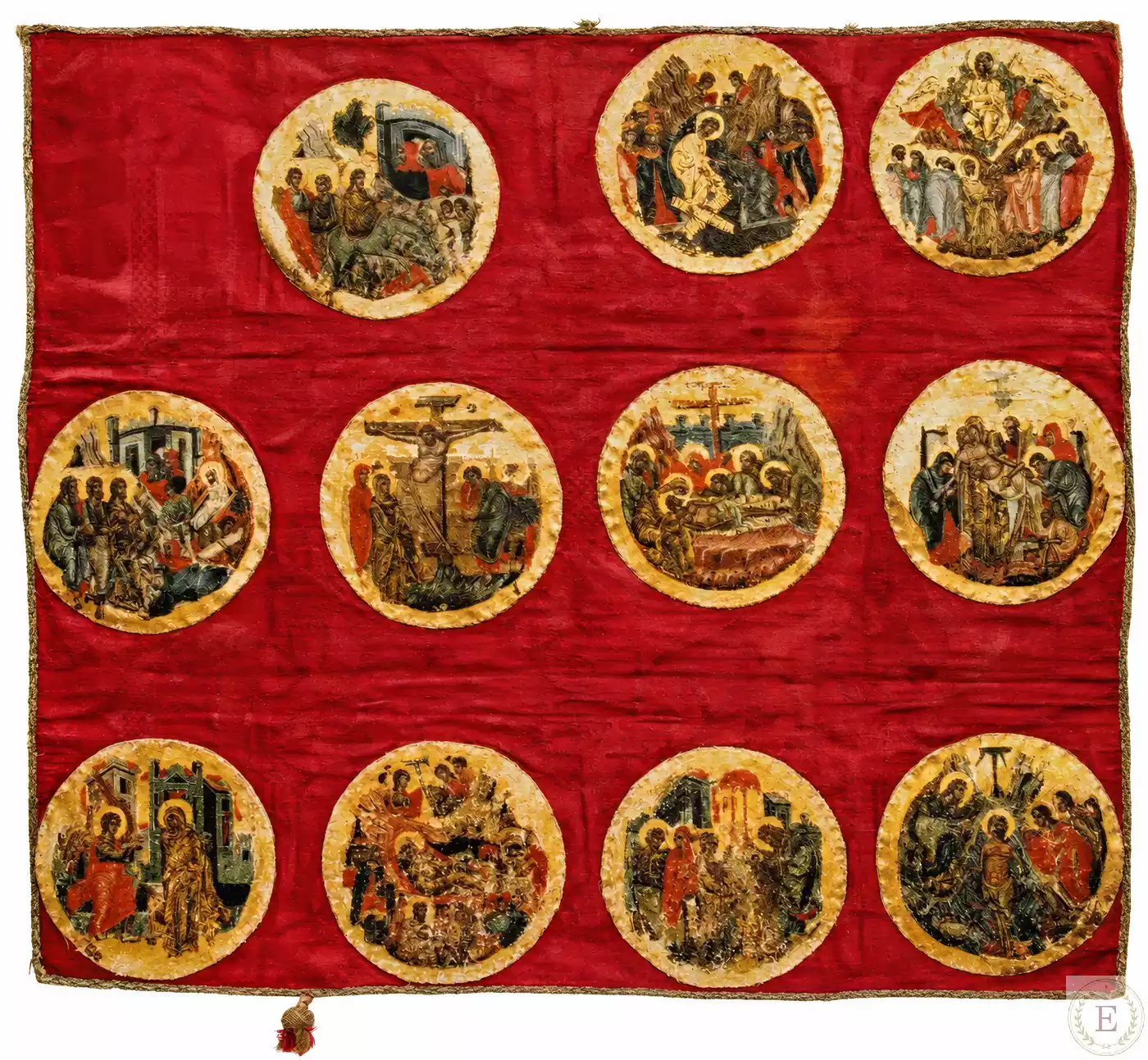
Eleven round medallions, painted on a miniature scale, are set into a piece of red silk: this is the aer with scenes of the Great Feasts kept at the Leimonos Monastery on Lesbos. According to the collection’s records the medallions served some other purpose first and were only later stitched where they are now. The object measures 64 × 58 cm, belongs to the Collection of Vestments and Gold Embroideries in the monastery museum and is catalogued as an ecclesiastical liturgical textile. The miniatures are attributed to the 16th century; the fabric that carries them is thought to be probably later. Two stages, then, went into making the whole, one of painting and one of sewing, and how far apart they lie we do not know.
The covering of the holy gifts
In Orthodox liturgical practice the aer is the cloth that covers the holy gifts. How it was used in the late Byzantine period is a question Roland Betancourt has gathered evidence on, in his study of the Thessaloniki Epitaphios. The aer, on this evidence, lay over the gifts on the holy table, and Symeon, Archbishop of Thessalonica, writes that the celebrants held the sacred veil above them until the Creed had been completed. At the Great Entrance the aer is recorded as being carried on the deacon’s shoulder, while the great aer could be borne above the deacons’ heads. The same study traces the appearance of the dead Christ on the altar coverings, where by the 16th century the full composition of the Lamentation is found. The author also notes that in the period he examines the terms “great aer” and “epitaphios” were not clearly kept apart.
Silk, braid and an empty space
The silk is a deep red, and here and there one can make out a woven floral pattern in the same tone. Gold braid runs round the whole edge. A small tassel hangs from the lower side, towards the left. Two bands of horizontal creases cross the fabric, most likely the marks of an old fold. The collection’s records describe the silk as a secular textile adapted to church use and regard the painted medallions as appliqués in a second use. Where they came from, the records do not say.
Judging by their proportion to the width of the cloth, the medallions measure roughly thirteen to fourteen centimetres across. An irregular gold border surrounds each painted surface, and since the gold ground of the scene carries on into that border, every image stands out against the red like a small luminous disc.
They are not evenly distributed. The middle and bottom rows hold four each. The top row has three, placed towards the right, and the upper left corner is empty — with room enough for one more medallion. Whether a twelfth scene was once there, or whoever sewed the ensemble simply had eleven to hand, we cannot say. No certain traces of earlier stitching are visible in the silk.
From the Annunciation to the Ascension, with two departures
In what order are the scenes meant to be read? Start at the bottom left corner, read each row from left to right and move upwards row by row, and the narrative unfolds almost regularly. The bottom row opens with the Annunciation: the angel, in a red himation, approaches from the left towards the Virgin, who stands upright in front of buildings. Then come the Nativity, among the most worn scenes in the set, the Presentation in the Temple, its figures gathered beneath a red ciborium, and the Baptism, where Christ stands in the water between the Forerunner on the left and angels on the right. In the middle row the Raising of Lazarus shows the dead man wrapped in his grave clothes, upright in the mouth of the tomb. Next are the Crucifixion; the Lamentation, the body laid out on a slab with the empty cross behind; and the Deposition, in which a figure at lower right bends over Christ’s feet. The top row has the Entry into Jerusalem, Christ riding towards the city gate, followed by the Descent into Hades, with Christ in a light-coloured garment at the centre between two groups of figures. Last comes the Ascension — above, Christ in a glory borne up by angels; below, the Virgin among the disciples.
At two points the chronological sequence breaks. The Entry into Jerusalem, which in the Gospel of John follows the Raising of Lazarus, has moved up to the top row. The Lamentation, for its part, comes before the Deposition. Perhaps the shifts happened when the medallions were sewn onto the new cloth. Or perhaps whoever arranged them did not think it necessary to follow the narrative to the letter. The one possibility does not rule out the other.
Missing from the selection, as the collection’s records point out, are the Transfiguration, Pentecost and the Dormition of the Theotokos. The set also includes two scenes of the Passion that do not belong to the usual cycle of the Twelve Feasts, the Deposition and the Lamentation. George Kakavas, publishing a Cretan triptych with scenes of the Great Feasts from the second half of the 16th century, observes that Passion scenes were favoured in Cretan triptychs of the 15th and 16th centuries; the triptych he studies has none. The emphasis on the dead Christ is in keeping with the presence of his figure in the decoration of aers. Yet we cannot know whether the choice was made for this textile, since the medallions are in a second use. They may well have been selected for another object before they ever reached the red silk they sit on today.
The Crucifixion at close range
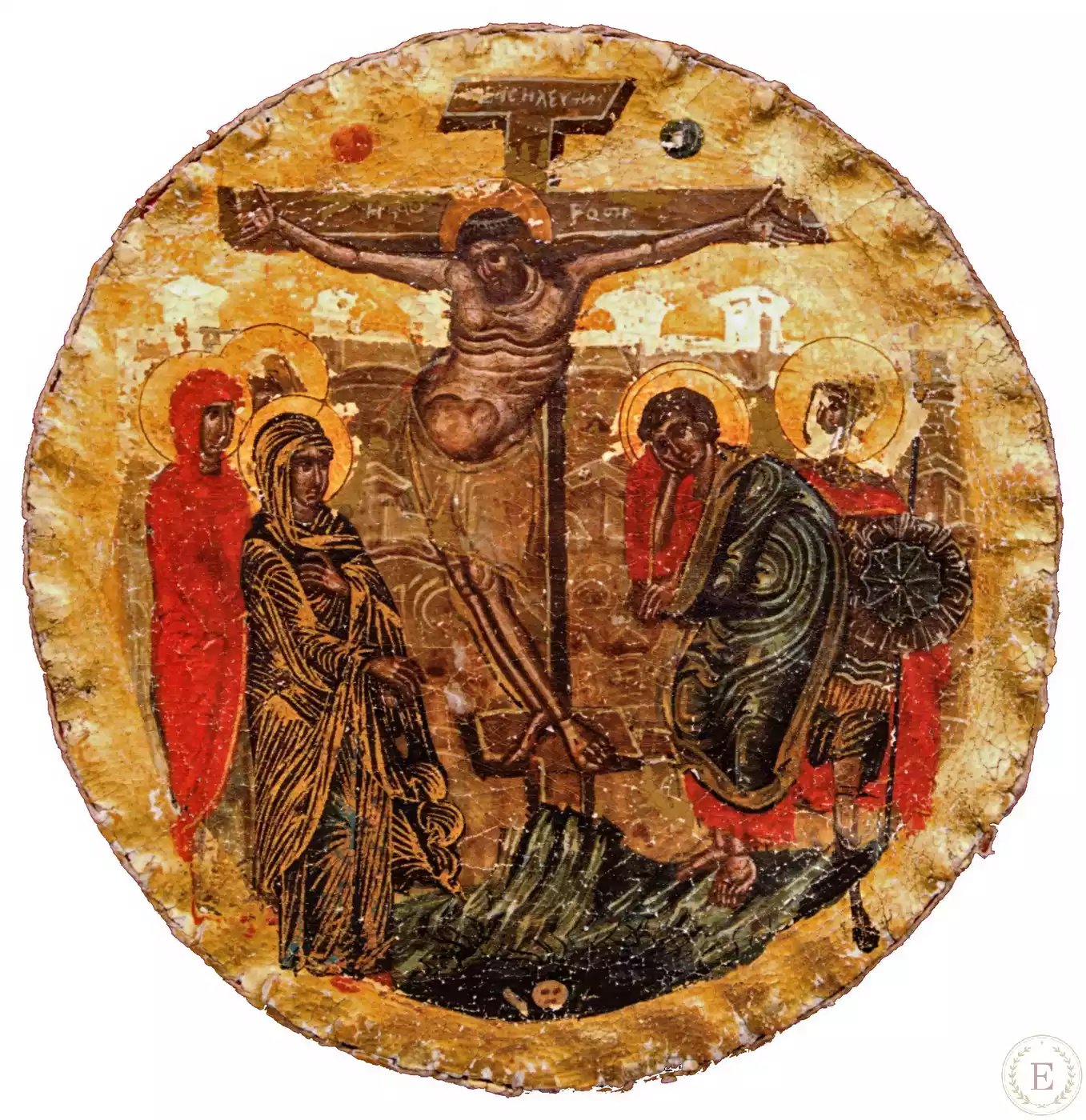
Better preserved than most of the scenes, the Crucifixion, second in the middle row, lets us look closely at the painter’s work. On the titulus at the top of the cross the inscription can be read only in fragments. On the crossbar, to either side of the head, capital letters from the Crucifixion inscription are visible. In the upper part of the medallion, flanking the titulus, are two small discs, red on the left and dark on the right, standing for the sun and the moon. Christ, haloed, is dead, his head inclined. His body bends sharply, so that the hips shift towards the viewer’s left. The ribs are drawn as a series of arcs; the loincloth, rendered in pale ochre tones, looks almost transparent; and the feet rest on a suppedaneum. Behind the figures runs the wall of Jerusalem, its towers rising roughly to the height of the Crucified’s chest.
Several of these features appear in other images of the Palaiologan period as well. Alexandra Trifonova, studying an icon from Varna, regards the curve of Christ’s body in the shape of a “reversed S” as part of its realistic rendering. She also writes that the gesture of the Virgin, with one hand held before her breast, spread widely in the same period, and notes that the wall of Jerusalem occurs frequently in Crucifixions of Palaiologan date. In the Leimonos medallion the Virgin stands on the left in a dark maphorion, criss-crossed by dense ochre lines of folds. One of her hands rests on her breast, the other reaches down towards the cross. Behind her stand two more haloed women, one of them in red.
Opposite, John the Evangelist rests his head on his hand, a gesture of grief; Trifonova discusses a related version in which the sorrowing disciple touches his chin. John’s deep green himation, worn over a red chiton, falls into concentric, almost spiralling folds across the thighs. Behind him, at the right edge, stands a haloed soldier in a red cloak, with a round shield decorated with rays and a spear — in all likelihood the centurion of the Gospel account. At the base, the cross stands on a dark hill. Below it, inside a dark opening in the rock, a small skull can be seen, the skull of Adam according to iconographic tradition.
A dense network of cracks covers the whole paint surface. Losses, which show as pale patches, cluster in the gold ground of the upper part and near the border; there the gold has worn away and lets a light-coloured preparation layer show through.
Painting, workshop and dating
In the miniatures the collection’s records find features of the Cretan School: conservatism, a deliberate return to Palaiologan and early post-Byzantine models, a classicising restraint and the absence of strong Western influence. The painting bears out a good deal of this. In the faces one can make out a dark proplasmos, that is, the dark base layer of the flesh, with sparse light highlights laid over it. The folds of the garments are drawn with a geometric stylisation. The palette rests on red, deep green and ochres, set against the gold ground.
In the Cretan triptych he published, Kakavas sees the iconographic types as deriving from the Palaiologan tradition as established by the Cretan painters of the 15th century. On the wings of the same work he also detects a Venetian Mannerist influence, and he praises the painter’s skill as a miniaturist. In the Leimonos medallions the virtuosity on a small scale is plain to see. Western Mannerist elements are not. The architectural backgrounds and the landscapes stay within the conventions of Byzantine painting.
The dating to the 16th century, which the records consider the most likely, rests on style; no dated inscription or document supporting it is mentioned. As for the fabric, the collection’s information describes it as later without saying by how much, and elsewhere leaves open the possibility that it is contemporary with the miniatures. What material the medallions are painted on remains unspecified in the collection’s records.
Sources and bibliography
Betancourt, R. (2015). The Thessaloniki Epitaphios: Notes on Use and Context. Greek, Roman, and Byzantine Studies, 55(2), 489–535.
Cite this article
How to cite this article
Pafilis, T. M. “The aer with scenes of the Great Feasts from the Leimonos Monastery.” Greek Encyclopedia of Art and Culture, November 19, 2026. https://www.elpedia.gr/en/aer-great-feasts-leimonos-monastery/.
Pafilis, T. M. (2026, November 19). The aer with scenes of the Great Feasts from the Leimonos Monastery. Greek Encyclopedia of Art and Culture. https://www.elpedia.gr/en/aer-great-feasts-leimonos-monastery/
Pafilis, T. M. “The aer with scenes of the Great Feasts from the Leimonos Monastery.” Greek Encyclopedia of Art and Culture, November 19, 2026, https://www.elpedia.gr/en/aer-great-feasts-leimonos-monastery/. Accessed .
Pafilis, T. M. (2026) “The aer with scenes of the Great Feasts from the Leimonos Monastery”, Greek Encyclopedia of Art and Culture, November 19. Available at: https://www.elpedia.gr/en/aer-great-feasts-leimonos-monastery/ (Accessed: ).