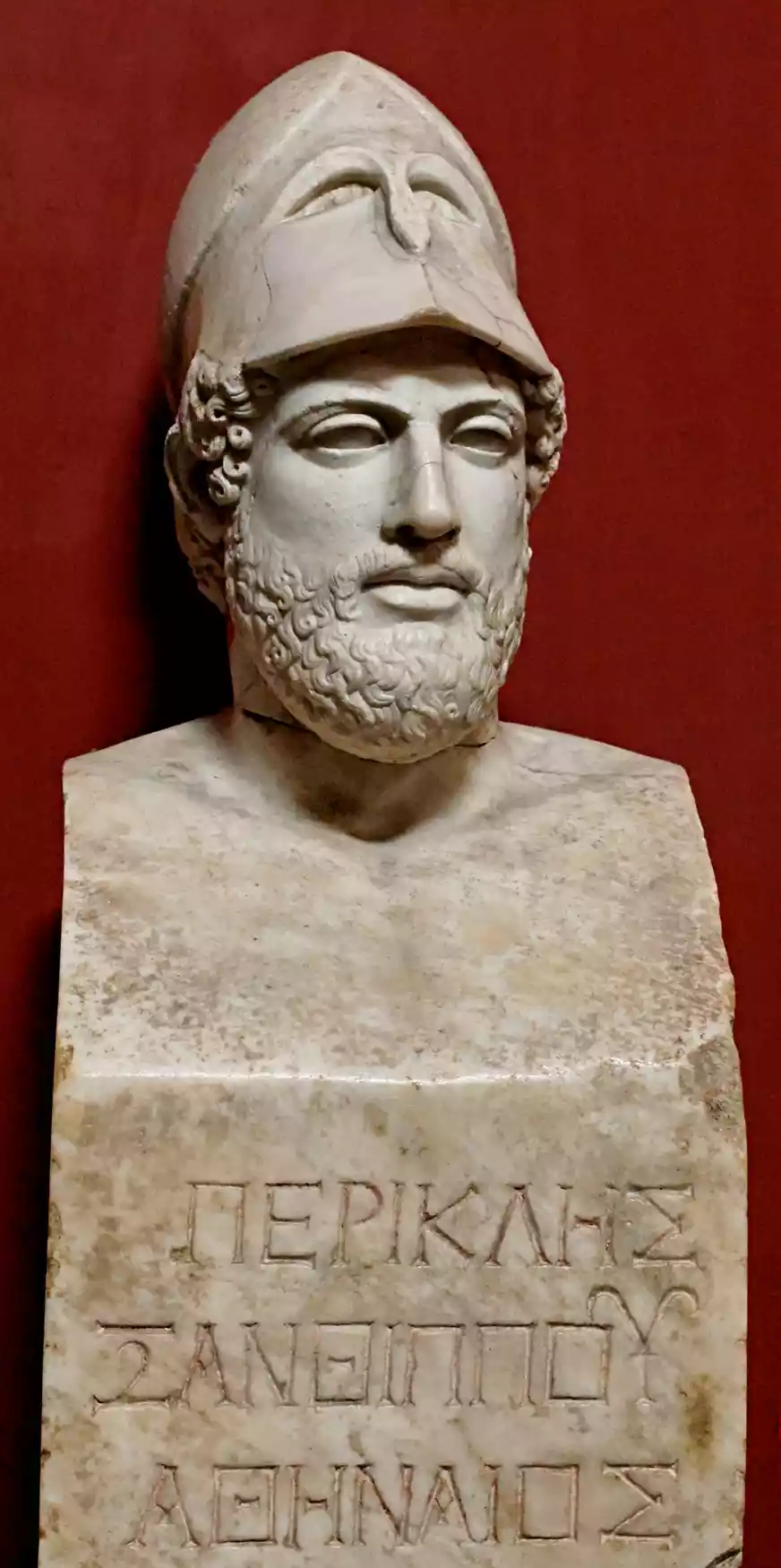
 Bust of Pericles in a Corinthian helmet, inscribed ‘ΠΕΡΙΚΛΗΣ ΞΑΝΘΙΠΠΟΥ ΑΘΗΝΑΙΟΣ’. Roman marble copy of a Greek original of c. 430 BC, attributed to Cresilas. Vatican Museums, Museo Pio-Clementino, Hall of the Muses, inv. 269. Photograph: Jastrow (2006), Wikimedia Commons, public domain.
Officially, the Athenian state called him ‘Pericles son of Xanthippus, of Cholargos’ (Periklēs Xanthippou Cholargeus). The name had three parts: the personal name, the patronymic and the demotic, that is to say the name of the deme, the small administrative community of Attica in which a citizen was enrolled on coming of age and through which he took his place in the tribe, the army and public office, as the reform of Cleisthenes had laid down. This was the name borne by the man who was to give his own to an entire age. The threefold name says more than it lets on, for it sets Pericles from the very start within the system he himself would serve and transform. The inscription on the Roman herm in the Vatican, for its part, carves in place of the demotic the ethnic ΑΘΗΝΑΙΟΣ, ‘Athenian’, and shows how the statesman from Cholargos became, for later generations, a symbol of Athens itself. Cholargos belonged to the tribe Akamantis. Its name survives today in a municipality in the eastern suburbs of the capital, though the exact site of the ancient deme has not been identified with certainty.
An Alcmaeonid on his mother’s side, son of the victor of Mycale
No ancient author records the year of his birth, which is put at around 495 BC on the strength of what we know of his age and career. His father was Xanthippus, a politician ostracised in 484 who returned under the general recall of exiles before Salamis and led the Athenians to victory at Mycale in 479. His mother was Agariste, a niece of Cleisthenes, of the Alcmaeonid family. That family had tied its name to the fall of the Peisistratids, but also to an old curse, the sacrilegious slaughter of Cylon’s followers in the seventh century. The curse, it is worth noting at once, would never be forgotten. The Spartans were to invoke it in 432, demanding that the Athenians drive Pericles out as one polluted, as Thucydides relates. Herodotus, writing a few decades later, reports that Agariste dreamt she had given birth to a lion and a few days afterwards brought Pericles into the world. He passes no comment on the dream, which modern interpreters read sometimes as praise and sometimes as a hint at the excessive power of one man within a democracy.
For his education our information comes chiefly from Plutarch. He names the musician Damon, to whom he ascribes the role of political adviser, Zeno of Elea and, above all, Anaxagoras of Clazomenae, the philosopher who taught that Mind sets the world in motion. From Anaxagoras, so tradition has it, Pericles learnt loftiness of speech and a disdain for superstition. The picture of the philosopher-statesman no doubt owes a good deal to later schools, and already to Plato. The first public appearance of the young Alcmaeonid, however, is epigraphically secure: in 472, as choregos, he financed the production of Aeschylus’ Persians, a tragedy about Salamis, where his father too had fought.
From the fall of the Areopagus to a long ascendancy
He steps onto the political stage in 463, among the prosecutors of Cimon. Cimon, then the most powerful man in Athens, was tried for bribery after the Thasian campaign and acquitted. Immediately afterwards, in 462/1, Pericles is found in the circle of Ephialtes, the politician who stripped the Areopagus, the council of former archons, of most of its political powers and transferred them to the Council of Five Hundred, the Assembly and the popular courts. Ephialtes was murdered shortly afterwards, and Pericles found himself at the head of a faction whose strength rested on the common people of the city and of the fleet. The sources link three measures with his name, measures that changed the character of Athenian democracy:
- Pay for jurors. This was a payment for those who sat in the popular courts, and it allowed the poor, too, to exercise their political rights. The Constitution of the Athenians from Aristotle’s school presents it as a counterweight to the private largesse of the wealthy Cimon.
- The law of 451/0. Under this law, only those born of two Athenian parents were citizens.
- The transfer of the Delian League treasury. The treasury was moved from Delos to Athens, in all likelihood in 454/3. The move set the seal on the gradual transformation of an alliance of nominally equal cities into an Athenian hegemony.
His chief opponent in these years was Thucydides son of Melesias, a kinsman of Cimon and not the historian. This Thucydides denounced the use of allied money to adorn Athens and was ostracised around 443. From then on, Plutarch writes, Pericles was elected general every year, for fifteen years in succession. What the office meant, however, needs to be made clear. The strategos was one of the city’s ten elected military officers, with no institutional precedence over his colleagues. He was accountable and could be removed. Pericles’ power rested on his ability to persuade the Assembly. That is why the celebrated judgement of Thucydides, that the Athens of the day was ‘in name a democracy, but in fact the rule of the first man’ (λόγῳ μὲν δημοκρατία, ἔργῳ δὲ ὑπὸ τοῦ πρώτου ἀνδρὸς ἀρχή), describes political influence rather than any office, and certainly not a tyranny.
The League treasury and the works on the Acropolis
Two peace settlements are associated with the period of the building programme. The first was the peace with Persia, which the sources connect with the embassy of Callias in 449 and whose historicity is still debated. The second was the Thirty Years’ Peace with Sparta in 446/5, which followed the revolt of Euboea and the loss of Megara. In these years Pericles turned to building up the city with a programme that had no precedent in the Greek world. Work on the Parthenon began in 447 under the architects Ictinus and Callicrates, while its sculptural decoration was completed around 432. The Propylaea of Mnesicles were built from 437 to 432 and never finished. On the south slope rose the Odeion, the roofed building for the musical contests. Oversight of the whole, according to Plutarch, lay with the sculptor Phidias, a friend of Pericles. The Erechtheion and the temple of Athena Nike belong for the most part to the years after his death. None of this prevents the UNESCO listing from attributing the whole ensemble of fifth-century monuments to the ambitious plans of the Athenian statesman.
These works were paid for in large part out of the allies’ contributions. Pericles’ opponents, again according to Plutarch, accused him of decking out the city like a vain woman with the money of Greece, gathered for the war against the Persians. He replied that the Athenians owed the allies nothing but their protection. The same biographer explains that Pericles wanted to secure work and wages for the mass of craftsmen who did not serve in the fleet. The explanation sounds reasonable, yet it may attribute to a fifth-century statesman the thinking of a much later age. Hegemony, after all, had its other face. There were the cleruchies, settlements of Athenian citizens on allied land, in the Thracian Chersonese, on Naxos and on Andros. There were the colonies of Thurii in southern Italy and of Amphipolis in Thrace. And there was the harsh suppression of the Samian revolt of 440–439, after a long siege directed by Pericles himself.
Private life and the trials of his friends
His first marriage was to a kinswoman who had previously been the wife of the wealthy Hipponicus. With her he had two sons, Xanthippus and Paralus, and the couple separated, as Plutarch writes, with her consent. There followed his life with Aspasia of Miletus, an educated woman and a favourite target of the comic poets. As a non-Athenian, Aspasia could not, under Pericles’ own law, give him children entitled to Athenian citizenship. Their son, Pericles the Younger, would obtain Athenian status only by a special decree of the people, once his father had lost the sons of his first marriage.
To the last years before the war Plutarch assigns a series of trials aimed at Pericles’ circle. Phidias was accused of embezzling materials for the chryselephantine statue of Athena. Aspasia was tried for impiety, with the comic poet Hermippus as her accuser. Anaxagoras was prosecuted under a decree of the seer Diopeithes against those who did not believe in the gods. Historians are divided over how far these stories are historical. It is unclear to what extent they draw on comedy or on the pamphlets of Stesimbrotus of Thasos, a contemporary writer hostile to Pericles. Nor is it certain exactly when they ought to be dated. No answer to these questions can be regarded as certain.
The war, the Funeral Oration and the plague
Thucydides held the conflict with Sparta to be inevitable, because of the fear that Athenian power aroused. The war broke out in 431. Before that, Athens had shut the Megarians out of the harbours of its empire and out of the Athenian agora by the so-called Megarian Decree, and Pericles had persuaded the Assembly to reject the Spartan ultimatums. His strategy was simple in conception and harsh in execution. The people of the countryside would shut themselves in behind the walls joining the city to Piraeus, and the fields would be left to the enemy’s raids. Athens would not give battle on land; it would rely on the fleet and on the revenues of its empire, and would attempt no fresh conquests for as long as the war lasted.
In the winter of 431/0 Pericles delivered the funeral oration for the first dead of the war. The text was set down by Thucydides in the second book of his history. Especially from the nineteenth century onwards, it became the best-known encomium of Athenian democracy, the constitution in which power lies with the many, the laws protect all alike and merit comes before birth. Yet Thucydides himself warns, at the opening of his work, that the speeches he reports convey the general sense of what the speakers said and not their exact words. Pericles’ Funeral Oration is therefore in part Thucydides’ Funeral Oration too, written by a man who already knew how the war had ended. The German painter Philipp Foltz painted a Romantic Pericles, in a Corinthian helmet and white himation, before the completed Acropolis. A photographic reproduction of the painting is included in an album devoted to the Maximilianeum in Munich. The work shows how far this speech had by then become part of the European political imagination.
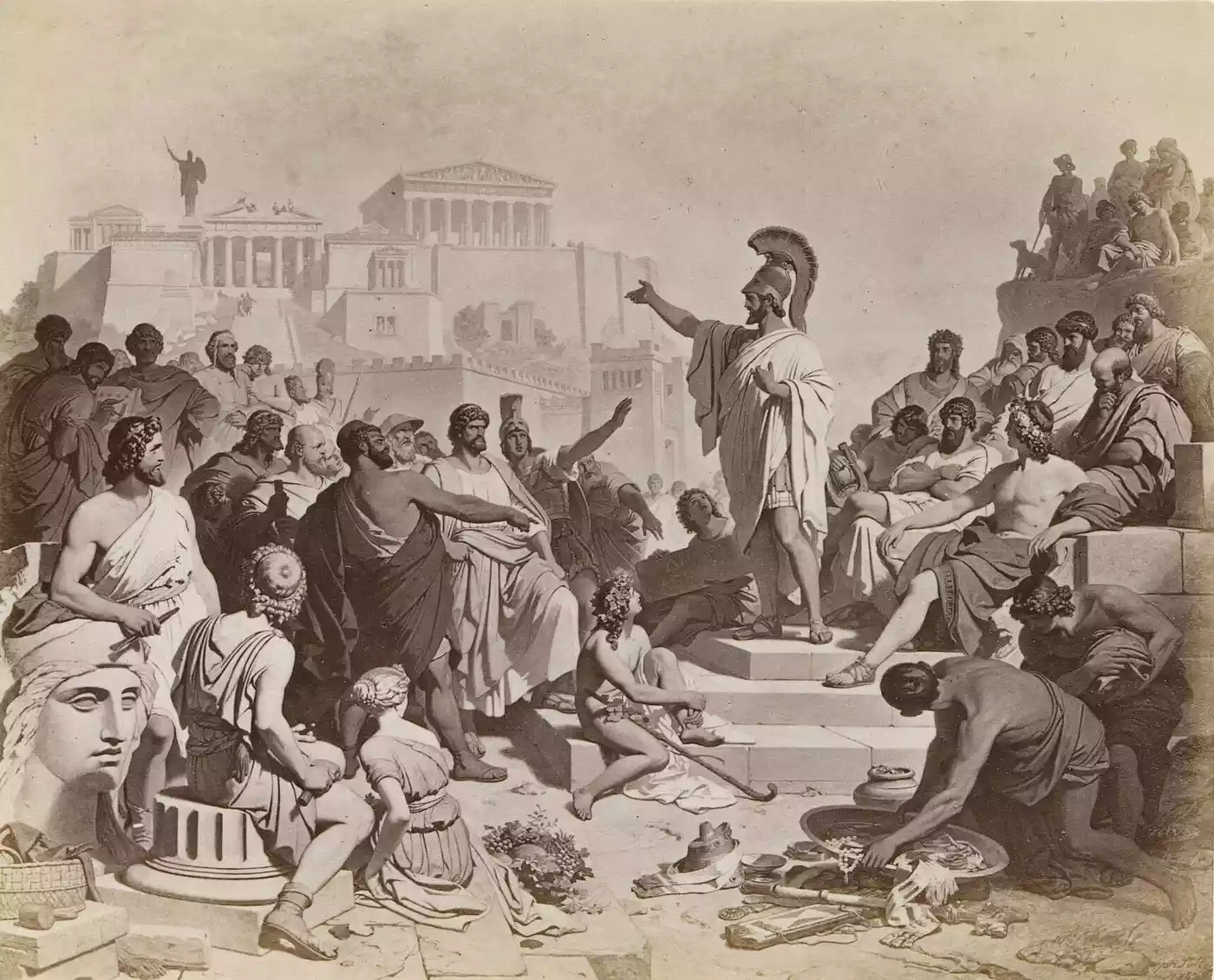 Pericles delivering the Funeral Oration. Photographic reproduction of Philipp Foltz’s ‘Das Zeitalter des Pericles’, anonymous photographer, c. 1875–1880. Albumen print, 9.8 × 12 cm. Rijksmuseum, Amsterdam, RP-F-2001-7-864-5. Cropped digital reproduction, Wikimedia Commons, CC0 1.0.
In the summer of 430 the plague broke out in the overcrowded city, an epidemic that modern research has not identified with certainty with any known disease. The Athenians, in their anger, stripped him of his command and fined him. A little later they elected him general once more. In the meantime the epidemic had carried off his sister and his two sons. Plutarch tells how Pericles, who until then had never shed a tear in public, broke down weeping as he laid the wreath on the body of Paralus. He died in the autumn of 429, two and a half years after the outbreak of the war according to Thucydides, after a lingering illness. To the friends who were recounting his trophies he is said to have replied that these were owed to fortune as well. Greater praise, in his view, was that no Athenian had ever put on mourning on his account.
Between Thucydides and comedy: the Pericles of the sources
Pericles left nothing in writing, and his image has to be pieced together from testimonies that do not agree with one another. Thucydides, his contemporary and admirer, wrote his final verdict after the defeat of 404. He wished to set Pericles’ prudent leadership against his successors, who in his view flattered the people and led the city into ruinous ventures such as the Sicilian expedition. The comic poets of the day, Cratinus, Telecleides, Hermippus and Eupolis, called him the Olympian and showed him as a Zeus with an enormous head. They also mocked him as schinocephalus, with a head like the long bulb of the squill. Aristophanes, in the Acharnians, had him thunder and lighten over the Megarians. Plutarch, finally, wrote his Life around AD 100, some five centuries later. He paired him with the Roman Fabius Maximus and drew at one and the same time on Thucydides, on comedy and on Stesimbrotus. The result is a portrait in which the demagogue of the early years is transformed into the aristocratic leader of maturity, a transformation that the modern historian treats with caution.
His face belongs to the same double tradition. Pliny the Elder records that the sculptor Cresilas had made a bronze portrait of the Olympian Pericles. The surviving marble copies, with the tall Corinthian helmet pushed up on the forehead, are thought to go back to this model. The helmet, the badge of the strategos, is explained today as a statement of the office Pericles held without a break for fifteen years. By contrast, Plutarch explains that artists favoured it so as not to show his long, ill-proportioned head, which the comic poets never tired of lampooning. The Vatican herm, inscribed ΠΕΡΙΚΛΗΣ ΞΑΝΘΙΠΠΟΥ ΑΘΗΝΑΙΟΣ, belongs to the series of busts of illustrious Greeks on display in the Hall of the Muses of the Museo Pio-Clementino. These works date, according to the Museum, from the reign of the emperor Hadrian and were found in the so-called Villa of Cassius near Tivoli. There, some five hundred and fifty years after his death, the man from Cholargos whom his fellow citizens had known both as the Olympian and as squill-head stood, in his general’s helmet, among the portraits of other illustrious Greeks.
Sources and bibliography
- Aristotle. Ἀθηναίων Πολιτεία, 26–27.
- Herodotus. Ἱστορίαι, 6.131.
- Jones, H. S. (ed.), rev. J. E. Powell (1942). Thucydidis Historiae. Oxford: Clarendon Press. Ἱστορίαι 2.65.
- Musei Vaticani. Museo Pio-Clementino. Sala delle Muse.
- Perrin, B. (trans.) (1916). Plutarch’s Lives, vol. III: Plutarch, Pericles. Cambridge, MA: Harvard University Press.
- Pliny the Elder. Naturalis Historia, 34.74.
- Stadter, P. A. (1989). A Commentary on Plutarch’s Pericles. Chapel Hill: University of North Carolina Press.
- UNESCO World Heritage Centre (1987). Acropolis, Athens.


