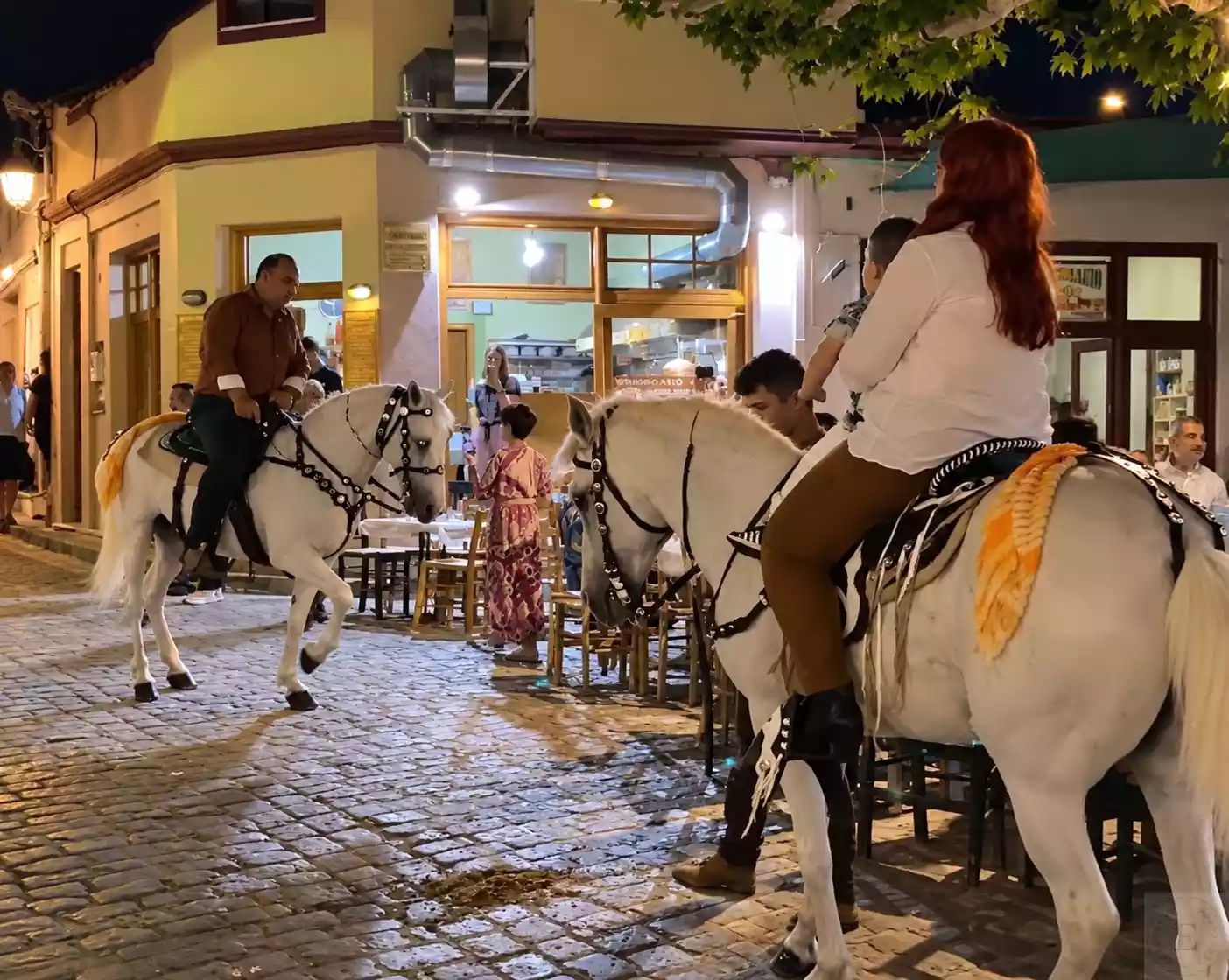
 Decorated white horses among the tables of a lit cobbled street. An image accompanying the account of mounted participation in the Bull Festival.
In Agia Paraskevi on Lesbos, the feast of Saint Charalampos became bound up with the votive offering of a bull, whose meat went into kiskek, the communal dish shared by everyone attending the festival. Around this offering grew a celebration that spilled beyond the pilgrimage site into the village streets and coffee houses. Emigrants came home for the festival, met their relatives and took part in the events, keeping alive ties that everyday life abroad made harder to sustain. It is precisely this relationship between the feast and migration that research on the ‘Bull Festival’ has set out to examine.
From a February feast to a summer festival
The Church commemorates Saint Charalampos on 10 February. The great festival of Agia Paraskevi, however, follows a calendar of its own. An older folklore record places it in the last ten days of May, before the Ascension; Evy Johanne Håland’s fieldwork in 1992 found it held on 26–29 June, while Theodora Charalampi’s study, published in 2024, now sets it in the first week of July. The shift was shaped by school examinations and by the wish to draw more visitors, as the relevant scholarly study explains.
For the zevgades, the ploughmen who worked the land with their draught animals, the saint’s protection bore directly on their livelihood. In popular piety, the health and fertility of livestock were tied to the hope of a good harvest. An ox that strayed or fell sick could leave a household unable to work its fields.
Local tradition and the offering of the bull
The origins of the festival are explained by a local tale that survives in several variants. During the Ottoman period, a ploughman from Agia Paraskevi was searching for his lost ox in the Tavros area when he came face to face with a brigand. According to tradition, he was saved through the intervention of Saint Charalampos and recovered his animal. The story goes on to tell how the priest and the village notables came to the site of the miracle, where the annual celebration was established. Ethnographic research records this narrative as the foundation legend of the festival.
The kourbani, known locally also as ‘koulbani’, had a particular donor but the whole community as its recipient. The donor bore the cost of the animal; the food prepared from its meat was shared out among the festival-goers. In his doctoral thesis on the celebration, Christos Ioannidis interprets the offering as a ritual gift to the village and examines how, through it, emigrants renewed their bonds with their home community.
Kiskek and the labour of the night
In the historically documented form of the custom, the slaughter was followed by the preparation of kiskek. The meat simmered all night in large cauldrons, and the cooking continued with the wheat until the dish reached a thick, porridge-like consistency. A dedicated ethnographic study considers the place of the communal meal within the pilgrimage, tracing the whole course from the offering of the animal to the distribution of the food.
In the 1992 fieldwork, it was men who worked at the cauldrons. By morning they were still stirring the mixture amid the smoke, their eyes streaming from the fires. Behind the finished dish lay hours of work, which carried on while new pilgrims kept arriving.
After the Divine Liturgy and the priest’s blessing of the food came the distribution. Festival-goers waited with containers, often to collect portions for those who had stayed behind as well. The pairing of a votive offering with a communal meal is found at other feasts on Lesbos too, with differences in ingredients and in local names.
Descriptions of the public slaughter do, however, call for clear dating. In her 2024 study, Theodora Charalampi notes that, following objections over the treatment of the animals, the public killing and the distribution of blood to those present have been discontinued. The observation belongs to her wider research on the festivals of Lesbos and on changes in festive practice.
Decorated horses and horse races
In the streets of the village, it is the riders who catch the eye. The grooming of the horses and the decoration of their harness are part of the riders’ public presence at the feast, and those on horseback join the movements of the festival crowd.
The accompanying image shows two white horses with black, ornamented harness and yellow-orange woven decorations behind the saddles. On the right, a woman sits in the saddle with a small child in front of her; on the left, a man rides the second horse. The tables reach almost up to the animals, on the lit cobblestones in front of the shops.
Horse races hold a special place in the festival. The 1992 record describes organised races with conditions of entry and prizes, in which the riders raced bareback. For a good many of the younger participants, the races were the main reason for coming, and their preparation went on from one festival to the next.
Kompanies among the riders
The musicians moved along with the riders. The University of the Aegean’s archive of North Aegean musical culture preserves a photographic record from 1996 showing a kompania of trumpet, clarinet and daouli drum accompanying riders at the Bull Festival. The same archive holds an item from 1995 with a different line-up: clarinet and violin, together with the daouli. The photographs document specific ensembles and let us see how different instruments coexisted at the same feast.
Brass instruments have a presence of their own in this musical history. A photograph of festival revelry in 1953 records a trombone alongside strings and other instruments, while an earlier item, from 1950, shows a band with two trombones. Sometimes the musicians follow the riders, sometimes they stand among the groups of revellers, with the coffee house and the street becoming an extension of the celebration.
Sources and Bibliography
- Charalampi, T. (2024). Feasts in Lesbos: Highlighting the Social and Cultural Changes. International Journal of Humanities and Social Science, 14, 385–395.
- Håland, E. J. (2014). The Legend and Popular Festival of Agios (Saint) Charalampos, and its Parallels in the Wider Greek Context, Ancient and Modern. Folk Life, 52(1), 13–48.
- Håland, E. J. (2022). Bull Sacrifice and Communal Meal — Kesketsi: Pilgrimage at a Greek Saint’s Feast. Mediterranean Review, 15(2), 1–27.
- Ιωαννίδης, Χ. (1997). Το πανηγύρι του Αγίου Χαραλάμπους στην Αγία Παρασκευή Λέσβου: Το κουλμπάνι ως τελετουργική συγκρότηση της κοινοτικής ταυτότητος. Doctoral thesis, University of the Aegean. Abstract in the institutional repository.
- University of the Aegean, Αρχείο Μουσικού Πολιτισμού Βορείου Αιγαίου [Archive of the Musical Culture of the North Aegean]. [A kompania accompanying riders at the Bull Festival, 1996]. Photographic record.


