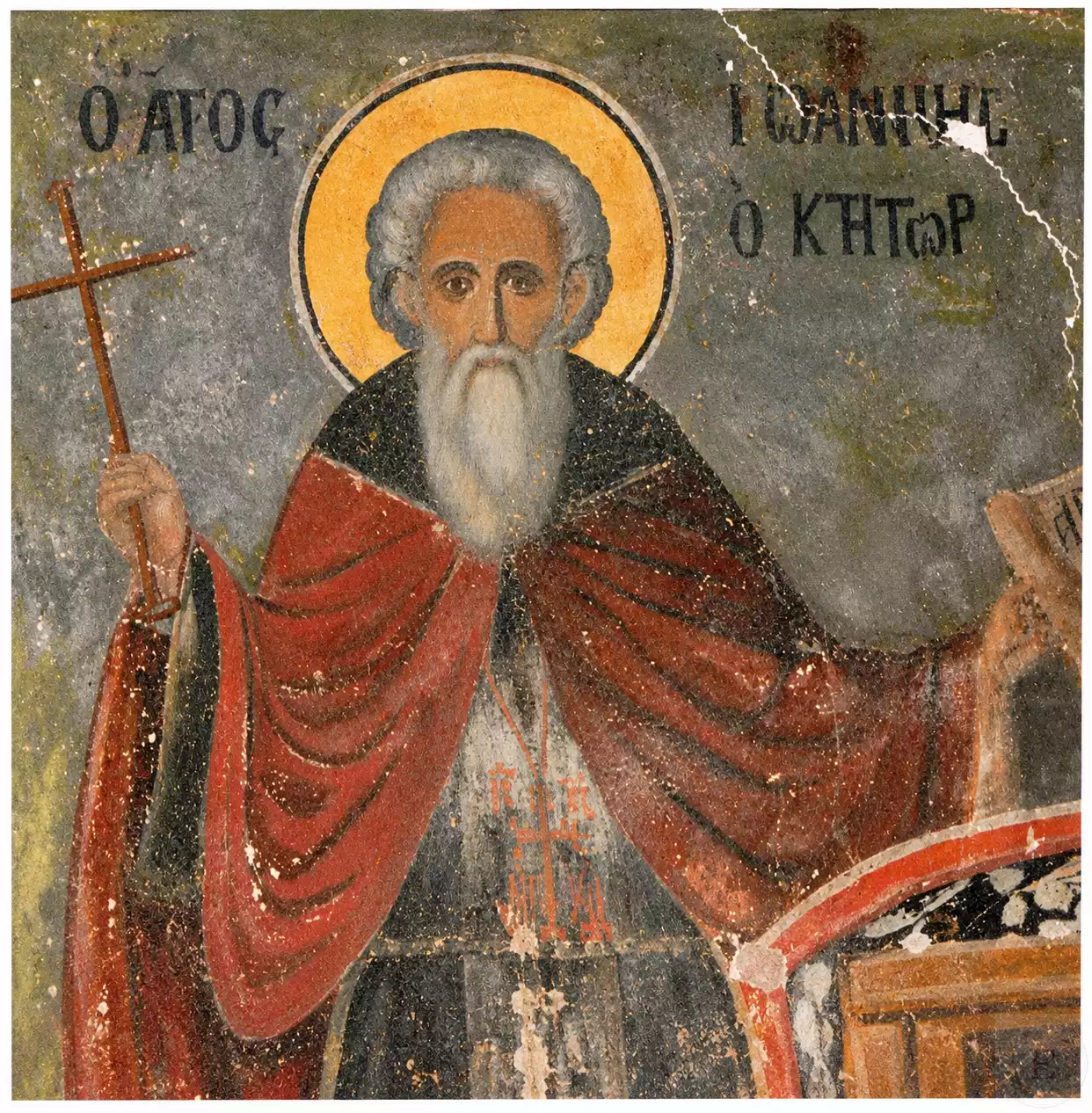
 Saint John the Founder. Wall painting in the exonarthex of the katholikon of the Holy Monastery of Iviron, Mount Athos, repainted in 1888.
Saint John the Iberian is closely bound up with the formation of the Georgian monastic community on Mount Athos and with the foundation of Iviron Monastery, at a time when Athonite coenobitic monasticism was acquiring a firmer organisation around large brotherhoods. A member of the aristocracy of medieval Georgia, and already a husband and father, he embraced the monastic life and settled near Saint Athanasius the Athonite; later he became abbot of a new monastery whose growth also rested on the ties its founders maintained with Byzantine imperial authority.
His biography thus brings together two aspects of a single historical reality: one man’s personal withdrawal from his former life, and the gradual making of a community that needed material resources and constant care if it was to keep its distinctive character within the Athonite world.
Origins and the road to Athos
Greek scholarship records John under the name Varasvatse, and his origins are associated with Artanuji and the Georgian lands of Tao-Klarjeti. The epithet ‘the Iberian’ refers here to Caucasian Georgia, following medieval Greek usage, and its survival both in the saint’s name and in that of the monastery preserves the origin of the first brotherhood.
Georgian biographical tradition places him in the circle of David Kouropalates and presents his turn to monasticism as a renunciation of social standing and of his property. Before settling on Athos he was connected with monastic centres in the Georgian hinterland and with Olympus in Bithynia, a region with a substantial monastic presence; on this journey he was joined by his son, the future Saint Euthymius. His arrival on the Holy Mountain is placed in the second half of the tenth century, with 965 being the date given in Greek synaxarion narratives.
It was alongside Saint Athanasius that the relationship took shape which would decisively influence the future course of the Georgian brotherhood. The trust placed in John is reflected in his appointment as epitropos, or guardian, of the Great Lavra, with provision for Euthymius to succeed him – a sign that the creation of a separate Georgian monastery went hand in hand with close bonds to the Lavriot community.
The founding of Iviron and the part played by Tornikios
Decisive for the establishment of the new monastery was the contribution of John Tornikios, a kinsman of John the Iberian and a former military commander who had likewise become a monk. Because the two men shared the same name, confusion arises easily; their roles, however, must be kept distinct. John the Iberian became the first abbot, whereas Tornikios was associated above all with securing the means for the foundation.
When the revolt of Bardas Skleros threatened the rule of Basil II, Tornikios was called upon to assist the emperor and took part in its suppression in 979. The rewards that followed gave the Georgian brotherhood a stronger economic base, and in the historical outline by Kriton Chryssochoidis the foundation of Iviron is dated to 979/980, on the site of an earlier house known as the Monastery of Clement.
Imperial support had a concrete institutional content, since the life of a large brotherhood presupposed secure landholdings and adequate revenues. Against this background the position of the ktetor also becomes clearer: the person who undertakes the foundation of a monastic institution, or its substantial financial support, without that status necessarily coinciding with the office of abbot.
Euthymius and the organisation of the library
The importance of the new community for Georgian letters comes into sharper focus once we consider the place that book production held within the monastery. John created the organisational setting in which Euthymius’ work developed, while the library and the scriptorium – the room, that is, where manuscripts were copied – served the needs of the brotherhood and the dissemination of ecclesiastical texts in Georgian.
The scholarly record of the Iviron library notes that a Georgian scriptorium was active in the tenth and eleventh centuries, and the monastery’s wider translation activity belongs within it. Euthymius translated Greek ecclesiastical works and worked on the correction of liturgical texts, helping to shape a body of readings that Georgian-speaking communities could use.
Such work demanded command of both languages and a continual series of interpretative choices, since a theological term or a biblical allusion had to be rendered intelligibly in a new linguistic setting. The relationship between father and son is of particular interest here. The former is associated chiefly with organising the community; the latter, within it, carried out the translation work for which he is remembered.
The sources for his Life and the conflicting dates
The principal source for the two founders is the Georgian Life of John and Euthymius, written in the eleventh century by George the Athonite. A university presentation of the work dates its composition to around 1042–1044 and notes that the author drew on the testimony of older monks. It is therefore a narrative close to the founding generation, yet one written within a community concerned to preserve the memory of its fathers and to uphold its rights.
The hagiographical form of the text has to be taken into account in any historical reading, as praise of the founders sits alongside information about the monastery’s everyday life. As Nina Chichinadze’s study Documenting Arts of Iviron shows, references to gifts of icons and liturgical objects shed light on relations between monastic communities and on the use of art in shaping their memory.
The sources disagree on the year of John’s repose. The date 998, transmitted in Greek hagiographical references, also appears in the older Enciclopedia Italiana, whereas Chichinadze’s more recent study accepts 1005, a date consistent with Chryssochoidis’ account of his abbacy. For this reason, 998 should be accompanied by the caveat that the literature offers differing dates.
Liturgical commemoration and the image of the founder
In the Orthodox Church the Venerable John the Iberian is commemorated on 13 May, together with the Venerable Euthymius and other fathers of Iviron. The joint commemoration also includes the Venerable George, who is described as a relative of John and belongs to the first succession of abbots – a different person from the later George the Athonite, author of the Life.
John belongs to the Christian tradition that predates the schism and also appears in Catholic hagiographical literature, where his feast is recorded on 12 July. He is thus a saint shared by the Orthodox and Catholic traditions, with a different date of commemoration in their respective calendars.
In the wall painting in the exonarthex of the katholikon of Iviron, associated with the repainting of the space in 1888, John is shown with a white beard and in monastic habit, holding a cross and an unrolled scroll. The inscription names him as ktetor, preserving on the painted surface the capacity in which he was bound to the monastery many centuries after its foundation.
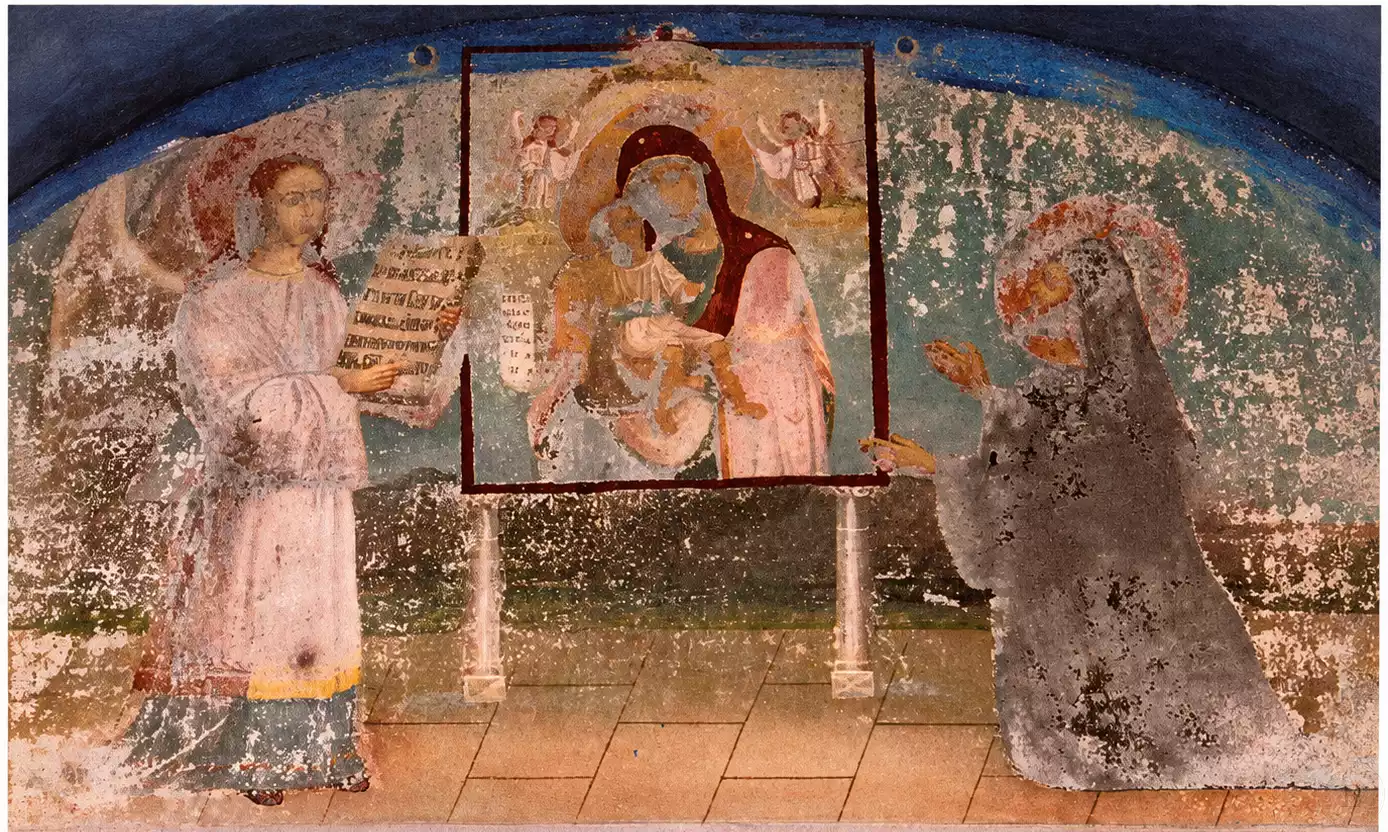 The Venerable Gabriel receives the visit of the Archangel Gabriel, according to the tradition of the ‘Axion Estin’. Wall painting on the sealed entrance of the Holy Kellion of the same name at Kapsala, Mount Athos. The entrance was sealed in 1897 in commemoration of the miracle.
The second wall painting reproduced here, from the Kellion of the Axion Estin at Kapsala, belongs to a different narrative cycle. It shows the monk Gabriel receiving a visit from the Archangel Gabriel before the icon of the Theotokos, in accordance with the Athonite tradition of the hymn ‘Axion Estin’. The date 1897 refers to the sealing of the entrance with which the scene is associated. This scene calls for a caption of its own, since it depicts neither an episode from the life of John nor Gabriel the Iberian of the Portaitissa tradition.
Sources and Bibliography
- Chichinadze, N. (2021). ‘Documenting Arts of Iviron: 11th Century Georgian Hagiographic Evidence’. Le Muséon, 134(1–2), 129–145.
- Deeters, G. (1932). ‘Eutimio il Grande’. Enciclopedia Italiana.
- Karaulashvili, I. ‘Lives of the Athonite Fathers’. OldGeoLit, Ilia State University.
- Orthodox Church in America. ‘Saint Euthymius the New, Founder of the Iviron Monastery, and his fellow Georgian Saints of Mount Athos’. Entry for 13 May.
- Peri Vivliothikon. ‘Βιβλιοθήκη Μονής Ιβήρων’ [Library of Iviron Monastery].
- Chryssochoidis, K. ‘Ιστορικό διάγραμμα Ιβήρων’ [Historical outline of Iviron]. Holy Monastery of Iviron.


