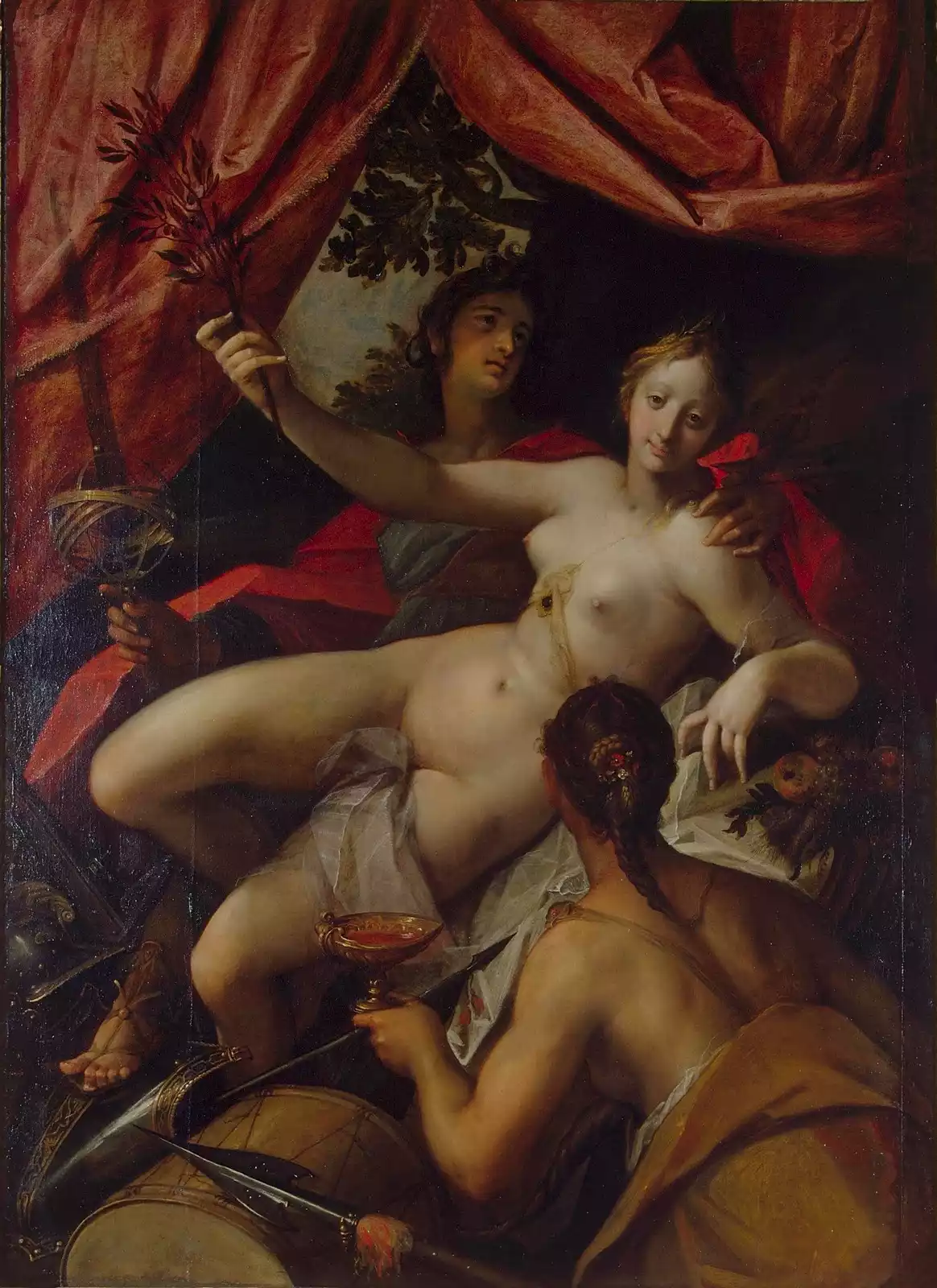
 Hans von Aachen, Allegory of Peace, Art and Abundance, 1602. Oil on canvas, 197 × 142 cm. Hermitage, St Petersburg.
Raising an olive branch beneath a heavy red curtain, the central female figure in Hans von Aachen’s Allegory of Peace, Art and Abundance draws together, in one expansive gesture, the figures and objects of a densely organised scene in which human corporeality sits alongside the emblems of learning. Painted in oil on canvas in 1602 and measuring 197 × 142 cm, the picture is in the Hermitage, St Petersburg. At the heart of its concerns lies the relationship between a life lived in peace, artistic creation and prosperity, voiced through female personifications.
The figures and the organisation of the scene
Peace commands the centre of the composition. She is seated with her torso turned towards the viewer and her knees to the left, while her head inclines the other way. Her pale body, set against the dark garments of the figure behind her, gathers the light. A fine, transparent veil falls low across her thighs and runs on in folds between the bodies, leaving the curve of the seated pose legible.
Behind Peace appears the personification of the Arts and of scientific knowledge. On the left of the scene one can make out the sphere with its metal rings, an instrument associated with astronomy, while lower down painting tools and other objects are gathered. In her study, Ming-Ling Tsai links the astronomical sphere, together with the palette and the sculpture, to the effort to have painting and sculpture recognised as pursuits equal in standing to the liberal arts, that is, to the disciplines of learned education.
Lower still, her back to the viewer, Abundance holds a gold cup and lifts her face towards Peace. The tawny-gold drapery wrapped around her body spreads into the right-hand corner, close to the horn of fruit. Placed in this way, the figure opens a second level of looking within the picture: the viewer faces Peace and, at the same moment, watches another figure turning towards her from only a short distance away.
The space stays shallow. Above the heads the curtain folds back in great curves, leaving between its pleats a narrow opening onto sky and foliage.
Peace and the place of the arts
At the foot of the scene, among the feet and the drapery, pieces of military equipment have been gathered. Their low position, against the raised branch, allows the composition to be read as the prevailing of a condition in which the arts are free to flourish. Tsai relates the discarded armour to the iconographic tradition of Venus and Mars and draws attention to the imperial dimension of the theme. This reading places the painting in the milieu of Rudolf II, at whose court the painter worked.
Within the image itself, however, the relationship between these ideas unfolds chiefly through the contact of bodies. The figure behind draws close to Peace, her hand resting on her shoulder, while Abundance turns from the foreground towards their shared encounter. Between the abstract meanings of the emblems, gestures of intimacy are thus inserted, and the slow turning of the heads and the meeting of glances hold the scene within a narrow circle.
Mannerist form and a related composition
The elongated torso, the small head and the refined articulation of the fingers lend Peace the studied elegance characteristic of Mannerism. The term describes here a handling of the human figure with emphasised proportions and complex poses, seen above all in the shift between pelvis and shoulders. Deep shadows answer the lit surfaces of the body, and the red of the curtain returns in the garments behind the figures.
Von Aachen put the same compositional arrangement to use for a different subject as well. The Liechtenstein collection catalogue relates Diana and her Nymphs Resting after the Hunt, a work of about 1602, to the signed and dated Hermitage Allegory, noting how closely the two compositions correspond. In the hunting scene the attributes of the figures change, with the spear and the animals establishing Diana’s identity, while the characteristic, elongated female figure is kept.
The comparison shows how much the objects carry in any reading of the Hermitage picture. The pose of the body could return in another narrative. Here, the branch reaching high in front of the curtain and the sphere outlined lower down, on the left, decide what the encounter is about.
Sources and Bibliography
- LIECHTENSTEIN. The Princely Collections, Vaduz–Vienna. Diana and her Nymphs Resting after the Hunt. Online collection catalogue, inv. no. GE 2418.
- Tsai, Ming-Ling (2021). ‘Hans von Aachen’s Allegorical Representations of the Arts, and His Newly Identified Painting Allegory of the Arts’. EURAMERICA, 51(1), 1–60. DOI: 10.7015/JEAS.202103_51(1).0001.


