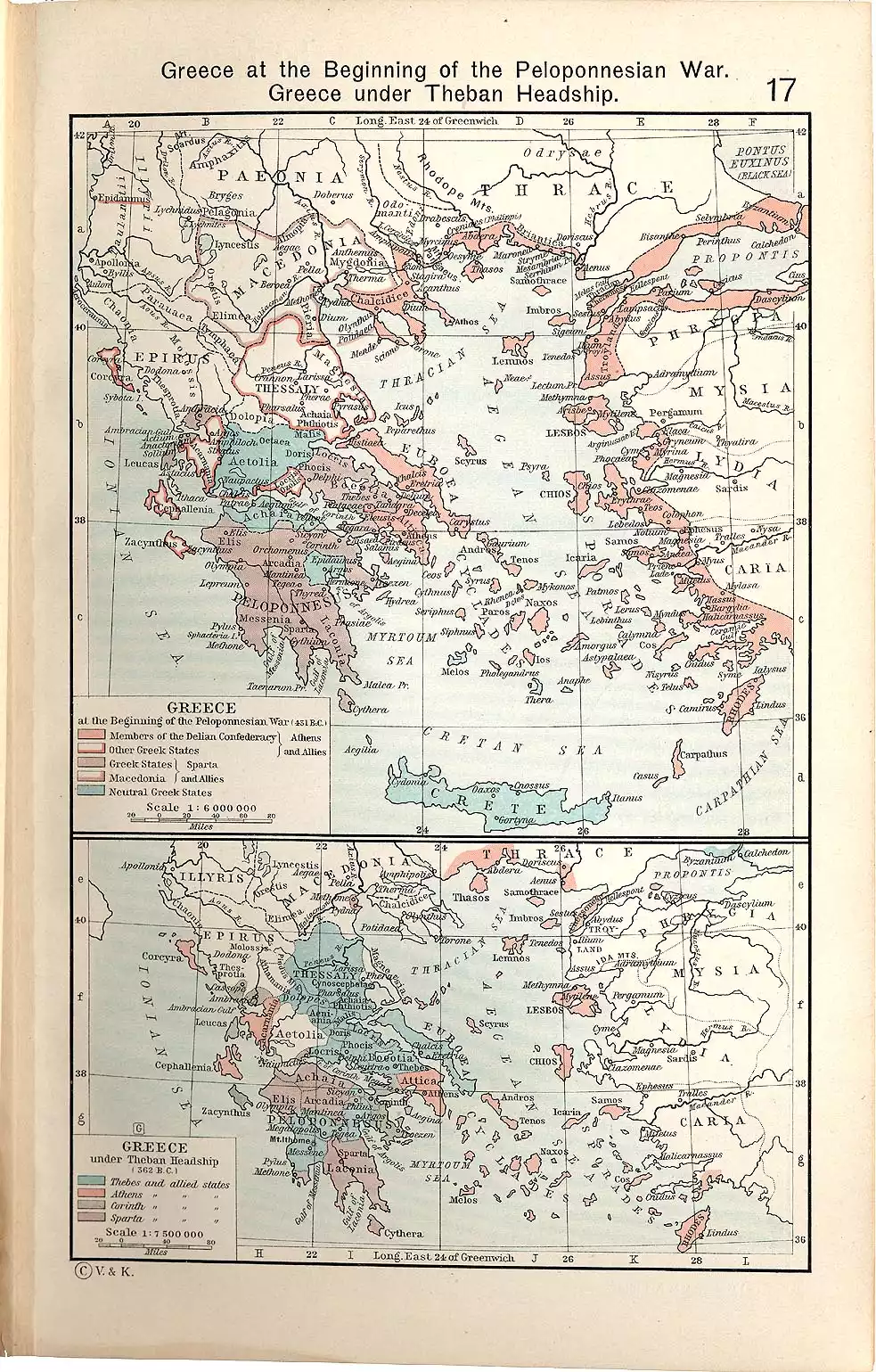
 Greece at the outbreak of the Peloponnesian War, 431 BC, with the alliances of Athens and Sparta. The lower map shows Greece during the Theban hegemony, 362 BC. Maps from William R. Shepherd’s Historical Atlas, 1911 edition.
The Greek cities shared a language and common sanctuaries, Olympia or Delphi, and yet they never formed a single state. Rome, by contrast, a city of Latium with no particular advantage at the outset, had by the early third century BC brought most of the Italian peninsula under its control. The contrast has recurred so often in modern historiography that it has come to be taken for granted. Less self-evident are the explanations offered for it. The oldest blames the terrain, the mountains, that is, that divide the valleys and the sea that isolates the islands. A second, vaguer one speaks of some innate Greek inclination towards autonomy, as though this were a trait of national character rather than a political stance with historical causes.
The geographical explanation holds up less well than it seems once it is tested against Italy itself. There the Apennines run the whole length of the peninsula, and Rome found itself facing peoples who did not speak its language: Etruscans, Sabines, Aequi, Volsci, Samnites and the Greeks of the southern colonies. Its task was therefore twofold, to subdue first and to assimilate afterwards, whereas Sparta and Athens, when they contended for the leadership of the Greek world, faced men who spoke the same tongue. The comparison has its own limits, of course. The Greek world was not confined to the Aegean and the southern Balkans; it stretched from Massalia to the shores of the Black Sea, and no state of the classical period could have controlled so scattered a network of cities. Yet the fact that Spartans and Athenians fought for decades over primacy, and that the Peloponnesian War, from 431 to 404 BC, was at bottom such a struggle, shows that the idea of a single political space was not alien, at least at the core of that world. What was missing was the means.
The Roman Solution: A Citizenship in Grades
Rome worked out those means gradually, and not without bloodshed, through wars against its neighbours that were no less brutal than the conflicts among the Greek cities. The settlement imposed in 338 BC, after the victory over the Latins, which Livy records in detail in his history of Rome, shows how little this policy had to do with generosity. Lanuvium, Aricia, Nomentum and Pedum received full Roman citizenship, and Tusculum kept the rights it already held. Capua and certain Campanian towns obtained the private rights of a Roman citizen, but without the vote. The remaining Latin towns were forbidden to intermarry, to trade with one another and to meet in common councils; forbidden, in short, to have any relationship that did not pass through Rome.
Incorporation thus went hand in hand with isolation, and it is precisely this double character that goes a long way towards explaining the durability of the Roman system. Each community was bound to the centre by its own separate relationship. The scale of rights left room for advancement to whoever stayed loyal, and the citizen body grew at a pace no Greek city ever knew. For 293 BC Livy records a census of 262,321 citizens. Modern scholars debate exactly whom these figures included, but the order of magnitude leaves no room for misunderstanding when set beside the few tens of thousands of citizens of the most populous Greek city.
This was the reservoir of manpower that Pyrrhus of Epirus came up against when he crossed into Italy in 280 BC to help Tarentum. He won at Heraclea and at Asculum, with losses that later gave their name to the “Pyrrhic victory”, yet the Roman alliance did not break apart. Plutarch has Pyrrhus’s envoy, the Thessalian orator Cineas, liken Rome to the Lernaean Hydra, because its armies sprang up again however often they were cut down. To the same cycle of stories belongs the scene with Gaius Fabricius Luscinus, whom Pyrrhus, again according to Plutarch, tried to frighten by suddenly bringing an elephant up behind him. Ferdinand Bol painted the scene in 1656 for the town hall of Amsterdam as an example of unshakeable civic virtue. These tales were written almost four centuries after the events and bear every mark of the moral exemplum. That does not undo the essential point: Pyrrhus was winning battles against a state that could make good its losses, while he could not.
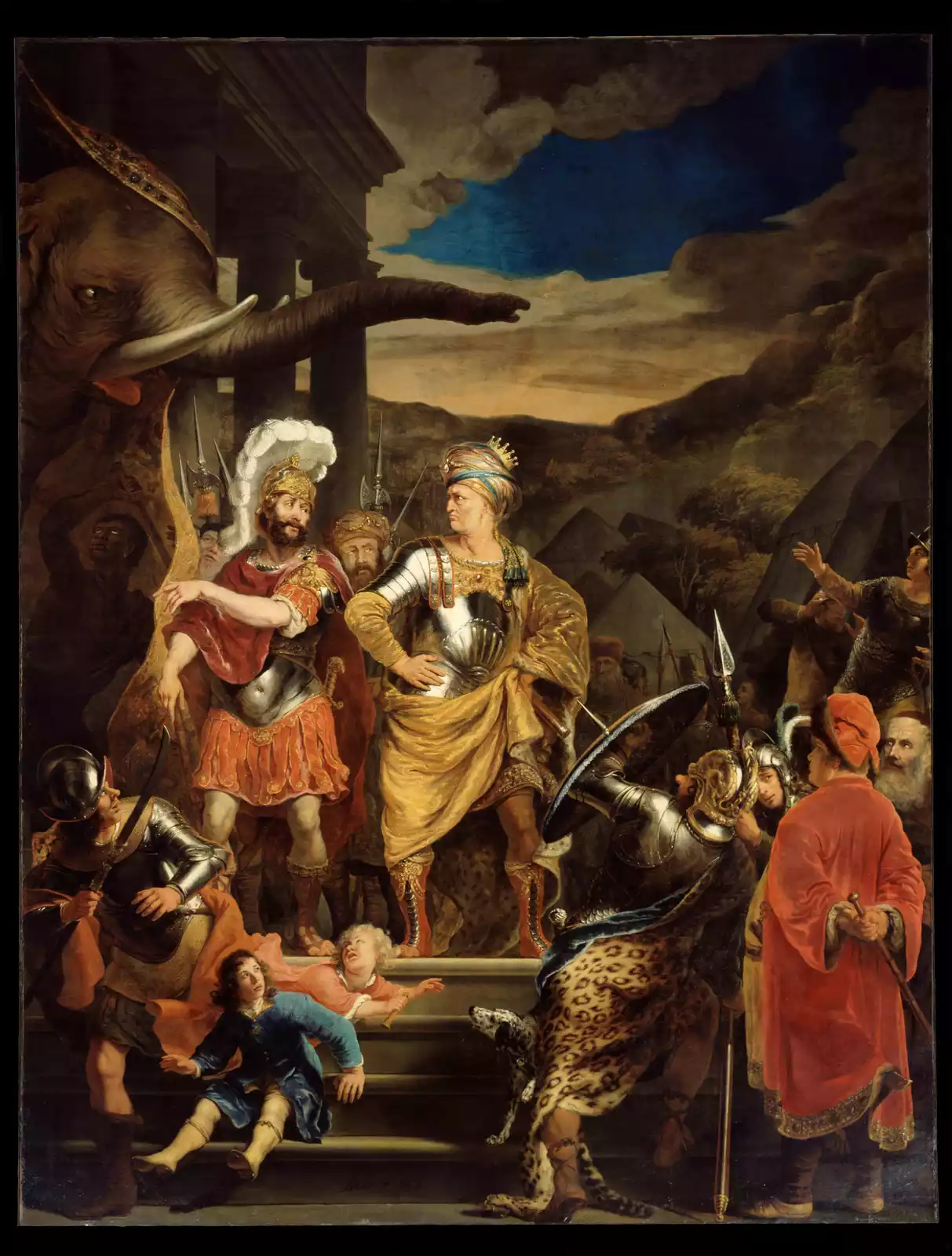 Ferdinand Bol (1616-1680), Fabricius and Pyrrhus, 1656. Oil on canvas, 485 × 350 cm. Pyrrhus attempts to intimidate the Roman envoy Gaius Fabricius Luscinus by confronting him with an elephant. Royal Palace Amsterdam, catalogue number 8.01.
It would nonetheless be misleading to imagine the spread of Roman citizenship as a smooth and voluntary process. For two centuries the Italian allies supplied soldiers for Roman campaigns without any share in the decisions. They had to take up arms in the Social War of 91-88 BC to wrest from Rome the equal citizenship it was reluctant to grant, and only then did Roman citizenship extend over Italy south of the Po.
Sparta: A Citizen Body in Decline
While Rome grew, Sparta shrank. The figures handed down by ancient authors are far from censuses in the modern sense, but they all point in the same direction. Herodotus has the exiled king Demaratus tell Xerxes, in 480 BC, that the men of Sparta numbered about eight thousand. A century and a half later Aristotle notes in the Politics that the city no longer had even a thousand, at a time when its territory could, in his view, have supported fifteen hundred cavalry and thirty thousand hoplites. Plutarch, writing of the reign of Agis IV in the mid-third century, states in his life of Agis that no more than seven hundred Spartiates remained, and of these barely a hundred or so still held land and an allotment.
The mechanism of this contraction is no mystery. The status of full citizen, of one of the “Equals” (homoioi) as they were called, presupposed an allotment of land and a regular contribution to the common messes, the syssitia. Whoever could no longer meet the contribution fell into an inferior category without political rights. There was no systematic means of renewing the citizen body from the perioikoi or the helots, while the enrolment of foreigners among the Spartiates remained exceedingly rare. Aristotle already saw the root of the problem in the concentration of land in a few hands.
When the attempt at renewal came, it came late. Agis IV proposed the cancellation of debts and a redistribution of land, and was put to death in 241 BC. A few years later Cleomenes III carried through much of the same programme, granted citizenship to perioikoi and formed a body of four thousand hoplites. He was defeated, however, at Sellasia in 222 BC by the Macedonian king Antigonus III Doson, who, according to Polybius, left the Boeotian Brachylles in Sparta as its governor. The two reforming kings are easily confused when they are discussed together. Antigonus, though, confronted only Cleomenes, since Agis had died almost twenty years earlier, and that defeat brought Sparta under direct Macedonian influence.
Athens: More Open, but Not Open
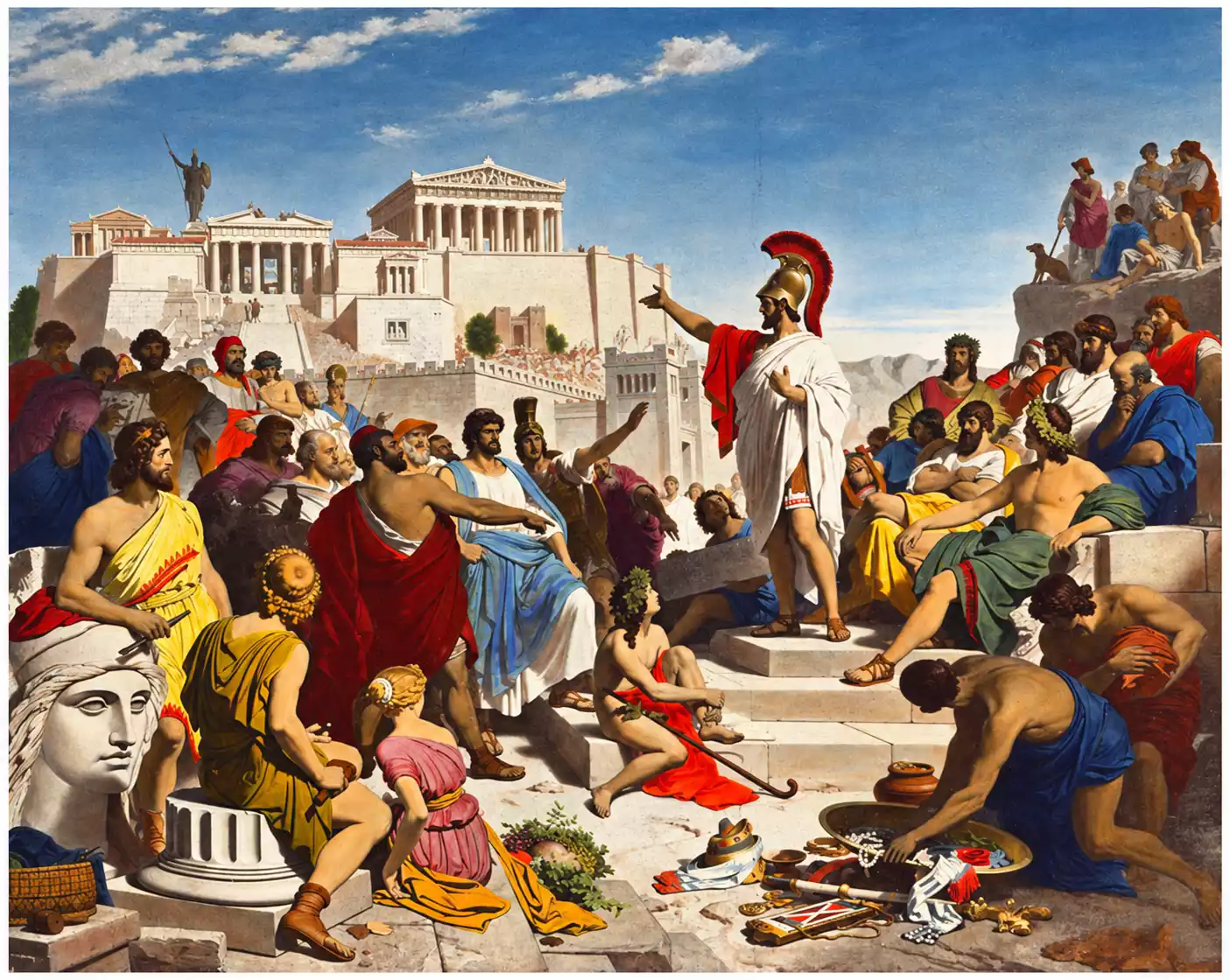 Philipp von Foltz (1805-1877), Pericles Delivering the Funeral Oration, 1852. A later pictorial reconstruction of the Athenian statesman delivering the speech in honour of those who fell in the Peloponnesian War. Private collection.
Athens did not experience Spartan oliganthropia and is often presented as the opposite case: a city where a metic could become a citizen and where the losses of war were made good with new citizens. The picture needs correcting. For its citizen body Herodotus uses, in a rhetorical formulation set in the early fifth century, the figure of thirty thousand Athenians. Yet the law passed in 451/0 BC on the motion of Pericles, as the Athenaion Politeia reports, restricted citizenship to those whose parents were both Athenian. The naturalisation of foreigners required a special decree of the assembly and remained the exception. And the city’s hegemony, the Delian League shown on the map of 431 BC, rested on tribute and garrisons, with no provision whatever for the allies to share in political rights. The grant of Athenian citizenship to the Samians in 405 BC, after the disaster at Aegospotami, came when the city no longer had a fleet with which to defend it.
The Trial of the Generals after Arginusae
In this Athens, in the twenty-sixth year of the war, took place the episode often invoked by those who wish to show where the absence of institutional checks on the popular assembly could lead. In the summer of 406 BC the Athenian fleet defeated the Peloponnesians at Arginusae, small islands off the coast of Asia Minor opposite Lesbos. The Spartan admiral Callicratidas was killed in the battle, and the enemy lost, according to Euryptolemus, seventy ships. Xenophon reports at first that the Athenians lost twenty-five ships together with their crews, apart from a few men who were saved, while later, in the speech of Euryptolemus, there is mention of twelve lost ships and of forty-seven ships that had been assigned to the rescue. The generals entrusted the rescue operation to these forty-seven ships under the trierarchs Theramenes and Thrasybulus and themselves sailed against the enemy at Mytilene. A storm, however, frustrated both plans, and the shipwrecked men were lost.
For what followed in Athens our principal source is Xenophon’s account. Of the eight generals who fought the battle, two did not return. The six who came back, among them Pericles, son of the statesman of the same name and of Aspasia, were imprisoned and made their defence before a first assembly, briefly and without the time the law prescribed. They nevertheless came very close to persuading it, until the decision was postponed because night had fallen and the raised hands could no longer be made out in the vote. In the interval the Apaturia was celebrated, the festival at which kinsmen gathered. At the next assembly the council brought forward the proposal of Callixenus: that the Athenians should vote by tribes, with two urns for each, on the guilt or innocence of all the generals together, in a single vote.
In Xenophon’s account, what was unlawful was the collective judgement of all the generals by a single vote instead of a separate trial for each, and it was around this that resistance formed. Euryptolemus, son of Peisianax and a kinsman of one of the accused, joined others in lodging a charge of illegality against Callixenus. The crowd, however, shouted that it was monstrous for the people to be prevented from doing whatever it wished, and when Lyciscus proposed that those who persisted with the charge should be judged by the same vote, they gave way. Of the prytaneis, whose duty it was to put the question to the vote, some refused at first, were threatened in the same manner and yielded. The only exception was Socrates, son of Sophroniscus, who declared that he would do nothing contrary to the law. Euryptolemus then proposed that each man be tried separately, in accordance with the stringent decree of Cannonus. He also reminded the assembly that one of the generals had himself been saved on a disabled ship and had needed, at that very moment, someone to pick him up. His motion prevailed in the first vote, but a sworn objection by Menecles led to a second, in which the council’s proposal carried. All eight were condemned, and the six who were in the city were executed.
Xenophon was a contemporary of the events, but he wrote the Hellenica a good many years later, as a pupil of Socrates and with evident reservations about radical democracy. His version lays much of the blame on Theramenes and on the false mourners whom, by his account, Theramenes sent to the assembly after the Apaturia. At critical points it differs from the narrative of Diodorus, who wrote three and a half centuries later, drawing, in the prevailing view, on Ephorus. From the time of George Grote, the nineteenth-century English historian who took up the defence of Athenian democracy against its critics, scholarship tended to prefer Diodorus, and only recently has that preference begun to be questioned. Nor is the role of Socrates described in the same way in all the sources. In Plato’s Apology and in the Hellenica he appears as one of the prytaneis, whereas in Xenophon’s Memorabilia he is the epistates, that is, the presiding officer of the assembly on that day.
Older essay-writing attributed the frenzy of the assembly to a citizen body that had supposedly been corrupted by new citizens with no ties to the city, a thesis for which the sources offer no support. Another interpretation seems more probable: the trial showed what the sovereignty of an assembly of thousands of citizens could mean in a city exhausted by a quarter of a century of war, with thousands of sailors lost at sea and no institution capable of halting the demos when it resolved to bypass its own procedures. A little later, as Xenophon himself observes, the Athenians repented and turned on those who had misled them. The following year, at Aegospotami, the fleet that had triumphed at Arginusae was destroyed, deprived of many of its experienced generals.
The Clive Counterpoint and Its Limits
A counterpoint from an entirely different age helps to show what was at stake. Robert Clive, soldier and administrator of the East India Company, had received in the aftermath of his victory at Plassey in 1757 gifts worth some £234,000, chiefly in connection with the installation of Mir Jafar, the ruler whom he himself had helped to power in Bengal. In May 1773 the House of Commons debated the charges brought against him by the committee of Colonel Burgoyne, as the History of Parliament records. According to his biographer John Malcolm, the House accepted that he had received the sum of £234,000 but rejected the part of the motion accusing him of abusing his power, while a subsequent resolution acknowledged that he had at the same time rendered great services to his country.
Set side by side, the two cases can be read as proof that a mature state knows how to weigh justice against interest, where the Athenian assembly sacrificed both. But they can also be read the other way round, as a case of a powerful man escaping punishment at the hands of a House with a narrow electorate, in which Clive himself controlled seats and some members had interests in the Company. The generals of Arginusae, by contrast, however unjust their condemnation, answered before a body that included the relatives of the dead. The two institutions differed so radically, an eighteenth-century representative House against a direct assembly of the fifth century BC, that the comparison sheds more light on the question of who judges the powerful than on the question of unity. And here perhaps lies its usefulness for the original question: a polity that could not protect its own generals from its momentary anger would hardly persuade other cities to entrust it with their citizens. Clive died in November 1774. Callixenus, according to Xenophon, escaped before he could be tried, returned to Athens with the democrats from the Piraeus after the fall of the Thirty and, hated by all, died of starvation.
Sources and Bibliography
- Aristotle (attrib.). Athenaion Politeia, 26.4.
- Aristotle. Politics, II, 1270a.
- Diodorus Siculus. Bibliotheca historica, XIII, 97-103.
- Herodotus. Histories, V, 97 and VII, 234.
- Lee, A. Xenophon and the Arginusae Trial. Society for Classical Studies. Conference paper abstract.
- Livy. (1912). Ab urbe condita, VIII, 14 and X, 47 (trans. Canon Roberts). London: J. M. Dent & Sons. Perseus Digital Library, Tufts University.
- Malcolm, J. (1836). The Life of Robert, Lord Clive, vol. III. London: John Murray. Project Gutenberg.
- Plato. Apology, 32b.
- Plutarch. (1921). Agis and Cleomenes, Agis 5-6, Cleomenes 11 (trans. B. Perrin). Plutarch’s Lives, vol. X. Cambridge, MA: Harvard University Press.
- Plutarch. Pyrrhus, 19-21.
- Polybius. Histories, XX, 5.
- Sutherland, L. S. & Namier, L. (1964). Clive, Robert (1725-74). In L. Namier & J. Brooke (eds), The History of Parliament: the House of Commons 1754-1790.
- Xenophon. Hellenica, I, 6-7. Perseus Digital Library, Tufts University.
- Xenophon. Memorabilia, I, 1, 18.


